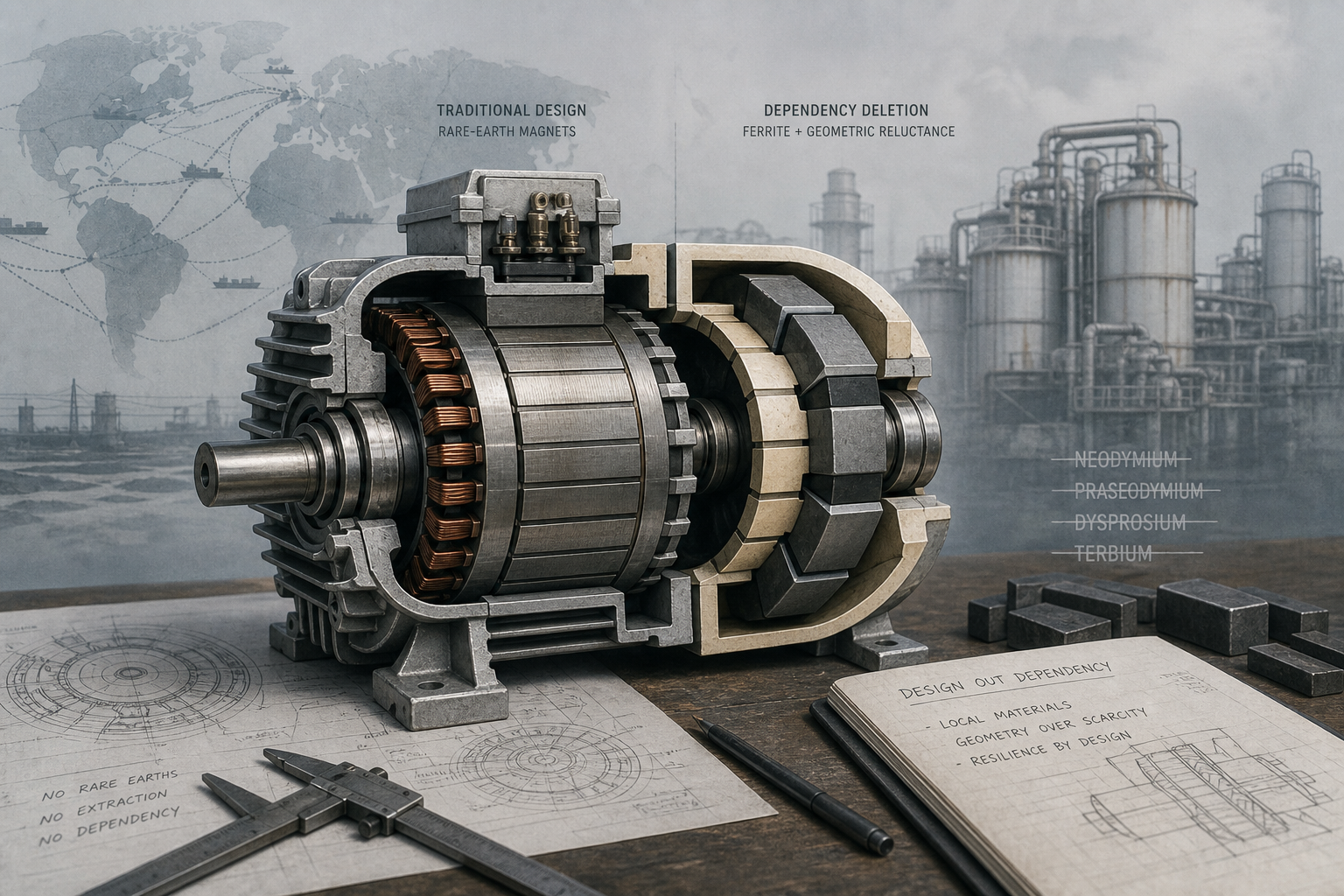
This deserves attention because most Western talk about strategic dependence still suffers from a cartographic imagination. People see a vulnerable chain and immediately reach for route-thinking. More mines. More stockpiles. Another friendly jurisdiction. Another shipping path. Another emergency supplier. All that matters, of course. But it remains a thought process trapped inside the existing object. The object stays the same; only the path to its ingredients changes.
What Varroc signals is a different order of response. According to the company, it is working on alternative synchronous reluctance motor topologies specifically to avoid dependence on rare earth inputs dominated by China. That is not a better detour. It is a wager that one can remove the coercive component from the bill of materials itself.
The leverage was never only in the mine
This is where a great deal of public language still goes soft in the head. Politicians love announcing mines because mines photograph well. A pit in the ground looks like action. But the strategic leverage in rare earths was never merely geological. It sat in the middle industrial layer: separation, refining, process discipline, equipment, waste tolerance, engineering habit, and the ugly chemical seriousness required to turn ore into something an actual factory can use.
That is why so many sovereignty speeches ended up smelling faintly theatrical. Reopening ore supply without owning the decisive chemistry was a little like reopening forests while importing all sawmills and carpenters from the same power one claimed to be escaping. The map looked more plural. The dependence remained intact.
Under such conditions, redesign becomes more than a technical curiosity. It becomes a strategic maneuver. If the hostage component lives in the magnet, then the cleanest escape may be not to outbid the monopolist for the magnet but to build a motor that asks less or none of it.
Resilience matures when design enters the room
The sentimental version of resilience imagines society as a warehouse with backup keys. One route fails, another opens. One supplier stumbles, another steps in. A little expensive, perhaps, but manageable. The harder version begins when the system understands that some dependencies are too concentrated, too dirty, too politically exposed, or too slow to replicate in time. Then resilience stops being a logistics function alone. It becomes a design brief.
This is the same civilizational move seen elsewhere under pressure. Energy systems begin favoring fewer imported assumptions. Payments systems look for domestic rails. Logistics planners begin shortening the elegant global chain into something uglier but harder to blackmail. The mature question is no longer, How do we secure this dependency? It becomes, Why does this object still require the dependency at all?
That is a ruder question. Engineers tend to like it more than ministers do, because it can produce embarrassment. If a critical object can in fact be redesigned around a strategic bottleneck, then years of solemn policy drama may turn out to have been partly a failure of imagination.
The price of this move will be real
None of this means rare earth-free design is magically frictionless. It may cost more at first. It may compromise performance in some use cases. It may demand manufacturing adjustments, new tooling, different control logic, fresh supplier relationships, or a slower path to scale. Good. That is what real adaptation looks like. Only fools expect civilizational course correction to arrive gift-wrapped and margin-neutral.
But those costs should be compared against the right thing. Not against the fantasy of a perfectly smooth global market in peacetime. Against the cost of recurrent exposure to a concentrated dependency sitting inside an increasingly geopolitical century. A component that works beautifully in a calm empire may be the wrong component for a rougher world.
Europe should notice the lesson quickly
Europe still has a bad habit here. It tends to narrate strategic dependence morally before it narrates it mechanically. One gets speeches about values, green transition, competitiveness, and de-risking, as if rhetoric might soften a materials problem. It will not. Material dependence is defeated either by owning the middle industrial layer or by reducing the object's appetite for it.
The sharper lesson in the Varroc case is therefore not Indian optimism or startup sparkle. It is that serious industrial actors are beginning to treat dependency as a design flaw. Europe should do the same across motors, power electronics, grid gear, fertilizers, batteries, pharmaceuticals, and every other domain where one brittle imported assumption still hides inside an otherwise civilized-looking product.
A society that cannot redesign around choke points ends up paying tribute to them. It may call the tribute trade, sustainability, diversification, or prudent partnership. The invoice does not care what euphemism was used.
Watchpoint
The next thing to watch is whether this remains a single-company gesture or becomes a broader industrial grammar. If more manufacturers start deleting rare earth reliance where performance allows, the strategic story changes. The question stops being how quickly the West can clone China's supply chain and becomes how much of the hostage architecture can be dissolved before the next squeeze.
That would be the more interesting future: not a heroic race to rebuild every dependency domestically at any price, but a harder, cleverer century in which objects themselves are redesigned to need less tribute from the empires that once held them. When pressure rises high enough, the best route is sometimes not around the bottleneck. It is out of the bottleneck's ontology altogether.
Sources
Sahi, Varroc Engineering Creating Rare Earth-Free EV Motor to Cut China Reliance, 27 August 2026: Varroc says it is developing alternative synchronous reluctance motor topologies to bypass Chinese-controlled rare earth supply chains.
sahi.com / rare earth-free EV motor
Background on the earlier rare-earth refining and processing asymmetry discussed on this site:
HW / The Mines Came Home. The Chemistry Did Not.