Politics this week
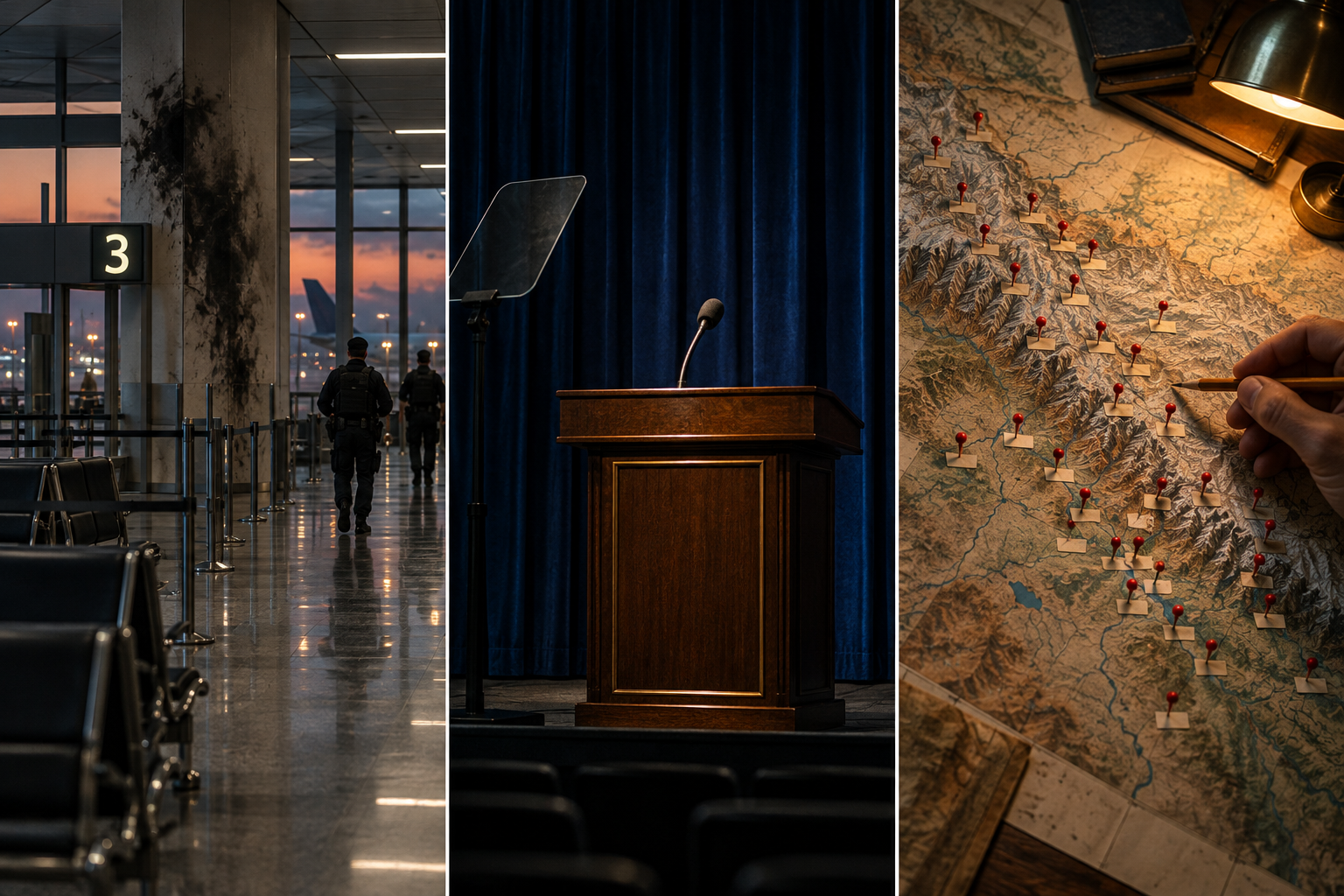
Saudi Arabia / the Houthis reach into the capital's passenger terminal. Al-Monitor reported on October 12 that a projectile struck King Khalid International Airport on Sunday, a day after the deadliest attack on Saudi soil in more than a decade, with a dozen passengers killed in Terminal 3 on Saturday and one more and eleven wounded on Sunday. The National's timeline from Abu Dhabi places the hits in a wider campaign that now includes Dammam and threats to the Kingdom's wider transit grid. The strategic point is simple and ugly. The Houthis have moved from refineries and tankers to a flagship civilian terminal, and have forced a Gulf monarchy to admit publicly that its ordinary air traffic can be interrupted. Everything about Saudi self-image — the Vision, the tourism, the Gulf as neutral platform — now has to be reconciled with closed gates and extended curfew hours.
Russia / Ukraine — a ceasefire announced before it existed. Ukrainska Pravda reported on October 11 that President Zelenskyy, speaking at the Warsaw Security Forum, had learned of a Trump-announced "energy ceasefire" from the media; Kyiv said it would honour such a deal only if Moscow confirmed it. Spectrum News reported the next day that Russia had kept striking Ukrainian energy facilities — a Kharkiv power station, a gas production site — and that the Kremlin's spokesman would only say "contacts are ongoing." This is the mature form of the Trump method: the announcement is itself a negotiating move, aimed at both parties and at domestic audiences, with the actual agreement left to catch up or fail. Ukraine lives with winter in mind; the Russian line is written into the generation grid before it is written on any paper.
European Union / three capitals ask for a brake on their own machine. TASS summarised a Politico scoop on October 12 that the leaders of Germany, Italy and Belgium had written to European Council president António Costa proposing an "emergency brake" to let member states suspend EU rules and Commission decisions seen as hurting competition and industrial growth, together with a "priority rule" to pause whole regulatory areas and accelerate planning procedures. The letter arrived days before the October 15–16 summit and in the thick of the 2028–2034 budget fight, now notionally at 1.76 trillion euros. The deeper reading matters more than the letter's drafting. A Union that spent two decades manufacturing rules is being asked, from inside its own founding core, to admit that competitiveness and climate ambition cannot both run on autopilot. The Commission will push back. The signal is that the political ground has shifted under its feet.
India / twenty-eight names on a map Beijing will not accept. Swarajya reported that the Ministry of Home Affairs, together with Ladakh, had standardised twenty-eight names on the Survey of India's official maps, including friction points along the Line of Actual Control such as Gogra and Hot Spring. Business Standard reported on October 14 that Commerce Minister Piyush Goyal, while talking up a renewed warmth with Beijing on trade and investment, left the political line unchanged. India now runs a two-track approach: cartographic firmness and commercial opening, both at once. Beijing's recent batches of its own Mandarin names across Arunachal and Aksai Chin are the mirror image. A frontier that cannot be settled by force is being settled by nomenclature. Each name is a quiet article of war.
Africa / Chinese weapons in both of the continent's uglier wars. The China-Global South Project reported on October 6 that footage showed the Sudanese Armed Forces downing a Chinese-made CH-95 drone operated by the RSF over West Kordofan, while its late September piece identified Chinese FK-2000 short- to medium-range surface-to-air systems with Ethiopian federal forces as fighting with Tigray resurfaces. Older Amnesty investigations had already traced Chinese GB50A guided bombs and 155 mm AH-4 howitzers to the RSF through the United Arab Emirates. The reading is sober rather than hysterical. Beijing is not a belligerent in either war. It does not need to be. Its small-arms, drone and air-defence industries are now so cheap, so portable and so widely laundered through third parties that they shape African wars the way American small arms shaped Latin American wars half a century ago. State power is leaking through the catalogue, not the embassy.
Bangkok / the Fund opens its ledger inside Asia. The IMF's World Economic Outlook landed on October 13 as the centrepiece of this year's Annual Meetings in Bangkok, with the companion SUERF briefing flagging cost-of-living pressure, AI deployment and public finance stress as the connecting themes. Choice of venue matters. The Fund has moved its headline moment out of Washington and into a Southeast Asian capital at a time when global growth is dependent on Asian supply, Asian demand and Asian savings. The analytical chapters on cost-of-living and corporate tax spillovers already circulating since October 5–6 point to a sober admission: inflation hurt was not fairly distributed, and the tax base that would normally pay for the aftermath leaks faster than any single government can patch.
Stockholm / the Nobel goes to the microfoundations of stabilisation. The Royal Swedish Academy announced on October 12 that Robert Hall and Michael Woodford had won the Sveriges Riksbank Prize in Economic Sciences for their work rebuilding a framework through which business cycles and stabilisation policy can be studied from microfoundations. On most Mondays this is a specialist footnote. In this week it reads as commentary. Trump announces ceasefires; three European capitals ask for emergency brakes; the Fund warns about cost-of-living trauma — and the discipline hands its highest honour to two economists who insist that macroeconomic stabilisation is a serious craft, not a press release. The prize is a quiet rebuke to improvisation.
Watchpoint
Watch what the EU summit does with the "emergency brake" letter and whether Commission president von der Leyen gives any inch of ground on simplification before the 2028–2034 envelope is settled. Watch whether the Houthi reach into Riyadh forces Saudi Arabia into either a Yemeni land operation or a decisive drone-defence industrial choice. Watch whether the Kremlin lets Trump's energy ceasefire ripen into a documented pause, or whether the Russian winter campaign on Ukrainian electricity continues without interruption. Watch India's cartographic campaign extend from Ladakh toward Arunachal before Chinese renaming grows further. Watch which African governments are willing to admit publicly how much of their artillery, drones and air defence came through Chinese catalogues laundered through Gulf partners. Watch, in Bangkok, whether finance ministers accept that cost-of-living damage is a political debt, not a cycle.
The deeper pattern is the one visible in every room this week. The age in which an announcement, a letter, or a map could stabilise a reality by itself is draining out. The hard work of agreement — in refineries, in regulatory texts, in border tongues, in weapons catalogues, in finance — has to be done, and done by someone who can be held to it. The world remains addressable. It is simply no longer addressable by press release alone.
Sources
Al-Monitor, on the fresh Houthi strike on Riyadh airport.
al-monitor.com / Riyadh airport hit by fresh Houthi strike day after deadly attack
The National (Abu Dhabi), on the escalating timeline of Houthi attacks on Saudi airports.
thenationalnews.com / Timeline: Houthis escalate attacks on Saudi airports
Ukrainska Pravda, on Zelenskyy being unaware of Trump's energy ceasefire and conditional support.
pravda.com.ua / Zelenskyy was unaware of “energy ceasefire” but is willing to agree to it
Spectrum News, on continued Russian strikes on Ukrainian energy facilities despite Trump's claim.
spectrumlocalnews.com / Zelenskyy says Russia strikes energy facilities despite Trump ceasefire claim
TASS (summarising a Politico scoop), on the German-Italian-Belgian "emergency brake" letter to Costa.
tass.com / Three EU countries call for mechanism to suspend EC decisions
Swarajya, on India's twenty-eight standardised Ladakh names on the Survey of India map.
swarajyamag.com / Government adds 28 strategic Ladakh locations to Survey of India maps
Business Standard, on Goyal's parallel push for warmer India-China trade and investment ties.
business-standard.com / India working to develop relations with China once again, says Goyal
China-Global South Project, on Chinese weapons in Sudan and Ethiopia.
chinaglobalsouth.com / Chinese Weapons in Sudan and Ethiopia Conflicts · chinaglobalsouth.com / Chinese-Made Air Defenses Appear as Fighting Escalates in Ethiopia
International Monetary Fund, on the World Economic Outlook release at the 2026 Annual Meetings in Bangkok.
imf.org / World Economic Outlook, October 2026 · suerf.org / Key insights from the IMF October 2026 WEO, GFSR and Fiscal Monitor
The Nobel Prize, on the 2026 prize in Economic Sciences for Robert Hall and Michael Woodford.
nobelprize.org / Prize announcement, 12 October 2026