Asia
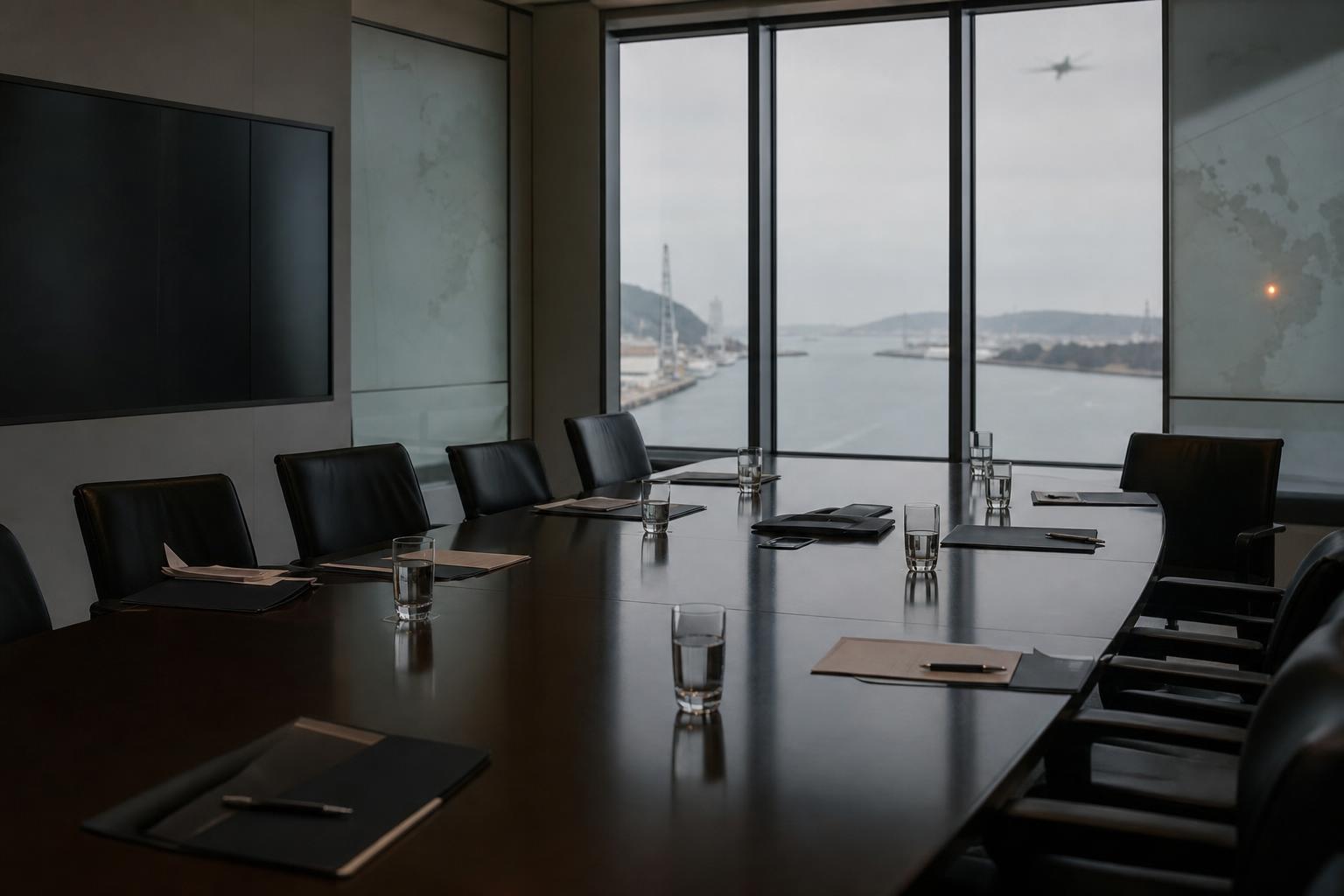
Singapore supplied the week’s clearest diplomatic image: a region trying to keep a usable security room intact while both great powers become harder to trust. AP framed Pete Hegseth’s Shangri-La appearance as a reassurance exercise, with Washington insisting it remained committed to Pacific security while toning down some of last year’s theatrical China language. SCMP, from the other side of the same room, noticed something equally important: Beijing also dialled down its rhetoric, with Major General Meng Xiangqing avoiding last year’s sharper denunciations and instead stressing the need for China and the United States to move toward each other. That is not harmony. It is two powers feeling for a lower temperature because the alternative is too expensive.
The regional emphasis was more interesting than the western one. CNA’s reporting on Chan Chun Sing and The Straits Times’ own post-mortem both treated the forum less as a stage for grand declarations than as a place where officials still talk usefully behind closed doors. Chan’s sharpest line was that more defence spending without more reassurance merely exports insecurity to the next state. That is a very Asian diagnosis. The question is not who gave the loudest speech. It is whether the room remains breathable for trade, planning, and ordinary statecraft.
The week’s harder Asian subtext was infrastructural rather than theatrical. CNA and SCMP both highlighted the launch of a 17-country framework for protecting critical underwater infrastructure. That sounds dry until one sees what it reveals. The region is now speaking in the language of cables, pipelines, and seabed vulnerability because the old promise of frictionless interdependence no longer feels self-enforcing. When the summit’s most serious by-product is a pact on undersea infrastructure, the real subject is no longer posture. It is continuity of systems.
The larger pattern is armed interdependence without strategic trust. Asia is rearming, hedging, and hardening infrastructure without any settled belief that Washington will stay steady or that Beijing will become fully legible. That is why Shangri-La still matters even in its more bureaucratic years. When trust thins, even the conference hotel becomes infrastructure.
Europe
Europe’s fact of the week was not a communiqué but a roof. Reuters, via MarketScreener, reported that a Russian drone crossed into Romanian airspace, struck an apartment block in Galati, and injured two civilians. A few days later, AP reported that a Ukrainian maritime drone exploded in Romania’s Constanta port after several such drones went astray in the Black Sea. Roof and quay, apartment block and port: the point is not to stage a moral equivalence between Moscow and Kyiv, but to note that the eastern flank now behaves like an exposed operational zone whether Brussels enjoys the vocabulary or not.
What followed was revealing in its own way. Reuters also reported, again through MarketScreener, that Romania’s foreign minister said several allies were preparing to reinforce air-defence capabilities on NATO’s eastern flank. The Straits Times, from Singapore rather than Brussels, caught a second piece of the same story: Europeans arrived at Shangri-La in unusual numbers, openly preoccupied with Ukraine’s strain on military capacity and with the need for cheaper, more adaptive systems. Europe’s strategic conversation is finally getting ruder because reality has done the discourtesy first.
The week’s European diagnosis is therefore harsher than the official tone. Europe still likes to describe exposure as if it were a communications problem and deterrence as if it were a sentence to be tuned. The drone does not care. It asks for sensors, cheaper countermeasures, production runs, resilience, and crews who are ready before the press conference begins. This is not an age for artisanal security.
The historical comparison is not flattering. The old continent is once again discovering that frontiers are material before they are moral. Wealth and procedure are useful, but they are not a shield. The eastern flank now belongs to the same category as Hormuz and the undersea cable: a place where fragility stops being metaphor and becomes engineering.
Americas
Across the Americas, the political grammar kept hardening around control. El País argued on June 7 that Central America is being bent back under Washington through fear, calculation, and a revived anti-cartel doctrine. Its value lies not in slogan but in pattern recognition: the region is being pushed to widen the category of acceptable intervention in the name of narco emergency, maritime interdiction, and sovereign failure.
The White House logic is visible even through the diplomatic varnish. A second El País piece, published June 6, widened the frame from Central America to Mexico, Brazil, and Colombia and argued that the old interventionist reflex is no longer being hidden behind much diplomatic lace. Its English-language Colombia coverage on June 3 made the same point in more concrete form: Trump’s personal endorsement of Abelardo de la Espriella was not background noise but overt political pressure from the north. That matters because the shift is not only operational. It is semantic. Security, drugs, sovereignty, and electoral legitimacy are being fused into one legitimising language.
Colombia offered the electoral version of the same phenomenon. AP reported on June 2 that European Union observers rejected Petro’s fraud claims and described the first-round vote as transparent and orderly. Set beside El País’ intervention reporting, the Colombian case reads less like a local procedural spat than like part of a wider hemispheric hardening: when legitimacy thins and Washington stops pretending neutrality, the promise of force begins to outrun the promise of improvement.
The continental pattern is a plebeian security turn. Weak growth, criminal power, migration pressure, and exhausted institutions are producing electorates increasingly willing to accept rougher bargains. Governments that can no longer promise ascent promise enforcement instead. Some of those bargains will be ugly. Many already are. But the old liberal script of reform, inclusion, and patient capacity-building is losing the room.
Middle East & Africa
The Middle East remained the week’s master switch because every diplomatic sentence still bent back toward Hormuz. Reuters reporting carried by CNA on June 2 showed markets parsing the proposed U.S.-Iran agreement chiefly through one question: would it reopen the Strait of Hormuz or not. That is the useful hierarchy. The diplomacy may wear the language of ceasefire extension and war termination, but the system keeps translating it back into corridor status, shipping risk, and energy passage.
And then the week ended by proving how brittle that bargain still is. On June 5, AP reported that U.S. forces intercepted Iranian missiles and drones launched toward Gulf allies and the Strait of Hormuz, then hit Iranian radar sites in response, further fraying an already shaky ceasefire. In other words, the week began with corridor optimism and ended with corridor enforcement. That is the essential Middle Eastern condition now: every truce talks like a settlement and behaves like an interval.
Africa’s place in this story remains the familiar unjust one. It does not need to be a battlefield to inherit the price of the corridor. Freight costs, fuel stress, and fertiliser risk travel outward faster than diplomatic reassurance does. This is one of the oldest imperial habits in the world: control the passage elsewhere, invoice the periphery later.
The larger mechanism is antique even if the dashboard is digital. The war, the blockade, the sanctions, the insurance premium, the escort mission, the memorandum, the emergency rerouting of imports: it is all still corridor politics. Modern empires wear more software, but they remain obsessed with the choke point.
Watchpoint
Watch what governments start building once they stop pretending these are temporary disruptions. Asia will keep investing in resilience around rooms, cables, and shipping lanes. Europe will be forced toward more honest anti-drone procurement on the eastern flank. The Americas will keep broadening the category of acceptable coercion. The Middle East will continue teaching the rest of the world that a corridor under arms is never merely a regional story.
The week, in other words, was not mainly about the return of ideology but about the return of conditions. Trust is thinner, movement is dearer, and reassurance now costs cables, radars, stockpiles, escorts, and political permissions that would have sounded excessive only a few years ago. The world still speaks in the language of openness. It is increasingly governed in the language of guarded passage.