The most important Dutch political sentence of this month was not delivered in parliament. It was delivered by the river itself. On 12 August 2026, NOS reported that the Rhine at Lobith had fallen to an average inflow of 614 cubic metres per second over the previous day, below the old low-water record from 1947 and far below the seasonal norm of roughly 2000. The truly indecent detail was not only the number. It was the date. The old record had belonged to early November. This one arrived in the middle of August, while summer still had time left to misbehave.
That is the hinge. Scarcity has moved forward in the calendar. It no longer waits politely for the end of the year, when low water can still be narrated as a stern but familiar seasonal inconvenience. It now arrives before autumn, before the public imagination has even given itself permission to think in triage terms. A country that built its self-image on water competence is being told that competence no longer means only holding back excess. It also means deciding, early and publicly, who gets less.
The river has stopped behaving like a background service
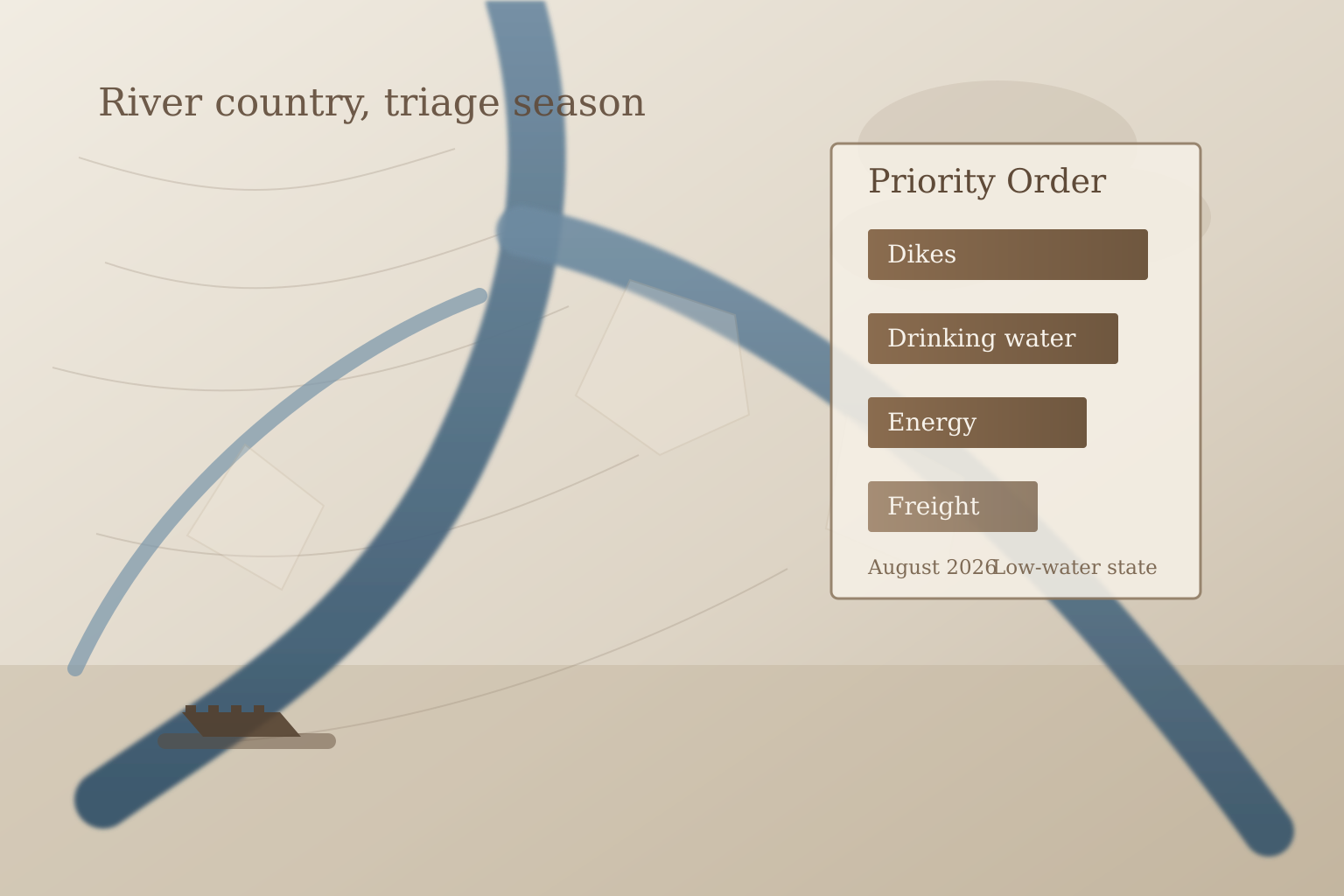
The Rhine is not scenery for the Dutch state. It is part of the state. It brings freshwater, depth for inland shipping, cooling and process water for industry, and the hydraulic pressure that helps keep salt where it belongs. Once the inflow weakens enough, all those functions stop harmonising and start competing. That is why Rijkswaterstaat's dry-weather material reads less like environmental communication and more like quiet command language. Water is distributed as well as possible by sluices, weirs, and pumping stations. If too little is available, the verdringingsreeks comes into play: priorities are applied.
The Dutch genius has always been to make such decisions disappear into infrastructure, to let the gates and levels do the politics silently. This summer the silence has weakened. On 3 August, Rijkswaterstaat fully opened the weir at Driel because the low water had become so extreme that its regulating function could no longer be maintained. Amerongen had to take over. The official note stressed that this was the first time this happened because of extremely low discharge. A state does not usually announce such things unless the machine has begun speaking through its limits.
A few days later the cabinet supplied the social meaning. Businesses suffering damage from low water, minister Karremans said on 6 August, should not expect compensation. The shortage was not being treated as a disaster in the compensatory sense, but as something closer to entrepreneurial exposure. That sentence deserves to be read with more care than it received. It means the state will still defend dikes, drinking water, and the energy system, but will not automatically socialise all downstream commercial pain. In other words: the sovereign function remains public; the economic bruise may remain private.
Freight falls down the ladder first
There is nothing mysterious about the hierarchy. If water is scarce, the first obligations belong to physical safety and basic social continuity. Nobody sane wants the opposite. But the revealing thing is which functions become negotiable once the ladder appears. Inland shipping is one of them. Agriculture in many places is another. Decorative uses vanish first, then ordinary commercial expectation, then more substantial economic routine. The barge learns what the household learned long ago: scarcity always arrives as a moral ordering disguised as logistics.
The Rhine's German reach has made that ordering visible in almost theatrical form. NOS reported on 13 August that the river had effectively split in two for shipping, with the critical point near Kaub becoming too shallow for normal passage. Ships were moving with a fraction of their usual load. Transport plans were being torn up every morning. One ship began to imply one hundred trucks. This matters in Dutch terms because the Netherlands likes to speak about trade as though it were an eternal national condition rather than a physical achievement renewed each day by water depth, clearance, and boring competence. The river is reminding the country that trade is not a birthright. It is hydraulics.
That same reminder reaches into the Dutch interior more quickly than people think. Once freight goes shallow, costs rise, schedules decay, and industrial planning becomes more speculative. Once freshwater must be held back for dikes and drinking water, the public learns that not every use is equal. Once salinity pressure increases, the old fantasy of endless managerial adjustment begins to look a little worn. A delta remains governable, yes, but only through harder ranking than prosperity taught it to expect.
Scarcity is arriving before the rhetoric is ready
What makes this a proper Tuesday essay rather than a weather bulletin is the temporal insult built into it. Scarcity is no longer merely deepening. It is arriving early. NOS quoted hydrometeorological analysis pointing to an unusually warm spring and snow in Switzerland melting roughly three months earlier than usual. The Rhine was, in effect, being emptied ahead of schedule. That alone changes the political grammar. If the seasonal cushion is consumed before late summer has even finished, every reserve measure becomes less a response to an exception than a rehearsal for recurrence.
The long view has already begun catching up with the short emergency. On 14 August, NOS reported on Deltaprogramma research showing that the seven-day summer minimum discharge at Lobith could be 10 to 30% lower by 2100. Even that estimate excludes whatever water-retention measures upstream countries may adopt for themselves. Which is to say: the Dutch state is not only facing less water in dry summers. It may also face neighbours who become more interested in keeping their own share. Anyone still speaking about drought here as though it were mostly a mood problem with cracked lawns should be sentenced to one afternoon with a river chart and a little shame.
The Dutch administrative response remains competent, but competence is not the same as innocence. The public language still prefers phrases like droogtemonitor, waterverdeling, and maatregelen. Fine. But the thing itself has become clearer than the prose. A wealthy lowland state is now triaging freshwater in August; shipping is losing depth at home and upstream; business is being told that some losses are simply its own; and the official future says summer scarcity will grow harder still. The structure has already changed, even if the national self-description has not.
The real Dutch question
The question is therefore not whether the Netherlands can manage this summer. It can, more or less, because it is still staffed by serious hydraulic adults. The sharper question is what sort of country emerges when water management stops being mainly a triumph over excess and becomes a repeated exercise in ranking insufficiency. That is a different political culture. It asks for investment, yes, but also for candour about which sectors will be protected first, which will be disciplined, and which risks will simply be pushed back onto whoever still has to move the goods.
A river country likes to believe it has water policy. What it is beginning to acquire, whether it likes it or not, is water politics. The difference is brutal. Policy assumes enough room for optimisation. Politics begins when there is not enough room, and the order of sacrifice has to be decided in daylight.
Sources
Rijkswaterstaat, Rivieren, waterbericht updated 25 August 2026, 02:00: current warning remains lage waterstanden.
rijkswaterstaat.nl / river bulletin
Rijkswaterstaat, Waterstanden en afvoeren rivieren: Lobith and Sint Pieter are the key inflow locations for Dutch freshwater management; the page frames river-flow data as critical during drought and extraordinary situations.
rijkswaterstaat.nl / river levels and discharge
Rijkswaterstaat, Verdeling water bij droogte: explanation of how freshwater is allocated in drought, including the role of sluices, weirs, pumping stations, and the verdringingsreeks when supply is insufficient.
rijkswaterstaat.nl / water allocation in drought
Rijkswaterstaat, Stuw Driel volledig geopend, published 3 August 2026: the Driel weir was fully opened for the first time because of extremely low discharges, with Amerongen taking over the regulating role.
rijkswaterstaat.nl / Driel weir fully opened
NOS, Kabinet: geen compensatie voor ondernemers die schade lijden door laagwater, 6 August 2026: the cabinet declined compensation for low-water business losses and treated the shortage less as disaster than as commercial exposure.
nos.nl / no compensation for low-water losses
NOS, Rijkswaterstaat: nog hele jaar problemen met droogte, drinkwatervoorziening op orde, 11 August 2026: the drought was described as historically unusual and likely to create problems for the rest of the year.
nos.nl / drought problems for the rest of the year
NOS, Record uit 1947 gesneuveld: niet eerder zo weinig water door de Rijn, 12 August 2026: Lobith discharge fell to 614 cubic metres per second, below the old 1947 record and far below the seasonal norm.
nos.nl / record-low Rhine inflow
NOS, Scheepvaart over Duitse Rijn deels gestremd, miljardenstrop dreigt voor economie, 13 August 2026: the German Rhine was effectively split for shipping, showing the wider logistics consequences of the same low-water regime.
nos.nl / German Rhine shipping disruption
NOS, Waterschaarste Rijn wordt komende decennia in de zomers steeds prangender, 14 August 2026: Deltaprogramma research indicates the seven-day summer minimum discharge at Lobith could be 10 to 30% lower by 2100.
nos.nl / Rhine scarcity becomes more pressing