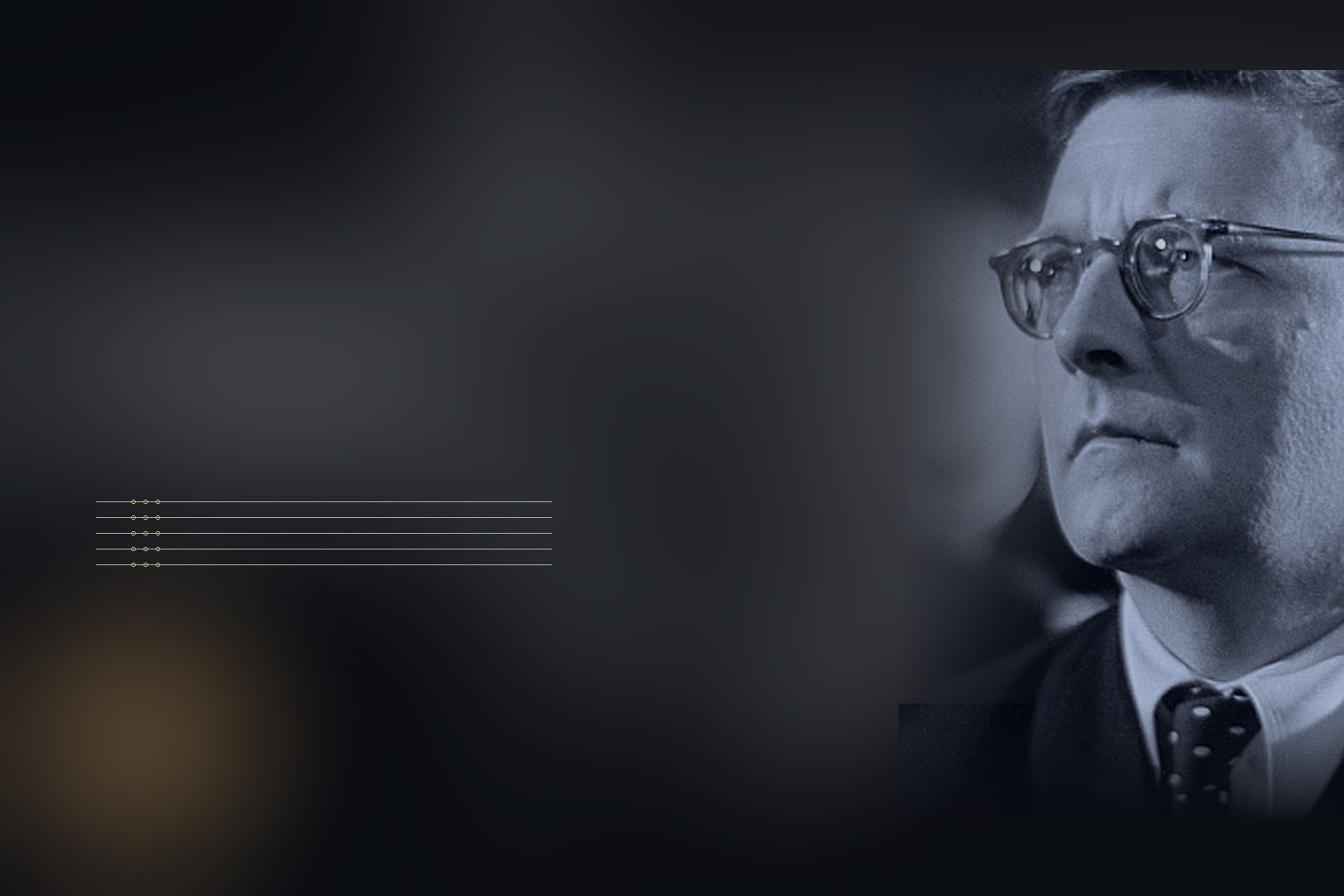
The score carries the dedication “to the memory of victims of fascism and war.” The private dedication, as the composer told his friend Isaak Glikman in a famous letter, was to himself. He had just been pressured into joining the Party. He had, in his own words, “a lot of time to think it over,” and this quartet was the thinking. Then came Dresden, a bus ride into a landscape of charred stumps and rebuilt staircases leading to nothing, and three days of composition that reads less like inspiration than like a man writing his own eulogy before anyone else could edit it.
The DSCH signature — D, E-flat, C, B natural, the composer’s initials in German notation — is the whole structure. It opens the first movement in a fugue so quiet the players must breathe for it. By the second movement, the Allegretto, the same four notes have been strapped to a motor. The violins knife upward in parallel octaves at the top of the fingerboard. The viola and cello hammer the ground. A Jewish folk theme — stolen out of his own Piano Trio No. 2, written in 1944 as he learned what had happened in the camps — comes screaming across the texture at bar one hundred and something, a klezmer line sharpened into a weapon. Four minutes, maybe four and a half. It does not relent. It does not soften. When it stops, it does not resolve; it is cut off.
This is the correct counter-weight to last Monday. Ibrahim’s Mannenberg was wu wei in the left hand: three chords settling into their own gravity, dignity by patience, the soft outlasting the hard. The Shostakovich Allegretto is the opposite proposition, and it is just as truthful. There are weeks when the honest response is not to settle but to run with the knife still in. The Taoist line about the soft overcoming the hard is a long-term claim. In the short term, there are mornings when a dispossessed man picks up his own name and uses it as a cudgel, and that too belongs on the page.
Note the economy. Four instruments. No orchestration to hide behind. No percussion to beg sympathy. The horror has to be made by rosined horsehair and gut, by bow pressure and double-stops and the discipline of a quartet that will not let itself ornament. This is why the piece has survived every regime that tried to claim it: it refuses the lie of grandeur. There is no Mahlerian consolation at the end, no cathedral chord to tell the listener it was all for something. There is a cut, a silence, and then the slow movement arrives as if nothing had happened, which is of course the worst part.
Play the Borodin Quartet, 1962 Melodiya, with Rostislav Dubinsky still at the first stand. They recorded it with Shostakovich in the room. There are glossier versions — the Emersons are precise, the Jerusalems are warm, the Pacifica is handsome — but the Borodin plays it as if they can still smell the Dresden brick dust. The attacks are ugly on purpose. The intonation is sharp with intent. The Russian school understood that this music is not asking to be made beautiful; it is asking to be made true.
Play it once through, in the morning, before the inbox opens. Four minutes. Loud enough that the room cannot pretend. Let the week understand that elegance is not always the correct instrument. Then put the Ibrahim on afterward, if you need to, and let the long marabi vamp carry you the rest of the way. A civilised ear needs both hemispheres. The warm patience of the township piano, yes — but also, when the century demands it, the cold four-string scream from a Dresden hotel room where a man wrote his own obituary and signed it with his name.