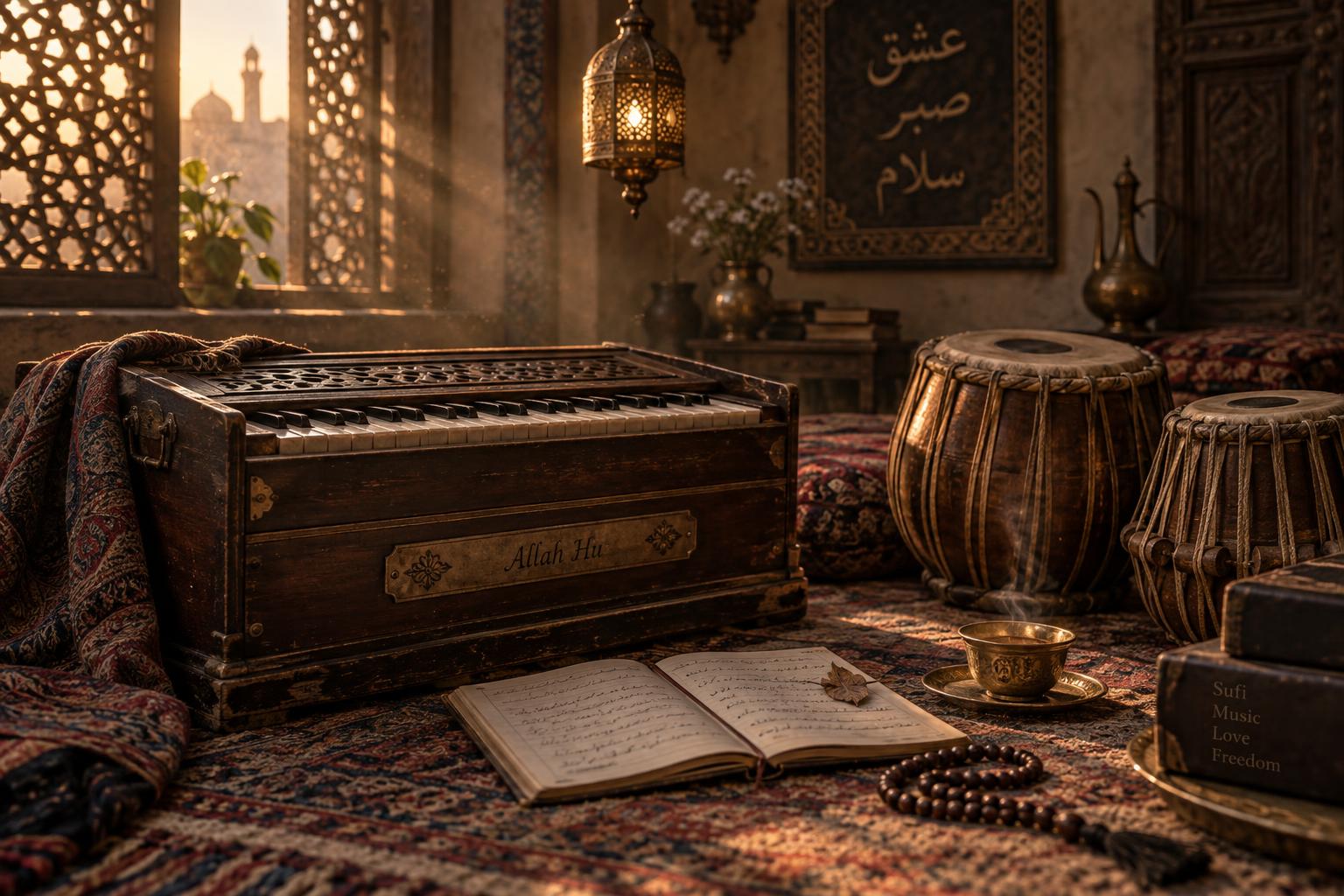
Mustt Mustt is the title track of the 1990 album Nusrat Fateh Ali Khan cut for Peter Gabriel's Real World label with the Canadian guitarist Michael Brook. It was recorded in a Wiltshire studio, released into a British world that thought it had music mostly figured out, and quietly rewired what a devotional voice could do in front of a Western sound system. The word mast in Urdu and Punjabi does not translate cleanly. It is drunk, intoxicated, ecstatic, out of one's ordinary mind, given over to something larger — the state a Sufi calls on when the discursive machine gives up and the body takes the argument.
What arrives on the track is not fusion in the tired sense of the word. There is a loop, a bass, a low pulse. Underneath and above it, Nusrat sings the way a Punjabi qawwal has sung for six centuries: hard consonants, long open vowels held past the point of comfort, ornaments that do not decorate but insist, hand-claps and small vocal shouts from his party pushing the meter forward. He is honouring the sixteenth-century saint Lal Shahbaz Qalandar, patron of Sindh and of the disreputable. The lyric is a chant of love drunk on a friend. The track is a work rig.
It earns Monday exactly because it will not behave. Last week the site was calibrated cool on purpose: whetstone, monastery, cable ship, pilgrim road. All of it accurate to a European September that begins to close its shutters. But a week that only breathes at one temperature starts to lie about the world. Mustt Mustt restores the other lung, and it does so without asking permission from the Atlantic. It brings in Lahore, Faisalabad, and the shrine at Sehwan Sharif on their own terms. The pulse does not sound apologetic. It sounds like a room that has decided the argument about whether God is embarrassing has already been settled somewhere else.
There is also a strategic point in it, and it should not be smuggled past. The Atlantic pop conveyor is a small provincial system compared to what has moved out of South Asia, out of the qawwali tradition, out of the Arabic and Persian devotional lines, and out of the East Asian classical repertoires. Nusrat did not travel to London to be validated by Real World. Real World, to its credit, arrived at his door. When a European ear hears Mustt Mustt and thinks it has discovered something exotic, the ear is late. The music has been sovereign for a long time. What is new is only that a Wiltshire mixing desk finally learned to sit still and record what was already there.
Play it early. Not as a curiosity. Not as world-music garnish. Play it because the coming week will try, as every week now tries, to reduce you to a well-managed nervous system with a schedule attached. Ten minutes of a qawwal opening his throat is the correct answer. You do not have to understand the Punjabi. The point of ecstatic devotional music is precisely that the meaning arrives before the translation does, and stays after the translation has been forgotten. Rumi already wrote the manual eight hundred years ago: when the intellect gives up, the heart moves the feet. On Mustt Mustt you can hear the feet.