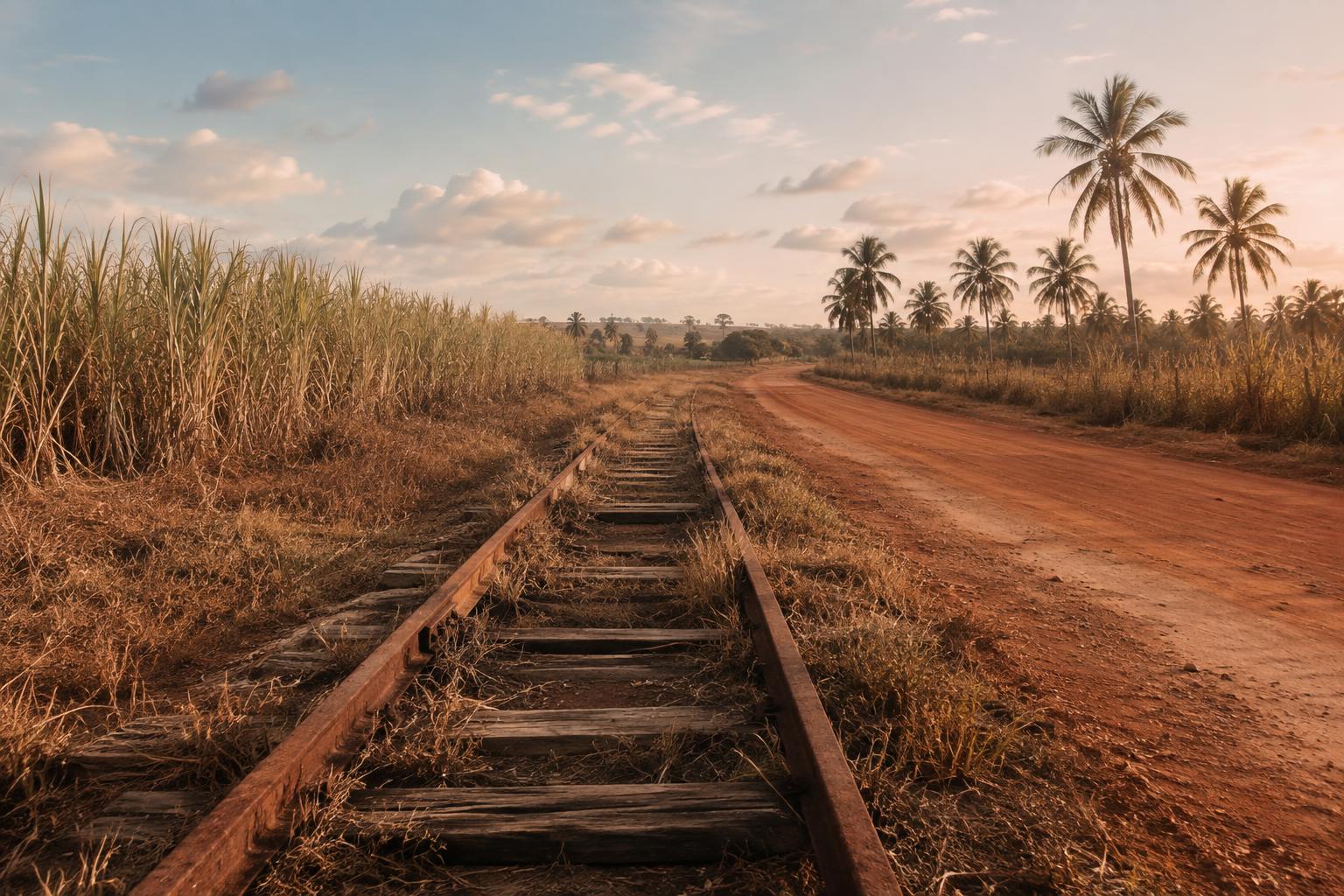
Ponta de Areia opens Wayne Shorter's Native Dancer (Columbia, 1975), but it is really Milton Nascimento's song, brought north to New York and given a saxophone that knows how to listen. Ponta de Areia was the terminus of the old Bahia and São Francisco railway in northeastern Brazil, a line closed and pulled up in the 1960s. The song is an elegy for a route: a train that no longer runs, a village that stopped being a destination, an interior of the country quietly unstitched from the coast by decree. Nascimento does not narrate any of that. He sings a melody without words, a wide open ay-ay-ay, and the geography carries itself.
That is the mercy of the recording. It refuses commentary. Herbie Hancock's electric piano lays down a rocking, slightly humid figure. Shorter's soprano arrives like a second voice, not competing, only agreeing. Airto Moreira's percussion is soft enough that you can hear the room breathing. Everything conspires to make the missing train present again for four minutes and thirty seconds, without a single announcement, without a single lecture on developmentalism, without a single pious note about the north-east.
It earns Monday because it does not sedate. Last week's HW pages ran cool on purpose: the coat back on its hook, the fig torn open at the counter, Mumford's clock, the design that deletes the hostage. That register was correct for its moment, but a week that only breathes in one temperature begins to lie. Ponta de Areia restores the other lung. There is nothing kitsch in this warmth. It is not the tropical postcard the northern imagination sells itself when it wants to feel exempt. It is Bahian light on a rusted rail: memory, humidity, and a small stubborn insistence that a route abandoned by the state can still be sung.
Politically the song is more serious than most of what dresses up as political music. It documents, without arguing, that infrastructure is not neutral. A railway closed is a village severed, a labour market shrunk, a whole grammar of movement erased. Brazil dismantled thousands of kilometres of narrow-gauge line during the great motorization; the interior was quietly re-arranged around trucks and the coast. Nascimento does not scold. He mourns beautifully, which is harder and lasts longer. Anyone who has watched a good line be pulled up in their own country — branch lines in Belgium, the Netherlands, England, the Rhineland — will recognize the shape of the grief.
Put it on early, before the inbox begins its small daily coup. A kitchen speaker is enough; you do not need to make a ceremony of it. Let the wordless voice pass through the room while the coffee comes up. You will not feel productive. You will feel restored to your own scale, which is more useful than productivity, and easier to defend across a whole autumn.