John Martyn — born Iain David McGeachy in Glasgow in 1948, raised between New Malden and his grandmother’s flat in Shawlands — was, by the summer of 1977, deep into the long second act of a career that had begun in the London folk clubs and slipped sideways into something for which the trade press had no honest name. He had spent the previous decade dragging a wooden Martin guitar through tape-echo units until it sounded like an entire small orchestra heard from underwater, drinking heroically, writing for the most part about love and its various failures, and quietly recording with Lee Perry and Steve Winwood and Danny Thompson and anyone else willing to entertain his bad habits. None of that is quite the point. The point, in July of that year, is the lake.
The Island Records mobile studio had been parked in the courtyard of Woolwich Green Farm in Theale, Berkshire, Chris Blackwell’s house — a place built around a substantial body of water, the sort of pond English landowners flatter by calling a lake. The engineer was Phill Brown. The plan, recovered later in his memoirs and in the deluxe-edition sleeve notes, was to use the property rather than disguise it. PA monitor stacks were set up behind the stables and pointed out across the open water at the surrounding hills. Two microphones were placed on the far side of the house to catch the sound returning naturally off the lake. Two more were dropped close to the shore to record the waves at the pier. Two guitar amplifiers were floated, on improvised pads, somewhere out near the middle of the water. Martyn himself stood at the pier with his Echoplex tape unit and an electric guitar.
The session began some time after midnight. It ran into the small hours, which is how the closing track of the album acquired its name, and the recording duly captured a flock of Canadian geese in the take, a freight train passing about two and a half minutes in, and at one point a duck — none of which was scrubbed from the master. The piece runs eight minutes and forty-five seconds. Almost all of it is an Echoplex meditation built on three or four notes; Martyn’s voice surfaces only in fragments, half-syllables, a breath, a wordless slur. The unit slowly multiplies what he plays and smears it into long delay; the lake returns it again as a second, even slower one. The reverb on the record is not artificial. It is Berkshire at three in the morning. The instrument is the country.
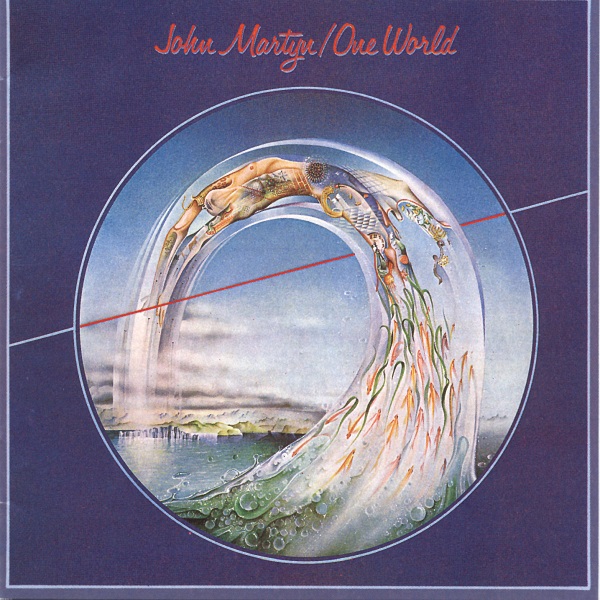
Tony Wright’s sleeve — Martyn nowhere in sight, a mermaid arched into a wave, fishlike figures cascading down, a single red horizontal line cutting the dusk-blue circle in half — was finished before the album was even delivered, which is why the back cover printed the running order in reverse and the original pressings were quietly mis-sequenced. The order as Martyn intended it begins with Dealer and ends here, with everything tapering out into a long exhale across open ground. The album was, by some margin, his first to chart in Britain. He spent most of the thirty years that followed drinking, recording when sober, falling out with friends, losing the use of his right leg, and gradually shrinking from the public stage. He died in Ireland in 2009. Small Hours outlived him on the only terms that mattered: it is still one of the few records of its scale that bothers to record the actual room around itself.
The reason to publish it now is the contrast with what most contemporary music has agreed to be. Producers compress the air out of pop records on principle. Vocals are tracked separately, in cubicles smaller than a confession booth, syllable by syllable, then sealed against weather. Nothing is allowed to drift in. The room is denied. Small Hours runs in the opposite direction. What the listener hears is also a physical event in southern England in July 1977, complete with birds, water, distant rolling stock, and a man at a pier deciding whether or not to play the next note. You are not given a song. You are seated outside, near a lake, and asked to remain there.
The track has since been quietly stolen by everyone from Talk Talk to Röyksopp to the entire English ambient diaspora, none of whom have ever quite produced its equivalent. The mistake the imitators make is to add: pad, drone, atmosphere by the litre, a fashionably hesitant beat. Martyn subtracts. The first thing he removes is the studio itself.
Wait until the apartment is mostly dark. Open one window if the weather allows. Headphones with enough range to catch the goose at the edge of the third minute. Eight and three quarters of a minute is short enough that pretending one does not have time would be embarrassing. Let the Echoplex come back across the water at you. Notice that you have stopped breathing badly. Notice, also, how rarely a record has actually bothered to wait for you to arrive.