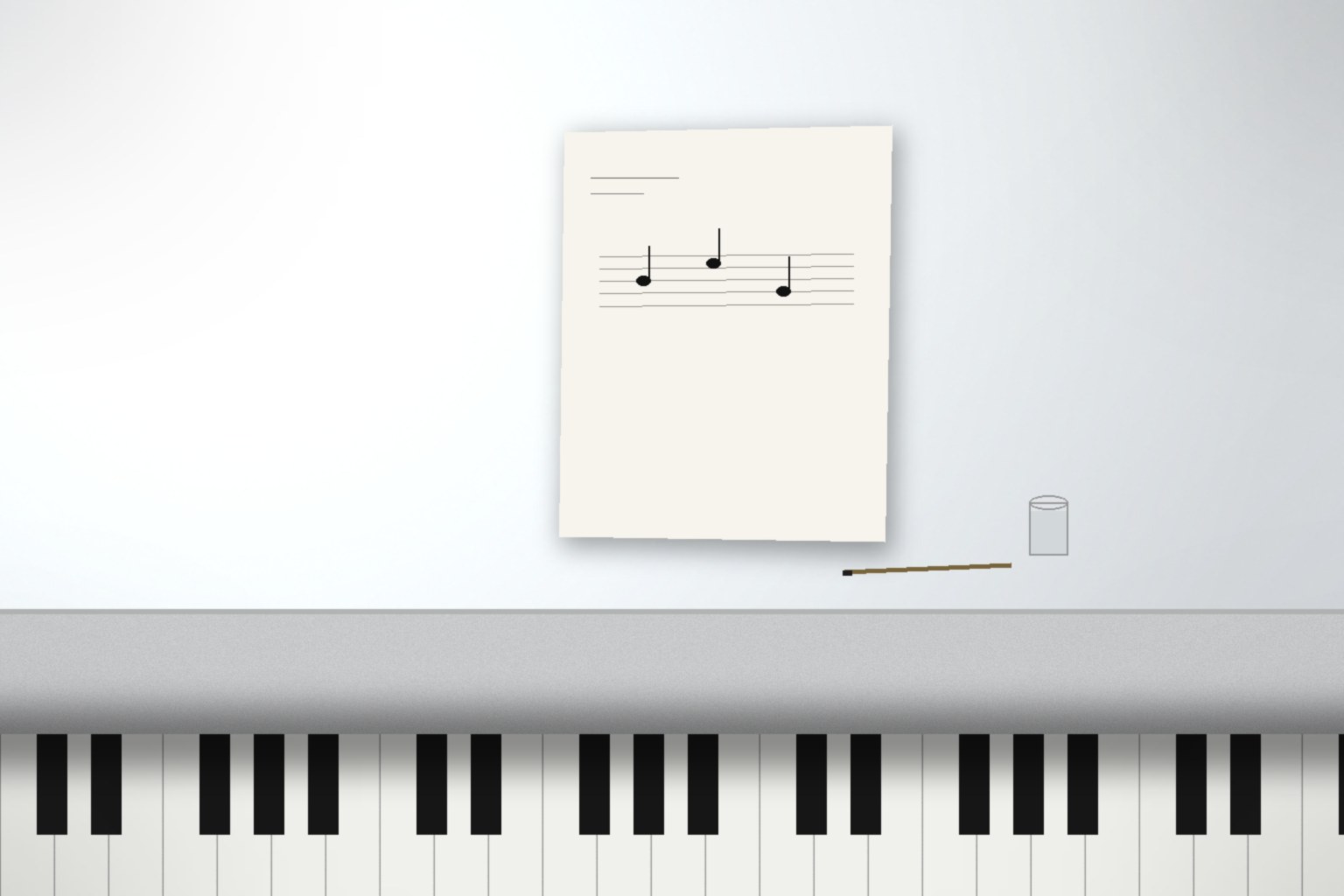
Für Alina was written in 1976 for a girl of that name, the daughter of a family friend, then eighteen and about to leave for London. It is under two minutes long. It is scored for solo piano. In the right hand, a slow descending line in B minor. In the left hand, a triad quietly following it, always shadowing, never insisting. Between the notes: silence, indicated with the same seriousness with which the notes themselves are indicated. That is the entire piece.
It matters because it is the door. After it, Pärt gave the method a name: tintinnabuli, from the Latin for little bells — one voice moving stepwise, another confined to the pitches of a single triad, both bound so intimately that they read as one line and one shadow. Everything that followed — Fratres, Tabula Rasa, Cantus in Memory of Benjamin Britten, Spiegel im Spiegel, the vast liturgical works — grew from this small hinge. He had spent almost a decade in what he later called silence, unable to write in any received modernist dialect and refusing to fake one. Then he sat down and produced a piece any child could learn to read but almost no serious composer of his generation would have dared to sign their name to.
Play it in a quiet room. The instrument matters less than one imagines: an upright with two ordinary hands will do, which is part of the point. What you are listening to is the invention of a language whose ambition is to disappear behind whatever is happening in the room. The notes do not perform. The triad does not comment. There is no development. The piece begins, moves through a small formal arc, and stops. The silence around it is not the silence of an absence of music. It is the silence for which the music was written.
This is the correct counter-weight to last Monday. Mustt Mustt was fire, throat, and forward pulse; a body in the room, a Sufi shrine in Sindh transported to a Wiltshire console and refusing to soften. Für Alina answers from the other side of the same religious impulse. Where the qawwal builds an ecstatic weight until the intellect gives up, Pärt strips until there is nothing left to give up: two voices, one triad, a great deal of air. Both are devotional. Both refuse the noise of the century that surrounds them. They simply refuse it from opposite ends of the same room.
There is a small European lesson buried in this piece for anyone still willing to be taught by one. It is not that less is more; that phrase has been ruined by furniture catalogues. It is that a real language can be built out of very few materials if you are willing to give up almost everything else. Pärt did not simplify from ornament to spareness as a style. He simplified because the alternative was continued dishonesty. The uncarved block is not a mood. It is a decision about what one will and will not add to a life — or, on a Monday morning, to a room.
Two minutes. Play it before the day opens its mouth. Then let the silence it leaves behind do its own small work, which is to make the noise that follows a little easier to recognise as noise.