There is a habit in Atlantic strategy commentary of measuring naval power the way one might measure a wine cellar — by counting hulls presently in the water. Aircraft carriers, destroyers, submarines, tallied and re-tallied in slick charts.
This is a reassuring exercise. It is also a lagging indicator. A navy in the water today reflects yards, welders, plate mills, propulsion suppliers, and steel decisions taken a decade earlier. What matters for the next war is not the fleet on the sea; it is the fleet in the order book.
On that measure, the balance has already tipped and almost no one wants to say it plainly.
The Industrial Fact
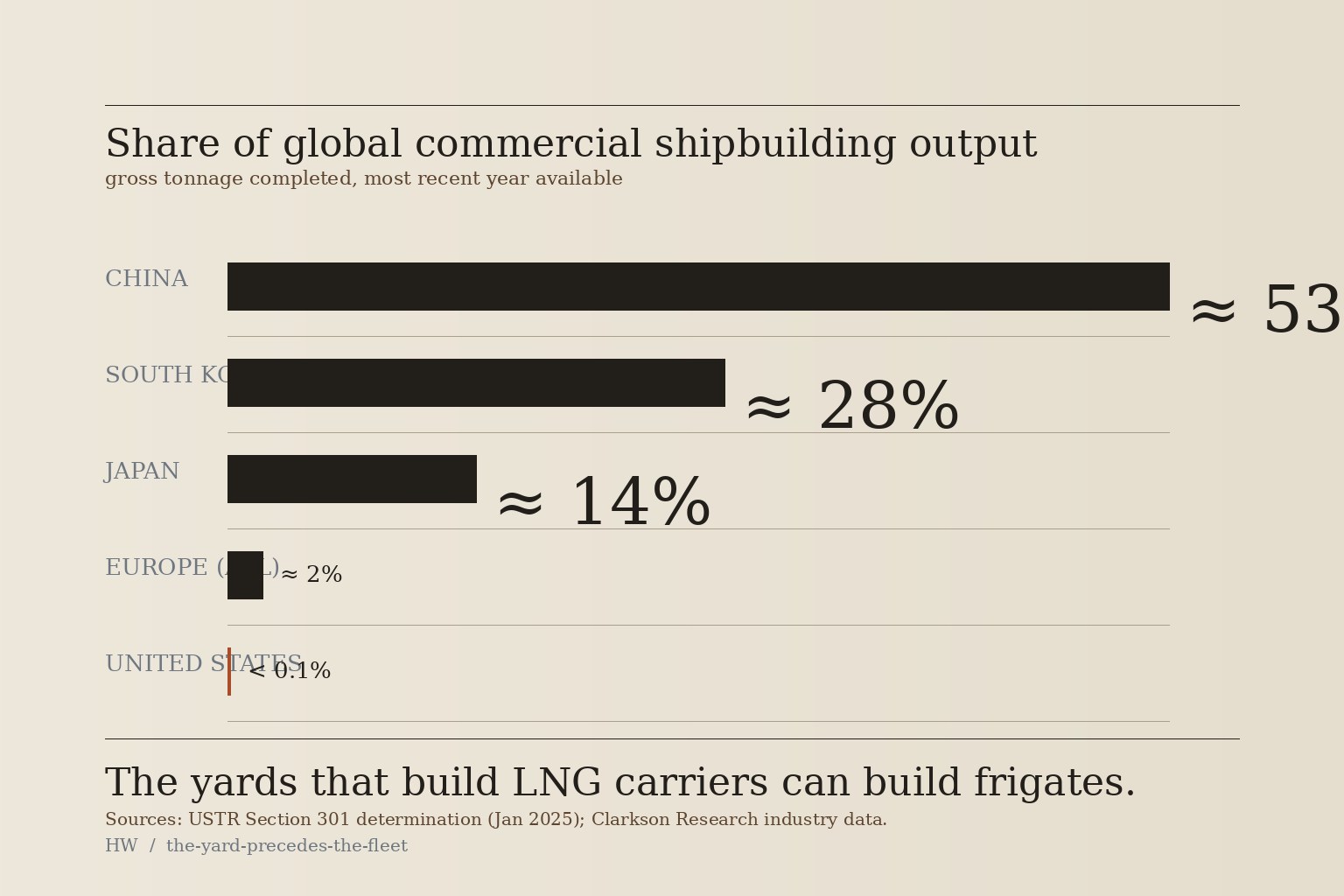
The United States Trade Representative’s Section 301 determination on Chinese maritime, logistics, and shipbuilding sectors, issued in January 2025, is careful, procedural, and quietly devastating. It records that China’s share of global commercial shipbuilding rose from less than 5% in 1999 to over 50% by 2023, that this ascent was engineered through decades of state support, and that Chinese yards now function as an integrated industrial base capable of producing both civilian and naval tonnage.[1]
South Korea and Japan absorb most of what China does not; European yards survive in specialised niches such as cruise ships and offshore vessels; the American commercial shipbuilding industry has become a rounding error. The Congressional Research Service records that the U.S. commercial shipbuilding industry produces roughly five large ocean-going ships per year, compared with over a thousand in China.[2]
These are not embarrassing details. They are the geometry of the next fifty years of Pacific power.
Yards Are Not Interchangeable With Ships
A common Washington reply is that commercial shipbuilding and naval shipbuilding are separate industries with separate skills. That reassurance is precisely half true, and the wrong half is decisive.
A yard is not a single machine. It is an ecology: heavy plate suppliers, welders trained on hulls larger than city blocks, propulsion integrators, cable and pipefitting industries, dry docks measured in football fields, cranes rated in the hundreds of tonnes, and a workforce that shows up because the yard has work. Naval combatants demand more specialised systems — combat management, missile silos, quiet propulsion — but they are built on that same industrial floor, by that same labour pool, using that same steel supply chain.
The Center for Strategic and International Studies has stated the asymmetry with unusual bluntness: leaked internal U.S. Navy documents cited by CSIS assessed that China’s shipbuilding capacity is roughly 232 times greater than that of the United States.[3] That number is not a rhetorical flourish. It is a physical statement about welders, dry docks, and steel throughput.
A country that welds a thousand merchant hulls a year is not merely a country that trades. It is a country that could, in an emergency, weld warships. A country that welds five is not.
The American Contradiction
The United States Navy currently plans a fleet in the mid-three-hundreds. The commercial yard base that would once have supported such a plan no longer exists. The Virginia-class submarine program is running years behind schedule; the Constellation-class frigate has slipped repeatedly; the Ford-class carrier is a lesson in yard concentration risk. The Congressional Budget Office and CRS have both flagged that Navy shipbuilding faces a compounding delivery problem driven by workforce shortages, supplier fragility, and the loss of a commercial pipeline that once trained the trades.[2]
Washington’s response has been characteristic: paperwork. In April 2025, USTR announced port service fees on Chinese-built and Chinese-operated vessels calling at U.S. ports, phased in over the following years.[4] The fees may irritate Chinese owners and burden American importers. They will not, in themselves, build a single new dry dock. A tariff is not an industrial policy. A hull is.
At the same time, South Korea’s Hanwha Ocean bought Philadelphia’s Philly Shipyard in December 2024 for roughly one hundred million dollars, in a bid to enter the American shipbuilding market through the Jones Act door.[5] The transaction has been welcomed in Washington as reindustrialisation. It is more precisely an admission: the country that once built the Liberty ships now buys its yard revival from an Asian conglomerate.
The Second-Order Consequences
This is not a story about ships. It is a story about the political economy of coercion.
First, allied dependency deepens. The American naval renewal, if it happens, will depend heavily on Korean and Japanese yards, Korean and Japanese welders, and Korean and Japanese supply chains. That is a strategic asset until it is a strategic vulnerability. Seoul and Tokyo will price accordingly.
Second, sea lane politics tilt. A country that dominates commercial shipbuilding also disciplines the commercial fleets that use its yards for repair, retrofits, and financing. Insurance markets, classification societies, and port service revenues follow the industrial base. Ownership of the workshop bends the market that circulates around it.
Third, deterrence quietly reprices. In a Taiwan scenario, sortie rates, attrition, and battle damage repair become as important as the initial force ratio. The side that can absorb losses and put ships back in the water is the side that outlasts the other. Attrition is a yard problem before it is a naval problem.
Fourth, Europe is largely irrelevant to the equation. Continental yards survive by making things Chinese yards do not yet care to make. That is a boutique posture, not a strategic one, and it will not scale into any serious blue-water capability if the Atlantic guarantor thins out.
What Would Adult Policy Look Like
Not slogans about “reshoring”. Not another executive order pretending to conjure a workforce. Shipyards are twenty-year investments in trades, tooling, and trust. They cannot be summoned in a speech.
Serious policy would treat the commercial yard base as strategic infrastructure on the same footing as semiconductor fabs, and finance it accordingly — through sustained procurement pipelines, apprenticeship at scale, plate mill and forging capacity, and a Jones Act reform honest enough to admit that protection without productivity is just a subsidy for scarcity.
It would also mean, uncomfortably for Washington, buying the truth: that in a serious conflict, the yards of Ulsan, Geoje, and Nagasaki are as strategically important as any American base, and that the political economy of alliance in this century runs through steel plate before it runs through communiqués.
Watchpoint
Watch the order book, not the headlines. Watch which yards are booked into the 2030s, which flag states are switching, and where LNG carriers — the most technically demanding civilian hulls short of an aircraft carrier — are being placed. Watch also for the moment when a Chinese state yard delivers a merchant vessel and, in the adjacent basin, floats out a frigate whose paint is still fresh.
The fleet in the water is the past. The fleet in the order book is the future. On present arithmetic, the future is not being written in English.
Sources
[1] Office of the United States Trade Representative, Report on China’s Targeting of the Maritime, Logistics, and Shipbuilding Sectors for Dominance (Section 301 determination, 16 January 2025): documents the rise of China’s share of global commercial shipbuilding from less than 5% in 1999 to more than 50% by 2023 and describes decades of state support.
https://ustr.gov/about-us/policy-offices/press-office/press-releases/2025/january/ustr-releases-section-301-report-chinas-targeting-maritime-logistics-and-shipbuilding-sectors
[2] Congressional Research Service, Navy Force Structure and Shipbuilding Plans: Background and Issues for Congress (recurring report, most recent update 2025): sets out U.S. commercial shipbuilding output at a handful of large ocean-going vessels per year and details compounding delivery problems for Virginia-class submarines, Constellation-class frigates, and other combatants.
https://crsreports.congress.gov/product/pdf/RL/RL32665
[3] Center for Strategic and International Studies, ChinaPower Project, How is China Modernizing its Navy?: cites leaked U.S. Office of Naval Intelligence figures assessing Chinese shipbuilding capacity at roughly 232 times that of the United States, with China’s largest state yards operating civilian and naval production in adjacent basins.
https://chinapower.csis.org/china-naval-modernization/
[4] Office of the United States Trade Representative, Notice of Action in Section 301 Investigation on China’s Maritime, Logistics, and Shipbuilding Sectors (April 2025): announces port service fees on Chinese-built and Chinese-operated vessels calling at U.S. ports, phased in over subsequent years.
https://ustr.gov/about-us/policy-offices/press-office/press-releases/2025/april/ustr-announces-action-restore-american-maritime-dominance
[5] Reuters, South Korea’s Hanwha completes acquisition of Philly Shipyard (December 2024): records the roughly one-hundred-million-dollar acquisition of Philadelphia’s Philly Shipyard by Hanwha Ocean and Hanwha Systems as a route into the U.S. Jones Act market.
https://www.reuters.com/business/aerospace-defense/south-koreas-hanwha-completes-acquisition-philly-shipyard-2024-12-20/