This is progress, though of a slightly humiliating kind. For two years the market sold a cheaper myth. Put a model next to the learner, the story went, and education becomes abundant: instant explanation, instant summary, instant answer, instant relief. One could almost hear the old dream of magical knowledge returning in silicon dress. Why struggle through the proof, the paragraph, the translation, the equation, when the machine can hand over the neat result in five seconds?
Because if the effort disappears, the education disappears with it. That is the part a great many investors, optimists, and overexcited school administrators had to rediscover the hard way. Learning is not the transfer of a finished object from one skull into another. It is the slow alteration of attention. It requires trial, retrieval, error, embarrassment, reformulation, and the mildly offensive experience of not yet being able to do the thing. Remove too much of that friction and you do not get mastery. You get a better-dressed form of dependency.
The answer machine ran into the nature of the task
This was always the structural problem with the first wave of education-AI rhetoric. The tools were excellent at producing the visible residue of learning: the solved problem, the cleaner sentence, the finished outline, the passable explanation. What they could not guarantee was that the student had done the internal work that gives those outputs meaning. A child who asks for the answer and receives it may submit homework. He may even receive a mark. But the mark will be sitting on a void.
A proper tutor has always known this. The tutor's job is not merely to possess the answer, but to regulate when the answer arrives. Too early, and the student's mind collapses into imitation. Too late, and frustration curdles into despair or boredom. Good teaching lives in the interval. It is a pacing art. One asks, nudges, rephrases, withholds, offers a smaller clue, points to the error without stealing the discovery. This is not inefficiency. It is the whole mechanism.
Which is why the new turn in the sector is so interesting. The machine is being pushed, reluctantly, toward the manners of a decent teacher.
The serious firms are adding friction on purpose
Anthropic's education launch said the quiet part aloud. Its new Learning mode, the company wrote, is designed to guide students' reasoning rather than simply provide answers. The product description is refreshingly un-magical. Instead of immediate solutions, the system is meant to ask things like, “How would you approach this problem?” and to support independent thinking by holding the answer at a slight distance.
Sal Khan, who has had more time than most to watch what students actually do with these systems, puts the matter even more bluntly. In a recent note on Khanmigo's redesign, he contrasts “cognitive offloading” with “cognitive onloading.” The revised product now asks students to explain how they arrived at an answer and tries to make what he calls “productive struggle” harder to sidestep. That sentence deserves to be engraved onto the forehead of half the ed-tech industry. The useful tutoring machine is not the one that removes the struggle. It is the one that preserves it at a tolerable level.
This is the paradox now settling over the field. The closer these products get to real educational value, the less they resemble a universal answer engine. They become slower, more Socratic, more irritating in the right way. They begin to understand that the premium feature is not omniscience but restraint.
Restraint is not a bug here. It is the pedagogy.
There is a wider lesson buried in this, one that matters beyond schools. We have spent the last decade training ourselves to treat speed as proof of intelligence. Fast search, fast chat, fast synthesis, fast completion, fast life. Education remains one of the last domains stubborn enough to remind us that acceleration and understanding are not identical twins. Often they are enemies. The student who reaches the answer too quickly may have learned less than the one who sat with the problem for ten untidy minutes and got there second.
In that sense, the classroom is where the broader AI argument becomes morally concrete. What do we actually want a machine to do for a human being? Replace the difficult part, or accompany it? Collapse the interval between question and solution, or help a person inhabit that interval with more courage and structure? These are not minor product questions. They are anthropological ones. They decide what kind of creature the user is allowed to remain.
The vulgar market answer is obvious: convenience sells. Parents under pressure, schools with thin staffing, students trained by platforms to expect instant service, administrators promised efficiency gains by men in expensive trainers. An answer machine is easy to market because it flatters everybody at once. It flatters the student by reducing effort, the parent by reducing anxiety, the school by suggesting scale, and the company by turning intelligence into throughput.
The trouble is that education cannot finally be outsourced in that form without becoming counterfeit. One may outsource the performance of learning. One cannot outsource the becoming.
The real test is whether the delay is honest
So the question now is not whether companies have learned to use the word Socratic in their launch copy. God preserve us from that theatre. The question is whether the product genuinely defends the student's encounter with difficulty, or merely stages a decorative delay before yielding the same answer two lines later.
Honest friction has a few recognizable signs. It asks the learner to attempt before receiving. It requests explanation, not only selection. It makes reasoning visible to the teacher. It helps break a problem into steps without stealing authorship. It keeps the answer accessible eventually, but not cheaply. Above all, it refuses to confuse a polished output with comprehension.
That means the best education AI may end up looking less glamorous than the general assistant. It may feel slower. It may annoy impatient users. It may even produce worse immediate satisfaction scores. Fine. A gym is also, in its way, a badly designed sofa. The point is not comfort. The point is transformation under load.
A tutor worth having slows you down at the right moment
I suspect this is where the whole field will eventually have to arrive. The machine's educational legitimacy will depend less on how much it knows than on how well it calibrates tempo, difficulty, and silence. In other words: less like a database with manners, more like a tutor who understands that timing is part of truth.
There is something almost comic in this return. After all the grand promises of synthetic cognition, the industry is rediscovering a very old human fact: the answer is often the least important thing a teacher gives. More important are the cue, the pause, the insistence that the student say it in his own words, the refusal to let understanding arrive dressed as copying.
A civilization that still wants educated adults should take that rediscovery seriously. The machine will be most useful in the classroom not when it performs intelligence at the student, but when it protects the conditions under which intelligence can slowly form inside the student. The answer, in other words, must often arrive later.
Sources
Anthropic, Introducing Claude for Education: launch of Claude for Education and Learning mode, described as guiding students' reasoning rather than simply providing answers.
anthropic.com / Claude for Education
Sal Khan, Khanmigo's first chapter changed how I think about AI: on moving from “cognitive offloading” to “cognitive onloading,” prompting students to explain their thinking, and making productive struggle harder to sidestep.
blog.khanacademy.org / Khanmigo's first chapter
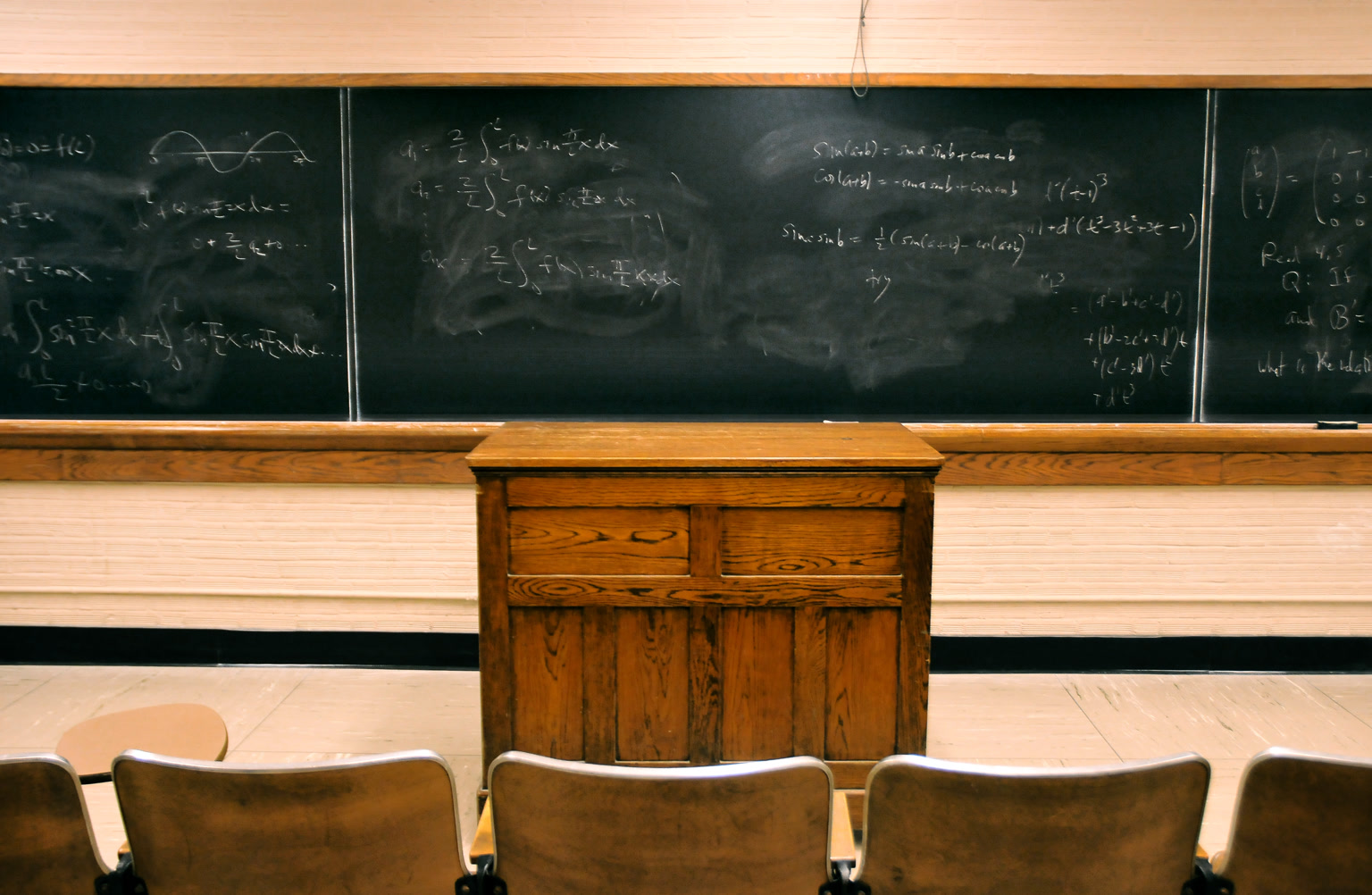
Wikimedia Commons, Classroom blackboard at Cornell University, Ithaca, NY 25, photo by LBM1948, CC BY-SA 4.0: image used for this essay.
commons.wikimedia.org / classroom blackboard
