The world has agreed on something historically rare. Governments, boards, central banks, environmental movements, and defence establishments have all converged on the same plan: electrify more of modern life, push more electrons through a grid that was mostly built for a slower century, and let the resulting flows carry everything from compute to transport to heating. The chips get the magazine covers. The batteries get the subsidies. The transformers get the three-year waiting list.
A large power transformer, or LPT in the trade, is a steel-and-copper box that steps voltage up at a generating station and down at a substation. There are roughly fifty-five thousand of them operating on the North American bulk grid alone. Each weighs between one hundred and four hundred tonnes. Each has, in normal times, taken somewhere between eighteen and thirty-six months to build. In 2026, “normal times” no longer exist. Lead times on new LPTs above one hundred megavolt-amperes have stretched to between three and five years. Smaller distribution transformers — the kind that sit on pole tops and in neighbourhood boxes — have reached around one hundred and twenty weeks. Prices have roughly doubled since 2020, and in some tenders have tripled.[1][2]
This is not a procurement curiosity. It is the material constraint behind every current narrative about the next ten years of the global economy.
Three fires, one piece of steel
The convergence that produced the transformer bottleneck is the first thing to see clearly.
The first fire is the AI buildout. A single hyperscale data-centre campus of the sort being commissioned in northern Virginia, Dublin, Jakarta, Osaka, and the Gulf now draws between five hundred and fifteen hundred megawatts. That load must be delivered through LPTs sized to match it. Dominion Energy’s interconnection queue in Loudoun and Prince William counties alone is sitting on tens of gigawatts of pending data-centre demand, more than the entire installed generation capacity of Ireland.[3] Each gigawatt requires its own transformer stack. The hyperscalers have, in effect, placed an order for roughly a mid-sized European country’s worth of grid every eighteen months.
The second fire is the electrification of transport and heat. The EV fast-charging corridor, electric trucking, heat pumps at residential scale, and the slow Europeanisation of American rail all pass through the distribution grid that was sized in the 1960s for a quiet residential load. Entire feeders are being re-rated at two to five times their original flow. Every one of those upgrades needs a transformer.
The third fire is renewables. Offshore wind, utility-scale solar, grid batteries — none of them deliver a single kilowatt-hour until the step-up transformer at the collection substation is in place. Much of Germany’s 2024 and 2025 offshore wind programme was renegotiated not around turbines but around transformer slots at Siemens Energy and Hitachi Energy. The intermittency of renewables also demands dense new interconnections, each one its own transformer.[4][5]
Three queues, one bottleneck.
The quiet manufacturing map
The world’s capacity to make large power transformers is extraordinarily concentrated. On paper there are many manufacturers. In practice, at the heavy end, there are four serious Atlantic and Pacific players: Hitachi Energy (headquartered in Zurich, the former ABB power-grids business), Siemens Energy (Germany), GE Vernova (United States, newly spun out of General Electric), and Hyundai Electric (South Korea). Add Mitsubishi Electric, Toshiba, Prolec GE in Mexico, and India’s CG Power and BHEL, and that is substantially the globally certified non-Chinese universe.
Then there is China. TBEA, China XD Electric, CSG Smart Science & Technology, Baoding Tianwei, and a long tail of regional makers now produce something close to forty percent of global transformer units by volume. Chinese plants are expanding faster than any Western equivalent. They do not meet Atlantic grid-certification regimes in many Western markets, but they are the dominant and often the only serious supplier across the Belt-and-Road belt — Pakistan, Bangladesh, Indonesia, Vietnam, significant parts of Africa, and increasingly the Gulf.[6][7]
More interestingly, China has captured the layer upstream of transformer manufacturing itself: grain-oriented electrical steel, or GOES. GOES is the specialised silicon steel whose crystalline grains are aligned so that magnetic flux moves through the transformer core with minimal loss. It is to the transformer what high-purity polysilicon is to a solar panel. Only a handful of mills in the world make it at commercial scale and acceptable grade: Nippon Steel in Japan, POSCO in South Korea, ThyssenKrupp in Germany (constrained by its own restructuring), Cleveland-Cliffs in the United States at a single Butler, Pennsylvania mill, and — the single largest producer by output — Baoshan Iron & Steel (Baosteel) of China. Chinese GOES capacity now exceeds the combined output of all other producers.[8]
Western transformer plants, when they want to expand, often cannot source enough high-grade GOES without buying from a Chinese mill. That is the sentence to sit with. The AI data centre in Loudoun County depends on a Hitachi Energy transformer plant in South Carolina, which depends on grain-oriented electrical steel partly sourced from Baosteel in Shanghai.
Lead time as geopolitics
A three-to-five-year lead time is not a procurement schedule. It is a political variable.
When Washington wants to accelerate AI infrastructure for national-security reasons, it runs into the fact that Hitachi Energy’s Columbia, South Carolina LPT facility is booked through the end of the decade. When Berlin wants to deliver a credible 2030 offshore wind target, it discovers that Siemens Energy’s Nuremberg transformer plant has committed its slots to German utilities three cycles out. When Jakarta’s PLN wants to connect West Java’s coal retirement to new solar capacity, it discovers that TBEA will deliver faster than any Western supplier, with Chinese financing attached. One hundred and ninety countries have now made some version of this discovery in sequence.
The second-order effect is dependency convergence. States that cannot wait buy from China. States that buy from China inherit Chinese standards for grid architecture, protection relays, supervisory-control software, and increasingly Chinese operation-and-maintenance contracts. A transformer is a Trojan substation: once installed, it is on the grid for forty years, and the whole adjacent equipment chain tends to follow it.
The third-order effect is a slow bifurcation of grid standards. The Atlantic belt is building to IEEE and IEC specifications. The Belt-and-Road belt increasingly builds to Chinese GB standards. These are not fully interoperable at the control-system layer. In twenty years’ time, significant parts of the world’s electricity infrastructure will not easily accept Western components even if the trade politics loosen, and the political reality that follows from that will be more lasting than any single sanction regime.
The Atlantic response, so far
Washington noticed the problem in 2024. The US Department of Energy’s Grid Deployment Office launched the Transformer Resilience and Advanced Components programme; the Inflation Reduction Act included production credits for domestic GOES and for transformer manufacturing; the 2024 Executive Order on supply-chain resilience named large power transformers as a strategic manufactured good.[1][9]
The industrial response has been real but modest. Cleveland-Cliffs committed roughly one hundred and fifty million dollars to expanding its Butler GOES mill. Hitachi Energy announced a new large-transformer line in Virginia. Prolec GE — now Mitsubishi-owned — is expanding its Monterrey site to serve the North American market under USMCA. Modest, however, is the right word. A single new transformer plant costs between three hundred million and eight hundred million dollars and takes four to six years from announcement to first delivery. The AI load that triggered the alarm will have arrived long before the response does.
Europe is in a worse position. Siemens Energy’s grid business is the healthy half of a company whose gas-turbine arm nearly collapsed in 2023 and whose equity base is still thin. Hitachi Energy is the strongest Western player, but its growth is capital-rationed by Hitachi’s parent-level cash discipline in Tokyo. ThyssenKrupp’s GOES mill in Gelsenkirchen is contested by ongoing restructuring. The French and Italian national suppliers are regional at best. Europe has decided to electrify, has committed hundreds of billions of euros of capex to that electrification, and has not yet seriously funded the industrial base that produces the single piece of hardware without which none of it works.
Where the decade actually goes
If one takes the transformer bottleneck seriously, the next ten years begin to look rather different from the glossy prospectus.
AI capex continues to grow, but it allocates increasingly by where the power — and the transformer slot — can actually be delivered. The Gulf, especially Saudi Arabia and the United Arab Emirates, becomes a major AI-compute geography not because its regulators are permissive but because its state utilities can allocate transformer capacity by sovereign decision. Northern Virginia slows. Dublin constrains. Jakarta accelerates. Hyderabad enters the queue. The map of the next phase of the digital economy is already being redrawn by electricians.
The energy transition continues but moves at the pace governed by substation hardware, not by panel prices or turbine throughput. Solar module costs can keep falling by ten percent a year; it will not matter if the step-up transformer takes forty-two months.
China’s grid standard spreads further. By the early 2030s, a reasonable projection is that more than half of all new substation capacity added worldwide will be built to GB standard, operated with Chinese protection relays, and serviced through Chinese contracts. This is not primarily a sanctions story. It is a lead-time story. Belt-and-Road is, among other things, an industrial-policy response to a lead-time asymmetry.
Europe either builds a serious transformer and GOES programme — most plausibly through a Siemens Energy / Hitachi Energy / ThyssenKrupp industrial pact backed by EU Innovation Fund money and ring-fenced state aid — or it accepts a quiet downgrade of its grid sovereignty. The current pattern suggests the second. The AI Act will arrive on time; the transformer plant will not.
The hidden piece of every era
Every generation of infrastructure has a hidden piece whose constraints are more decisive than the celebrated front-end. In 1900 it was the open-hearth steel furnace. In 1950 it was the ethylene cracker. In 1990 it was the semiconductor photolithography stepper — a machine that still gives one Dutch company, ASML, a quiet veto over the digital century. In the 2020s and 2030s it is the large power transformer and the grain-oriented electrical steel at its heart.
The chip wars will continue to produce the headlines. The transformer wars will decide more about which countries actually get to electrify, which ones run data centres at scale, and which ones can honestly narrate themselves as decarbonising economies rather than merely as consuming ones.
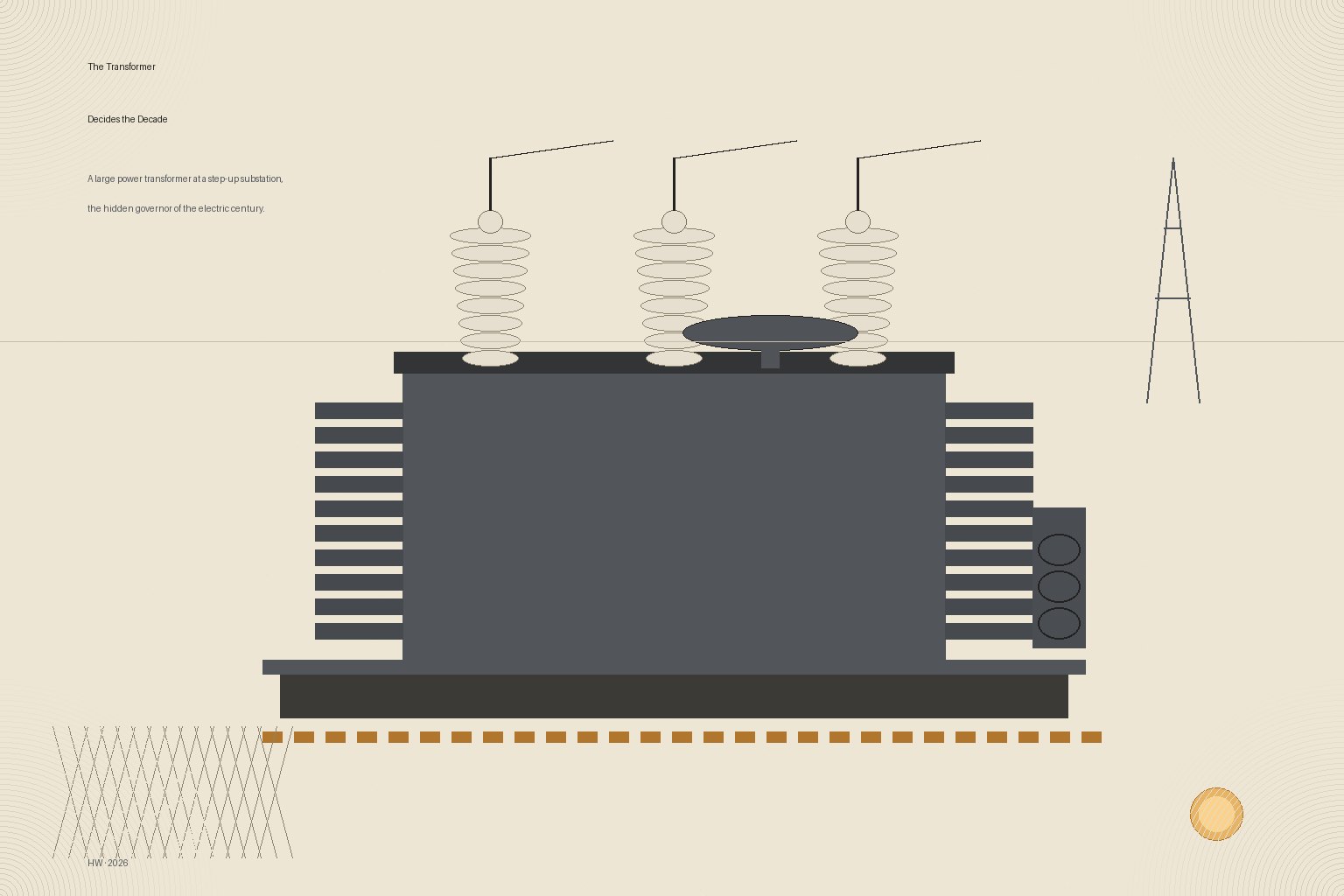
A dull steel box, sitting on a concrete pad behind a chain-link fence, cooled by a bank of radiator fins, surrounded by a dashed yellow safety line. Weighs three hundred tonnes. Takes four years to build. Decides the decade.
Sources
[1] US Department of Energy, Large Power Transformers and the US Electric Grid and the Grid Deployment Office’s Transformer Resilience and Advanced Components programme pages: official framing of LPT lead times, strategic criticality, and the IRA-era production incentives for grid hardware and electrical steel.
energy.gov / Grid Deployment Office — TRAC
[2] Wood Mackenzie, Power transformer supply chain report (2024–2025 editions): tracks LPT lead times rising from under eighteen months pre-2020 to three to five years in 2025, with distribution transformers at or above one hundred and twenty weeks and prices roughly doubled.
woodmac.com / power & renewables
[3] S&P Global Market Intelligence and Dominion Energy’s PJM filings: the composition and scale of the data-centre interconnection queue in northern Virginia, running into the tens of gigawatts of pending load.
spglobal.com / market intelligence
[4] Reuters, coverage of Siemens Energy’s grid-technology order book and Hitachi Energy’s multi-billion-euro backlog growth 2023–2025: useful for the Nuremberg and Zurich capacity picture and the Siemens Energy balance-sheet constraint.
reuters.com / energy
[5] International Energy Agency, Electricity Grids and Secure Energy Transitions (2023), with 2024–2025 updates: the global survey of grid-equipment lead times, interconnection queues, and the specific identification of transformers as a binding constraint on the energy transition.
iea.org / electricity grids
[6] Nikkei Asia and Caixin Global reporting on TBEA, China XD, and Baoding Tianwei: Chinese transformer capacity expansion, Belt-and-Road substation contracts, and GB-standard proliferation across Southeast Asia and Africa.
asia.nikkei.com
[7] International Copper Study Group and BloombergNEF, Grid equipment and electrification demand outlooks: cross-checks on the physical materials base — copper, electrical steel, insulating oils — required to build out global transformer capacity to meet announced electrification targets.
bnef.com
[8] Steel Business Briefing / Fastmarkets coverage of grain-oriented electrical steel: Baosteel, Nippon Steel, POSCO, ThyssenKrupp, and Cleveland-Cliffs capacity shares; GOES as the real bottleneck underneath the transformer bottleneck.
fastmarkets.com / steel
[9] The White House, Executive Order on America’s Supply Chains and follow-on Department of Energy supply-chain reports (2023–2024): identifies large power transformers and electrical steel as strategic manufactured goods, and sets out the policy frame behind the TRAC and IRA incentives.
whitehouse.gov / executive actions