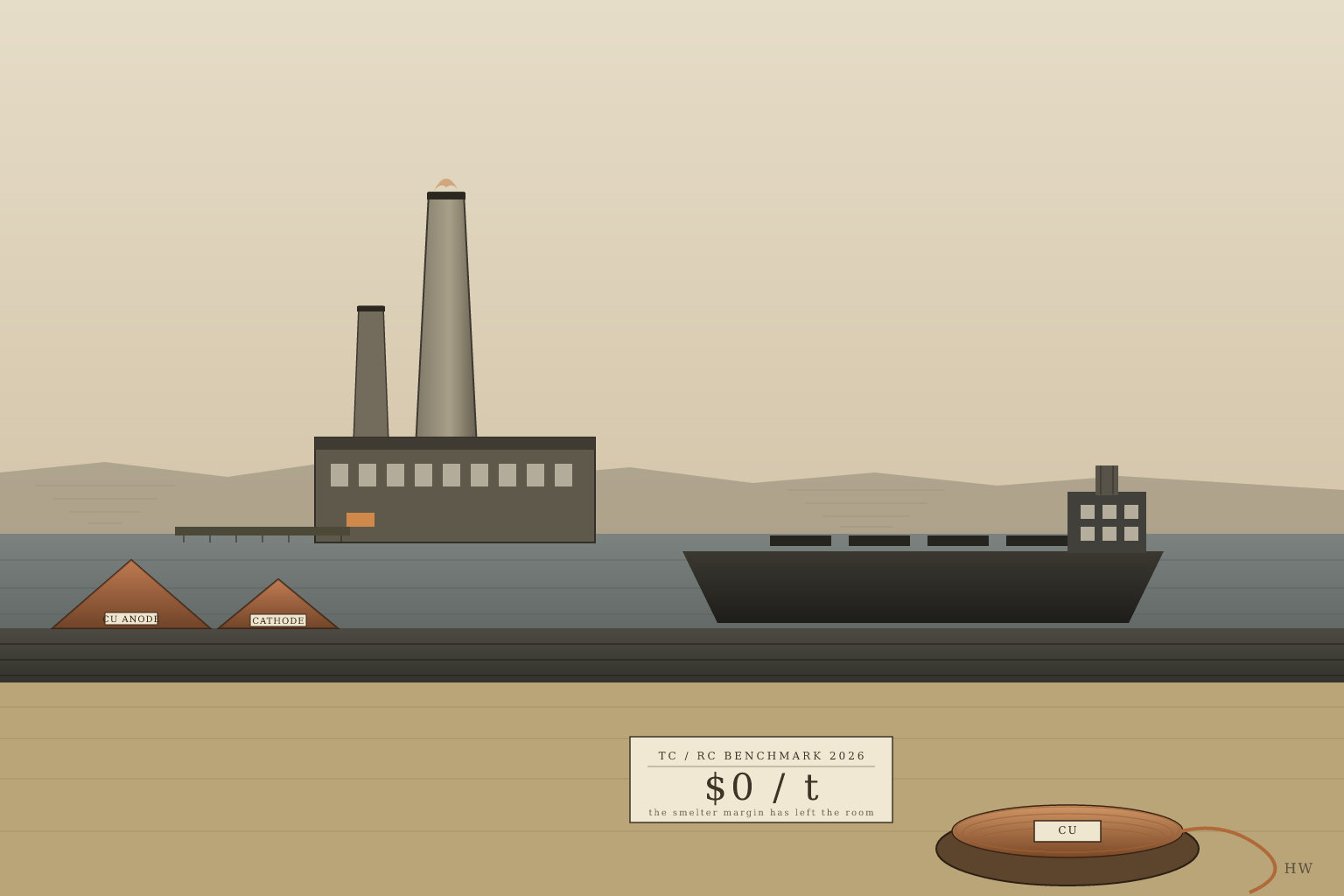
A price of zero is not a market signal. It is a bulletin. When two of the world’s most competent industrial counterparties — a Chilean state miner and a Chinese state-adjacent smelter — sit down for the annual treatment and refining charge negotiation and settle at $0 per tonne, they are not haggling over margin. They are telling the rest of us that the physical scarcity in copper has migrated. It is no longer in the metal. It is in the rock.
The number that broke the smelter
The TC/RC benchmark is the fee a smelter charges a miner to convert copper concentrate into refined metal. For as long as the modern copper trade has existed, that fee has been positive, because turning rock into wire is expensive, slow, and dangerous. In 2015 the number was around $107 per tonne. In 2020 it was $62. In 2024, $80. In 2025, $21.25. In 2026 it settled at zero, in a deal reported first between Antofagasta and China Copper. The Japanese smelters, who used to accept the Chinese number, are now trying to break away and negotiate their own; the last Japanese benchmark held at $25, and 2026 even for them will be below it.
A zero benchmark means one thing in blunt terms. The Chinese smelter, on this contract, will earn no money for processing the ore. It has to make its return either from selling by-products — sulphuric acid, gold, silver — or by absorbing the loss and pricing the cost of that loss into something else. In an ordinary industry that would trigger closures. In this industry it has not, because copper concentrate is now scarce enough, and downstream Chinese demand strategic enough, that the smelter chooses to run at zero rather than idle capacity that would then never be rebuilt at cost.
What actually happened to the mines
The instinct is to reach for the tariff explanation, or for the AI-data-centre-load explanation, or for the electric-vehicle explanation. Each is partly true. None of them is what broke the concentrate market. The concentrate market broke because the mines that were supposed to feed the smelters in 2026 are not producing what they were supposed to produce.
Codelco, the Chilean state copper company, historically the single largest miner on earth, reported 1.31 million tonnes for 2025. That is a 19% decline from the 1.62 million tonnes of 2021. Then in May of this year an internal audit found that roughly 26,875 tonnes had been booked as finished product without meeting the criteria; the restated 2025 figure is the lowest annual output for Codelco since 1998. The company’s longstanding ambition to return to 1.7 million tonnes by 2030 has been openly abandoned. Its own 2026 guidance is between 1.331 and 1.357 million tonnes. The state responded in May by announcing a $2.4 billion reinvestment programme; it also confirmed that the Andes Norte expansion of El Teniente is suspended for at least two years. Then on 31 July, at the Andesita section of El Teniente, an accident killed six workers, injured nine, and shut the mine for over a week.
Cobre Panamá is a different kind of story with the same effect. The First Quantum mine, which used to supply about 1.5% of global copper, was ordered shut in 2023 after the Panamanian supreme court voided its concession; its closure removed an estimated 4.5% of Panama’s GDP in a single regulatory action. In April 2026, Panama authorised First Quantum to begin processing and exporting the roughly 70,000 tonnes of already-mined material sitting on-site. In June an independent audit gave the mine an overall 88% compliance score. In August the government was still consulting on a scheme that would spin up a state mining company to partner with the Canadian operator on any future restart. This is what “waiting” costs the copper market: the metal exists, in Panama, in known geology, in a plant built for it — and it is stalled in political limbo while the world’s smelters starve.
Kamoa-Kakula, the Congolese complex run jointly by Canada’s Ivanhoe (39.6%) and China’s Zijin (39.6%) with a 20% DRC state stake, is the swing project of the decade. In 2024 it was on a trajectory towards 420,000 tonnes for 2026. Then a seismic event flooded part of the Kakula orebody. Guidance was cut to 330,000, and this year cut again to 290,000 to 310,000 tonnes in anode, blister, or saleable slag concentrate. The complex’s own smelter, commissioned on 1 December 2025, is now selling more copper in 2026 than it mines, because it is drawing down concentrate stock the mine can no longer replace at pace. Grade decline is doing the rest quietly. Global average copper ore grade has fallen from above 1% to below 0.6% in a generation; every marginal tonne of refined metal now requires nearly twice as much rock moved as it did in 2000.
The China stack in the middle
Between the mine and the wire sits a piece of infrastructure most people do not think about, because it is unlovely and it happens abroad: the smelter. Since 2005, China has accounted for more than 90% of the growth in global copper smelting capacity. By 2025 it controlled roughly half the world’s installed capacity. China now consumes about 58% of global refined copper, and it is the terminal buyer for a large share of the concentrate produced everywhere else. When the world’s copper concentrate market tightens, it tightens against a Chinese counterparty who has already decided that domestic wire, motors, transformers, and electric vehicles are the point of the industrial policy — not the smelter’s income.
A zero-dollar benchmark, seen this way, is a subsidy. Chinese smelters are agreeing to earn nothing on the conversion step so that Chinese downstream industries continue to receive refined metal on manageable terms and Chinese refining capacity does not idle. It is not the first time a Chinese industrial policy has priced through the P&L of one node to protect the P&L of the whole. Solar cells worked this way. Battery cathodes worked this way. Ship hulls worked this way. What is new about copper is that, unlike ships or panels, copper cannot be substituted at the last node. Aluminium can carry some current, but it cannot replace the coil in a motor or the winding in a transformer. If you want to electrify heat, transport, industry, and computation, you need copper. If the smelter that sets the world’s reference price for turning ore into copper works for free, you are, in effect, receiving a small transfer from Chinese state balance sheets every time you build a substation, and the price of losing that transfer is being locked out of an infrastructure you cannot rebuild on your own timetable.
Cycle time as a strategic weapon
This would still be a manageable situation if the West could simply respond by building more mines and more smelters. It cannot. Not because it lacks capital or geology; both exist. It cannot because a copper mine takes, on average, between fifteen and twenty years from discovery to first production, and a large smelter, once permitted, takes another five to seven years to commission and ramp. This is the material equivalent of the semiconductor lesson Europe pretended to learn: infrastructure that takes a generation to build cannot be summoned in one electoral cycle by press release.
The last decade offered a window to permit and build the mines that would supply the 2030s. Most of that window was spent, in the West, on climate targets denominated in emissions rather than in the metal, cement, cable, and chemistry required to deliver them. It was spent litigating Cobre Panamá and Resolution and Pebble and Rosia Poieni, revoking concessions after capital was sunk, and calling the resulting mine closures moral victories. It was spent, in Europe, on tightening permitting for the very projects the European Battery Alliance and the Critical Raw Materials Act would then formally list as strategic. Meanwhile Chinese state companies quietly wrote cheques into the DRC, Zambia, Serbia, Peru, and Kazakhstan, and Zijin, MMG, CMOC, and CNMC took long positions in the supply that would matter in 2030. In 2026 that positioning is billing.
Where the metal actually goes
A single AI data-centre campus of the size now being built in Virginia, Ohio, Ireland, and Malaysia can require between 50,000 and 120,000 tonnes of copper across its transformers, busbars, cabling, and cooling. A modern battery electric vehicle uses roughly 60 to 80 kilograms of copper, against about 20 for an internal-combustion car. An offshore wind farm carries around 8 tonnes of copper per megawatt of installed capacity, most of it in cabling that is not recyclable in economic time. A single kilometre of high-voltage direct-current cable carries about 50 tonnes. Every one of these numbers has been growing since 2020 and none of them are elastic to price the way historical demand modelling assumed. You cannot decide, at $12,000 a tonne, that a substation will simply do with less copper. You can only defer building it, and, at scale, deferring copper-intensive infrastructure means slowing the electrification of the underlying economy.
The IEA said as much this year in more careful language. The International Copper Study Group forecasts a 150,000-tonne refined deficit for 2026. J.P. Morgan puts the number at 330,000. The direction is the same. What is beneath both estimates is the observation, now openly stated, that mine supply and not smelter capacity is now the binding constraint on the global refined copper market. This is the first time in the modern industrial period that this has been true for a strategic metal at the scale of copper.
The oil parallel, and the one that does not hold
It is tempting to reach for the oil analogy, and half of it works. Like oil in the 1970s, copper has become a bottleneck whose politics run downstream through every other industry. Like oil, it is concentrated in a handful of geographies whose domestic politics can remove entire percentage points of world supply overnight. Like oil, a stubborn mismatch between long build cycles and short political cycles has been storing up its structural squeeze for years.
The half that does not work is more interesting. OPEC controlled the wellhead but never controlled the refinery. Copper in 2026 is closer to a case where a single power controls both an increasing share of the mine and half the smelter, and where the counter-power — the West and its allied miners — is left running mines it did not modernise in time and smelters it half-dismantled during the decade it decided industry was somebody else’s problem. The 1970s ended with strategic petroleum reserves and demand destruction. There is no strategic copper reserve. You cannot burn less copper the way you can burn less oil. You can only build less of the future the metal is used to build.
What a serious response would even look like
This is where the Weekly Reflections tone has to give way to something colder. A serious European or American response to a zero-dollar TC/RC benchmark is not a subsidy package or a public relations campaign about a “critical minerals strategy”. It is three things at once, and each is uncomfortable.
First, permitting reform whose brutality would embarrass a normal legislature. The mines that will matter in 2035 have to be approved this decade. In most Western jurisdictions the current process cannot deliver that under any reasonable extrapolation. If Europe is not prepared to permit new mines in Portugal, Sweden, Spain, and Serbia at speed and on hard, contestable, but time-boxed terms, it is choosing to import its future copper on Chinese smelter terms. That is a sovereign choice, but it should be an honest one.
Second, smelter capacity as public infrastructure. Aurubis in Hamburg is a serious operation and it is essentially alone in Europe. The United States has demolished more primary smelters than it has built in half a century. If a state considers electrification a matter of national strategy, it has to consider primary copper conversion in the same category, with the same tools: guaranteed offtake, land, energy contracts, and a shielded political frame that outlasts any one administration. The alternative is to source refined metal in a market where the counterparty has already priced its own margin to zero.
Third, recycling as a first-class metal source. Every substation, transformer, and cable already installed in the West is, in effect, a slow above-ground mine. Secondary copper now supplies roughly a third of global demand and could plausibly supply more, but the systems to collect, sort, and smelt it back to grade have been left to private markets that treat scrap as a nuisance rather than an asset. This is the single easiest lever, and the one Europe is slowest to pull.
The line between metal and morality
None of what precedes is an argument against caring about the ecological and human cost of mining. It is an argument against the peculiar Western pretence that one can decarbonise an economy while refusing to open the ground under it. If a country wants a wired future, it is going to move rock. The only question is whose rock, on whose terms, mined under whose regulator, protected by whose labour law, and priced by whose smelter. Refusing to answer any of those questions is not a moral position. It is a delegation of authority to whoever will answer them.
Two Tuesdays ago the argument on this page was about India shipping the state as a set of open protocols while Europe was still drafting the specification. Yesterday, in effect, was about the same asymmetry translated into digital rails. Today is the same asymmetry translated into metal. A protocol is a way of shipping the state on the wire. A cable is a way of shipping the state in the wall. Neither is an accident of taste. Both are a question of who is willing to build, and who prefers, at the middle of the decade, to stand at the counter and pay whatever the shipper decides to charge.
Watchpoint
Two dates will tell more than any macro forecast. The first is whenever, this autumn, Panama’s cabinet finally decides on the state-partnership model for Cobre Panamá. A restart at scale removes the largest single stranded asset from the copper balance sheet. Continued stalling means the 2027 concentrate market opens even tighter than 2026. The second is the resolution of El Teniente’s Andesita investigation and the Chilean state’s response. If Codelco’s decline is confirmed as structural rather than accident-driven, the Chinese smelter’s 2027 benchmark negotiation will start from below zero. There is already a phrase for that in the trade: negative TC/RCs. It means the smelter would pay the miner to have the ore. That is not a hypothetical any more. It is a live scenario for 2027, and it is a bulletin about what has happened to the world’s single most important industrial metal.
Sources
Crux Investor, Zero-Dollar Treatment Charges Signal a Multi-Year Mine Supply Shortfall & Lift Copper Project Values, 2026.
cruxinvestor.com / zero-dollar TC/RC 2026
Fastmarkets, Global Copper Smelting: What to Expect in 2026.
fastmarkets.com / smelter outlook 2026
Kitco News, Japanese copper smelters seek 2026 TC/RCs different from China-set benchmarks, November 2025.
kitco.com / Japanese TC/RCs 2026
International Energy Agency, Copper prices have hit record highs, but smelters face mounting strategic pressures, 2026.
iea.org / copper smelters 2026
International Energy Agency, Global Critical Minerals Outlook 2026, executive summary.
iea.org / critical minerals 2026
Metal.com / ICSG, Global Refined Copper Market to Face a Supply Deficit of 150,000 mt in 2026.
news.metal.com / ICSG 150kt deficit
Bloomberg, Codelco Copper Overstatement Implies Output Sank to 27-Year Low, May 2026.
bloomberg.com / Codelco 27-year low
Fastmarkets, Chile backs Codelco with $2.4 bln reinvestment as El Teniente output falls to 25-year low, Andes Norte suspended two years, 2026.
fastmarkets.com / Codelco reinvestment
Mining Weekly, First Quantum’s shuttered mine passes audit, as Panama weighs restart, June 2026.
miningweekly.com / Cobre Panamá audit
Rio Times, Panama Considers a State-Owned Company to Reopen the Cobre Panamá Mine, 2026.
riotimesonline.com / Panama state miner
Mining Weekly, Kamoa-Kakula Copper Complex, Democratic Republic of Congo — update, August 2026.
miningweekly.com / Kamoa-Kakula August 2026
Ecofin Agency, DRC: Kamoa-Kakula Cuts 2026 Output Forecast After Seismic Disruption.
ecofinagency.com / Kamoa-Kakula seismic