A sea is a political object dressed as a geographical one. Whoever builds the ships that sail across it eventually sets its terms. That was true when Venice ran the arsenal and dictated eastern Mediterranean insurance. It was true when Britain rolled the world’s tonnage off Clyde and Tyne. It was true, more briefly than Americans remember, when Kaiser yards in California welded a Liberty ship every four days and made the Atlantic and the Pacific into American administrative zones. The rule is boring and old: whoever holds the shipyards holds the sea.
The numbers that unmake the map
The H1 2026 figures are not a wobble. Chinese yards booked 121.06 million deadweight tonnes of new orders in the first six months, up 173.1% year on year, for an 82.3% share of the global market. Their orderbook stood at 363.25 million DWT at the end of June, up 54.9%, or 71.2% of the world’s outstanding tonnage. South Korea, once China’s serious rival, took 12.8% of new orders in the same period. Japan took 1.4%. Every other builder in the world combined took the sliver that remained.
These are not container-hobby numbers. Chinese yards now hold more than 80% of the market in dry bulk carriers, container ships, and crude tankers, and more than 90% in the largest segments — VLCCs, car carriers, and the ultra-large container ships above 10,000 TEU. Roughly three quarters of the metal that will move oil, grain, iron ore, cars, and consumer goods across the world for the next generation is being cut in one country. The others are running specialty scraps: cruise ships in Italy and Finland, some LNG carriers in South Korea, a shrinking specialist edge in Japan. The bulk work of the sea is Chinese work.
The 232-to-1 ratio
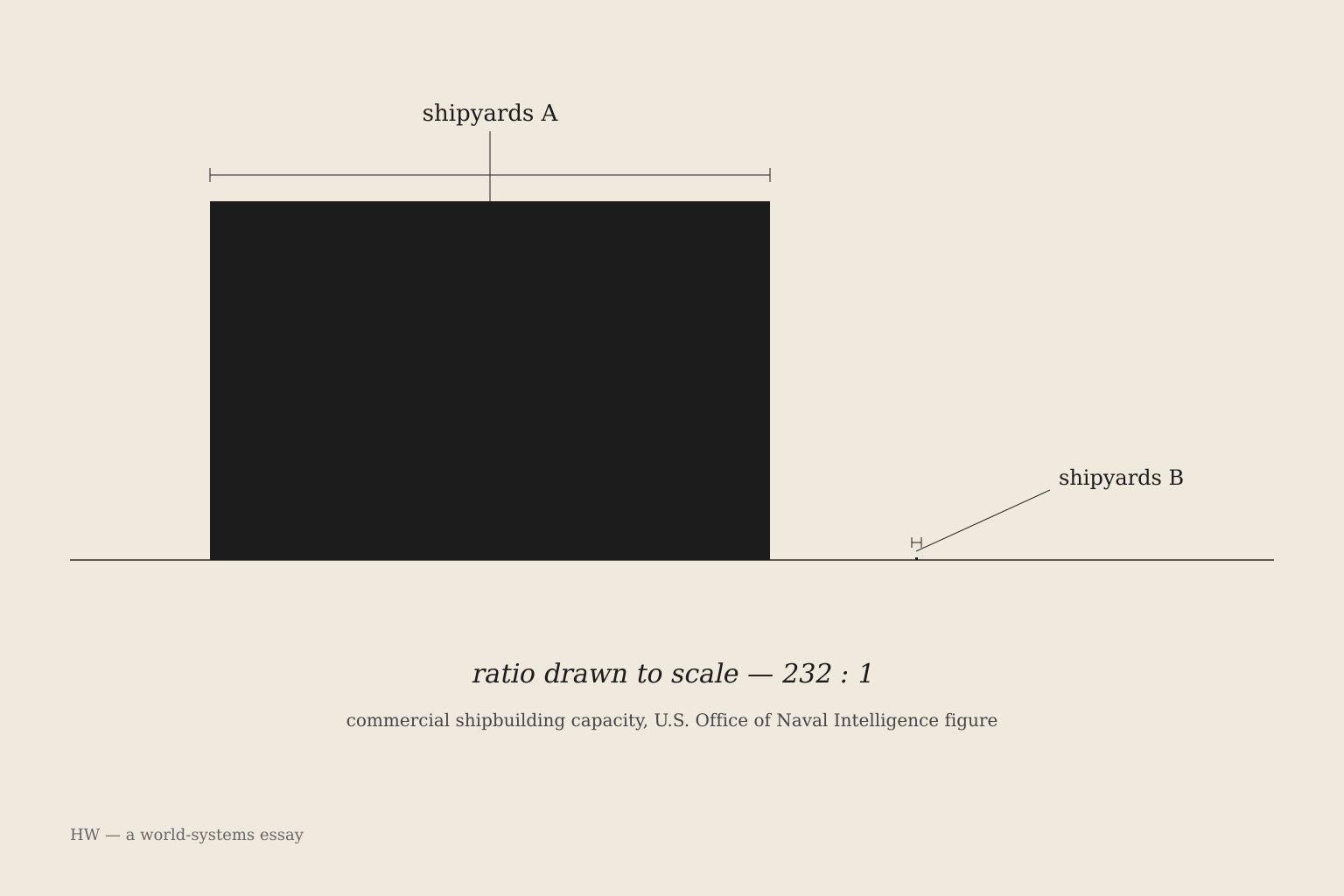
The military edge of this is now openly measured. A leaked 2023 U.S. Navy briefing slide put Chinese commercial shipbuilding capacity at roughly 232 times the American figure — about 23.25 million tonnes of manufacturing throughput on the Chinese side, well under 100,000 on the American side. That number has been reprinted, chewed over, and repeatedly confirmed since, and by 2026 it defines the strategic conversation more than any doctrinal document.
What the ratio really measures is not warships. It is the industrial pond in which warships are built and repaired. The PLA Navy has passed 370 hulls and continues to launch. The U.S. Navy has drifted to roughly 293, below its own 2016 target of 355, and its production line runs on a handful of yards clustered along the Gulf coast and in Virginia, most of them chronically late and personnel-starved. In a peer conflict, damaged ships must go somewhere. In China, they can go to almost any of a hundred yards. In the United States, they can go to a small number of overtaxed facilities that already cannot deliver on peacetime schedules.
This is the McNamara error inverted. The industrial base is not one factor among many. In a long war, it is the war.
The industrial hollow
How did the sea change hands? Not by conspiracy. By the arithmetic of comparative advantage as practised for four decades and then, quietly, weaponised.
American commercial shipbuilding was already dying before it collapsed. The Merchant Marine Act of 1936 and its Jones Act companion protected a domestic-flag fleet on paper while doing very little to keep the yards behind it competitive. Postwar orders drifted first to Europe, then to Japan, then to South Korea, then to China, following labour costs and industrial subsidy. By 2024 the United States accounted for roughly 0.04% of global shipbuilding output, ranked around nineteenth in the world. Europe reached the same terminus by a different route: a specialist niche in cruise and offshore, a strategic dependence on Korean LNG carriers, no serious commercial shipyard capacity to speak of.
China moved the other way. State support, cheap steel, deep engineering benches, a captive domestic order flow through COSCO and China Merchants, and a deliberate policy of consolidation reduced fragmented yards into a duopoly — CSSC and, until its 2019 merger back into CSSC, CSIC — that today builds most of the hulls above 50,000 DWT in the world. The 2026 boom was not lightning. It was a slow, forty-year assembly of every input needed to build a ship: rebar mills, plate mills, engine forges, propeller foundries, welding schools, dry docks, port cranes, financing arms, insurance houses.
The West watched, forgot, deregulated, and outsourced. Now it commutes to the finished product.
Green hulls as a second capture
The politically embarrassing detail is that the H1 2026 boom was disproportionately driven by the transition. About 65% of the Chinese order intake this year is for alternative-fuel vessels — LNG dual fuel, methanol dual fuel, ammonia-ready, and a growing tail of true zero-carbon designs. European regulators wrote the rules that made these hulls mandatory. European operators must place the orders. And the yards that will build them, almost without exception, are Chinese.
This is the perfect closing of a policy loop. Brussels writes maritime decarbonisation into IMO and FuelEU regulations. Beijing writes the invoices. The energy transition, which was supposed to be a great opportunity for European industrial policy, becomes in this dimension the largest transfer of shipbuilding demand ever recorded from Europe to China, executed voluntarily and celebrated as climate leadership. The reader may decide whether this is a scandal, a farce, or the natural consequence of a continent that discovered rulebooks before it lost its foundries.
Second-order effects: registries, insurance, sanctions
The consequences do not stop at the hull. Merchant tonnage disciplines everything above it. When one country builds the ships, that country becomes a decisive customer for engines, coatings, electronics, and classification services. It builds close relationships with Panama, Liberia, and the Marshall Islands, which flag the ships. It builds working relationships with Lloyd’s underwriters, and eventually with its own insurance houses, which is why the People’s Insurance Company and CPIC now write a rising share of hull-and-machinery cover for Chinese-built tonnage. The classification societies — ABS, DNV, Lloyd’s Register, ClassNK, RINA — still hold the standards, but a growing share of surveyors work in Chinese yards. Standards drift where surveyors live.
This matters most for sanctions. Western sanctions on Russian, Iranian, and other “shadow” fleets work only if Western insurers, classification societies, and yards can be pressured. A merchant fleet built and increasingly serviced in China is a fleet that can, on short notice, exit that pressure. The 2022–2026 shadow-tanker experience already showed how quickly a parallel maritime economy can be assembled when the standard one is treated as coercive. The H1 2026 orderbook says that assembly line is now the mainstream.
Steel and time
A world in which one country builds nearly all commercial ships is not a stable world. Historically, dominance of that scale has invited three responses in some combination: replication by rivals, coercion of the dominant power, or accommodation to its terms. Each requires time. Replication is slow — a serious yard is not built in a decade. Coercion is available mainly through control of steel inputs, engine technology, or key ports, all of which China has been diversifying away from Western dependence for years. Accommodation is available cheaply and dishonestly, mainly by pretending nothing has changed.
The United States has begun to react. The SHIPS for America Act, the 2025 executive order restoring the Maritime Administration’s planning function, USTR’s Section 301 investigation into Chinese shipbuilding practices, port-fee proposals on Chinese-built vessels, and Korean and Japanese partnership offers on U.S. yard modernization are all real and all late. A yard needs land, dredged access, cranes, dry docks, a welder-training pipeline, financing certainty, and buyers willing to accept above-market prices for a decade. Congress finds each of those items difficult and all of them together nearly impossible.
Europe has done less. Brussels has begun to speak of a European maritime industrial strategy, but the yards that would execute it have been closed for a generation, and the political appetite to pay for hulls that Chinese yards will build cheaper is, so far, missing. Korea and Japan can offer partnership and a specialist edge, but neither can restore an American or European commercial shipbuilding base that will not exist for another twenty years, if it ever exists again.
What a maritime order priced in hulls looks like
Here is the settled shape of the near future. The physical fleet that carries the world’s goods will be Chinese in build and, increasingly, Chinese in service. The naval fleet that could contest a Pacific war will be smaller in tonnage on the Western side and easier to attrit. The insurance, classification, flagging, and finance system that governs the sea will remain partly Western on paper and gradually more Chinese in practice. And the energy-transition rulebook — the very instrument Europe intended as a strategic industrial lever — will function, at sea, as a subsidy programme for CSSC.
None of this is inevitable in a metaphysical sense. It is inevitable in the sense that reversing it requires industrial choices Western states have refused to make for three or four decades, and there is no reason to believe they will make them now. Democratic politics does not easily fund heavy industry that will not pay back within an electoral cycle. Authoritarian industrial policy does. The sea is where that difference now shows.
This is not a story about ships. It is a story about what happens to a civilization that outsources the making of load-bearing things because the accounting looks tidier that way. The Middle Corridor moves in tonnes now, not press releases. The ammonia belt is being redrawn by state capacity, not markets. Distance has become a tariff. And the sea, quietly, has changed hands. A hull is a very unglamorous unit of power. It is also, on the water, the only unit that finally counts.
Sources
Maritime Executive, Chinese Shipyards Double Their New Order Volume in First Half of 2026.
maritime-executive.com / H1 2026 orders double
Global Times, China’s shipbuilding industry sees stellar growth in first 6 months, with new orders growing 173.1%, July 2026.
globaltimes.cn / 173.1% growth H1 2026
South China Morning Post, China tightens its grip on global shipbuilding, grabbing 85% of new orders, 2026.
scmp.com / 85% of new orders
Maritime Gateway (India), China’s Shipbuilding Output Surges 173% in New Orders During H1 2026.
maritimegateway.com / H1 2026 surge
IndexBox, China Shipbuilding Boom: H1 2026 Orders Exceed All of 2025, Global Share Hits 82.3%.
indexbox.io / 82.3% global share
Alliance for American Manufacturing, China’s Shipbuilding Capacity is 232 Times Greater Than That of the United States.
americanmanufacturing.org / 232x capacity gap
CSIS, Unpacking China’s Naval Buildup.
csis.org / naval buildup
Asia Times, Allied shipyards key to closing US naval gap with China, April 2026.
asiatimes.com / allied shipyards
19FortyFive / National Security Journal, China Has 230 Times the Shipbuilding Capacity of the United States — And the U.S. Navy Is Shrinking to 287 Ships While China Passes 370, April 2026.
19fortyfive.com / 230x and fleet counts
Image: original editorial image generated for HW, August 2026.