That is the reactive spasm: a condition in which your own attention has been taken hostage and your action no longer comes from clarity but from friction. You do things, sometimes even good things, but the engine is someone else. You read their announcements as if they were instructions. You build your day around their rhythm. You know exactly where they stand, and you slowly forget where you stood before you started reacting.
The treacherous part is that it often feels intelligent. As if you were sharp. Alert. Strategic. As if you were paying close attention. In truth you have handed your attention over and let something outside you decide what your mind has to circle around. You move into a house that is not yours, psychically speaking, and pay rent on it as well. It is an ordinary bad deal, and it is rarely visible because the prison looks like ambition.
The remedy is simple, but severe: take the other person out of view. Not out of contempt, not as a pose, but as hygiene. Ask yourself, with some seriousness: what would I choose, make or pursue if there were nothing to push against? What remains of my direction if I refuse their name, their product, their movement, their gaze, the run of the room for a single hour?
What is left then is closer to the truth. Sometimes less than you hoped. Sometimes more. Either way it is yours, and that is the only material with which anything that lasts can actually be built. Reactivity can run a whole life without ever producing a single piece of work that holds. Your own ground is slower, but it is ground.
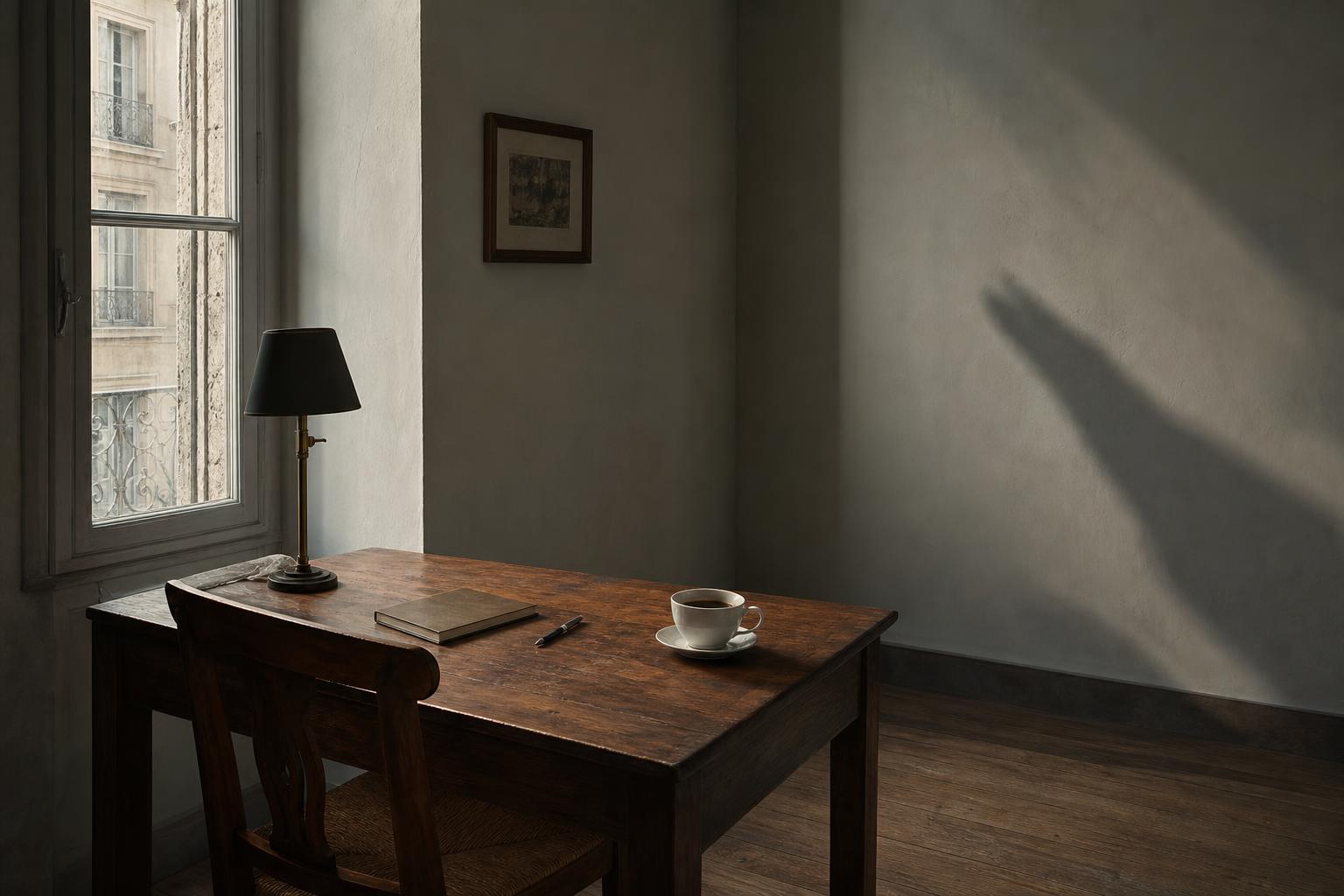
Direction rarely arises through comparison. It arises when the noise drops away and something of your own becomes audible again. That requires a kind of quiet the culture has largely forgotten: quiet not as a reward, not as wellness, but as a condition. A room in which the phone lies still, an hour in which nobody expects a reply, a morning in which the shadow on the wall is allowed to be there without the room having to turn toward it.
Quiet, in that sense, is not a luxury. It is the sign that you are no longer living in someone else's shadow. Those who are always reacting read it as laziness; those who know it from the inside recognise it as a return to proportion.
The wrong question is usually: how do I stand in relation to them? The better question is: what here is actually mine? The first lets you live with your back turned to your own work. The second finally makes you turn your back to the shadow, and your attention to the table where the work is waiting.