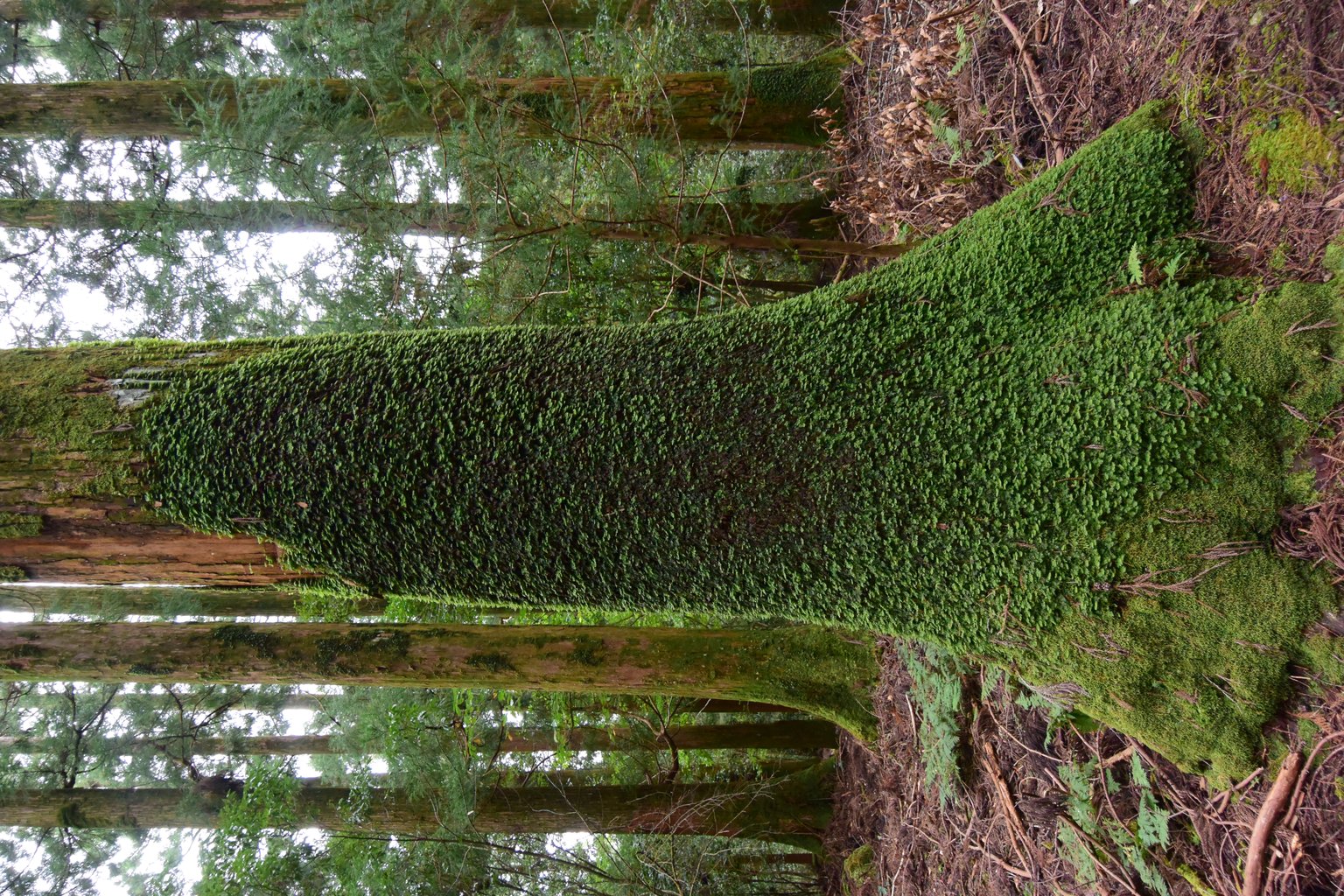
The Camino is the visible extreme, but the same current is running through the older Japanese routes. The Kumano Kodo network in the Kii peninsula, dormant for most of the twentieth century, has become one of the country's most booked-out international trails, its cedar tunnels and stone stairs now walked by silent northern Europeans, Australians, Americans, and a rising share of East Asian professionals. Shikoku's 88-Temple henro path receives a rising trickle of foreign walkers as well, most of them without any interest at all in Kōbō Daishi's biography. The road, apparently, does not care what one believes on the way to it.
This is where the phenomenon deserves to be taken seriously, and not filed under wellness travel. Something is happening to modern people, and the response is old.
A civilization that abolished the walk is now paying to reintroduce it
For a century the developed world has been optimizing walking out of daily life with impressive efficiency. Cars annexed the street. Elevators annexed the stair. Delivery annexed the errand. Screens annexed the errand's memory. By the 2010s the average adult in a rich country was covering a smaller daily distance on foot than any adult in any settled society on record. Then, quietly, the same people began flying to Spain, Japan, and Portugal to walk twenty-five kilometres a day for two weeks with a small bag on their back.
A polite way to describe this is compensation. A more accurate way is confession. The body, when it is honest, will tell a civilization when it is being underused. Long-distance walking is one of the few forms of physical labour the modern professional can perform without embarrassment or expertise. It requires no equipment, no license, no team, no coach. It is stubbornly proletarian even when repackaged for people who work in glass towers. That is part of its dignity.
The road is a slow tutor
What the walker actually meets on a long trail is not scenery. It is time. The Camino imposes a rhythm that no productivity app can imitate: rise early, walk, eat, wash, sleep, rise again. Days become identical enough to become distinct. The mind, denied its usual stream of interruptions, begins to metabolise material it had been avoiding for years — a father, a marriage, a decision half-made, a grief half-mourned. Walkers routinely report that by the second week something in them settles. This is not mysticism. It is what happens to attention when it is finally given a container long enough to hold it.
A great deal has been written about the collapse of attention in the age of the phone. Less has been written about the fact that human beings quietly, on their own, are now traveling long distances to buy attention back. That is what the road sells. Not enlightenment. Not epiphany. A container. A structure. A frame in which slow thought is allowed to happen without needing to explain itself.
Waymarks that do not require a doctrine
The genius of these routes is that they have not asked their new walkers to believe anything. The Camino still carries its scallop shells and yellow arrows; Kumano Kodo still has its oji shrines. But the routes have become morally hospitable. The atheist walks beside the Catholic beside the lapsed Anglican beside the Kyoto office worker who has quietly wondered for years what Kōbō Daishi meant. Nobody polices the interior. The infrastructure of belief is left standing, and the modern walker is permitted to fill it with whatever they arrive carrying.
This is a quietly extraordinary settlement, and it is worth naming. A secular age has learned to use religious architecture without insulting it. The routes are older than the walkers' worldview, and the walkers, mostly, know it. There is a shy respect that runs down the trail. Shoes are removed at the shrine. Voices are lowered in the chapel. The stone cross is not knocked down; it is walked past with a small, honest ambiguity that would probably have offended earlier centuries and would certainly bewilder the loudest atheists of the last one.
Sister-route agreements are now formal. Kumano Kodo and the Camino de Santiago run a dual pilgrimage protocol under which walkers who complete both receive joint recognition. Two of the great historic sacred networks of Eurasia have essentially signed a treaty of mutual hospitality. The god has quietly been demoted. The road remains.
The predictable predators are arriving
A phenomenon this large does not stay clean. The commercial capture of the pilgrim route is already visible, and the shape of it is the shape of every other captured intimacy of our era. Booking platforms buy up village albergues and re-price them for algorithmic tourism. Luggage-transfer services promise to remove the bag from the walker's back, then market the removal of the walk from the walk. Gear brands invent problems the pilgrim did not have, then sell four hundred euros of technical fabric to solve them. Slow-television companies film the Camino in drone footage and sell the completed idea of the walk to people who will not do it. This is the natural life-cycle of anything sincere in a market this hungry.
The instinctive response is to complain. That is the wrong response. The right question is whether the route itself is robust enough to survive its own popularity. And here the material design is oddly reassuring. A road cannot be scaled beyond its physical width. A stone stair cannot be optimised beyond its stone. The walker's feet remain the bottleneck of every commercial fantasy above them. The private company can sell the packaged Camino, but the client still has to walk it. At some point the twenty-fifth kilometre arrives, and the twenty-fifth kilometre does not care about anyone's brand.
What the road actually returns
People come off these walks changed in ways they cannot fully articulate. They have not, mostly, converted to anything. They have not, mostly, resolved anything dramatic. What they report is smaller and more durable. They notice things again. They eat with more attention. They sleep better for a while. They tolerate silence again without reaching for a screen. Some of them have made a decision they had been avoiding for years, not by thinking harder about it but by being tired enough at the right moment to see it clearly.
This is not a small yield. It is, in fact, the yield a civilization ought to be paying attention to. When half a million people a year walk five hundred kilometres and come home saying they can breathe again, that is a diagnosis of the country they left. It is worth taking that diagnosis seriously before pretending it is a marketing trend.
The old pilgrim believed the road led to a god. The new pilgrim mostly does not. But the road has not stopped teaching. It teaches now what it always taught, only without the doctrine: that a human being contains more than they use in daily life, that attention is a physical practice, that a body carried across a landscape at three miles an hour is not a sentimental object but a legitimate instrument of thought.
The oldest technology in the room
The temptation, in a technology-saturated century, is to treat everything ancient as ornamental. The pilgrim route punctures that. It offers a form of experience the whole edifice of modern convenience cannot replicate. There is no version of the Camino that runs in a browser. There is no premium plan. The suffering is the product. The slowness is the feature. The refusal to be optimised is what makes it work.
A serious observer should notice what this implies. The parts of human life most worth protecting appear to be the parts that most stubbornly resist being converted into data. Long walks, long meals, long friendships, long silences, long readings. All of them return to us now as luxuries, when they were once merely the shape of ordinary life. That reversal is worth grieving. It is also worth reversing.
One should be careful not to romanticise this too far. Most pilgrims are not saints. Many will forget the road within a month of returning to their inbox. The company they walked beside will fade. The revelations that felt permanent will thin out under the fluorescent light of the office. That is fine. The road does not require permanence. It requires arrival, and arrival is a technology that still works.
Five hundred thousand people a year is not a niche. It is a signal. A civilization that has spent a hundred years perfecting the removal of friction from human life is now, of its own volition, paying to reintroduce friction in one of its purest forms. The pilgrimage has returned without the god. It has returned because the god was never the point. The point was the walk, and the walk still works.
Sources
Oficina de Acogida al Peregrino, Santiago de Compostela: annual counts of Compostelas issued, showing roughly 347,578 in 2019, 446,035 in 2023, 499,239 in 2024, and 530,772 in 2025.
oficinadelperegrino.com / statistics
Wikipedia, Camino de Santiago: consolidated year-by-year pilgrim data drawn from the Pilgrim Office, useful for the long-arc chart of the modern revival.
en.wikipedia.org / Camino de Santiago
Wikipedia, Kumano Kodō: on the Kii peninsula pilgrimage network, its UNESCO World Heritage inscription, and the formal dual-pilgrimage arrangement with the Camino de Santiago.
en.wikipedia.org / Kumano Kodō
Wikipedia, Shikoku Pilgrimage: on the 88-Temple henro route, its rising international attention, and its enduring lay-practice character.
en.wikipedia.org / Shikoku Pilgrimage
Wikimedia Commons, Kumano Kodo Pilgrimage Trail, Koguchi to Nachisan, Japan, photo by Steve Shattuck, CC BY-SA 2.0: image used for this essay.
commons.wikimedia.org / Kumano Kodo trail
