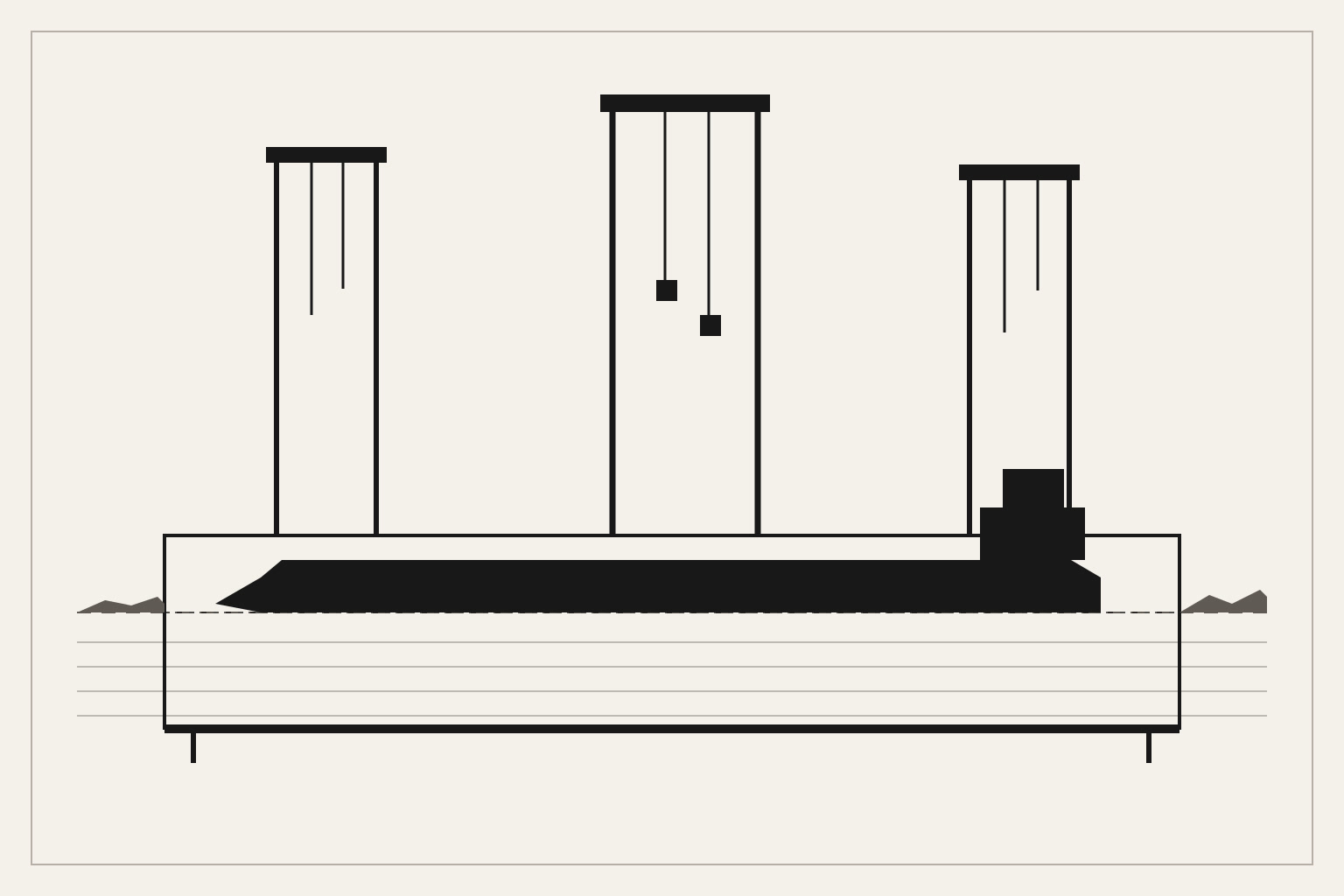
Begin with the first half of this year, because it is now the reference point for every subsequent argument. Between January and June 2026, Chinese yards took roughly 1,131 of the 1,481 vessel orders placed worldwide, worth about thirty-one million compensated gross tonnes. That is a market share of around seventy-two per cent, and it is roughly double what those same yards took in the same six months of 2025. Korea, historically the world’s second yard, took 195 orders and about eight million CGT, roughly a fifth of the market. Japan, once the reference builder of the postwar era, has almost disappeared as a comparable player.
Within the highest-volume, longest-lead-time class — the very-large crude carrier — the concentration is even sharper. The order book for VLCCs in 2026 is on track for its largest year since 1973. Of the first 127 vessels booked this year, thirty-eight went to Chinese yards, three to Korea, and one to Japan. Chinese yards regularly quote a hull for roughly ten million dollars less than a Korean equivalent, and can slot the delivery earlier because their berth pipelines are longer. Even official Chinese media is now willing to publish the number: more than ninety per cent of new VLCC contracts, over the last several quarters, have been signed with Chinese shipyards.
The consolidation nobody stopped
On the twentieth of January this year, China State Shipbuilding Corporation and China Shipbuilding Industry Corporation, the two state groups that between them had run more or less the entire Chinese naval and civil newbuild programme for a generation, completed their long-planned merger. The unified entity carries more than five hundred and thirty vessels on its outstanding order book and, at group level, controls somewhere in the order of eighteen per cent of the global newbuild market by compensated gross tonnage. That is a single firm owning almost one-fifth of the world’s shipbuilding capacity, without any competition regulator anywhere in the world having a meaningful say. The merger was welcomed in Beijing, filed for the record in Hong Kong, and treated as a housekeeping matter in Brussels. A Western consolidation of the same intensity in aerospace, autos, or telecoms would have been met with a Rule 6(1)(c) notice. The Chinese one produced a press release.
This is not a footnote. National champions built by state-directed merger are the industrial form the twenty-first century actually rewards, and the shipbuilding file is where that form now runs almost unopposed. The West, for all its criticism of Chinese overcapacity, has spent thirty years unable to consolidate its own yards even inside single national jurisdictions.
Korea’s dignified retreat
Korea has responded with the only strategy available to a serious industrial power that finds itself out-scaled. It has retreated up-market. Even as the Korean share of new orders slipped from roughly twenty-eight per cent a few years ago to around nineteen per cent in the first half of 2026, Samsung Heavy Industries, HD Hyundai Heavy Industries, and Hanwha Ocean have kept roughly two-thirds of the world’s liquefied-natural-gas carrier orderbook. LNG carriers demand membrane-tank engineering, cryogenic containment, and boil-off-gas management that even the best Chinese yards are still catching up on. Where the metallurgy and the physics still matter, Korea remains the reference builder.
The interesting part is what Korea has done alongside that segment retreat. In August 2025, Seoul offered the incoming Trump administration a package called MASGA — the acronym runs, without embarrassment, as “Make American Shipbuilding Great Again” — comprising up to one hundred and fifty billion dollars of Korean investments, loans, and guarantees into US yards, US supply chains, US MRO clusters, and US Navy programmes. Hanwha alone committed five billion dollars to the former Philly Shipyard, which it had acquired in December 2024, with the stated goal of raising annual output from about one vessel a year to ten to twenty, and its workforce from roughly seventeen hundred to over ten thousand, “within the next decade.” Samsung Heavy has signed an MRO partnership with Vigor Marine on the American West Coast. Hanwha and the White House have begun jointly using the phrase “next-generation frigate” in the same paragraph.
This is real money and real steel. It is also, on the timeline that matters, a decade-late reinforcement against a two-decade Chinese lead. MASGA reduces marginal Western dependence by some measurable increment; it does not restore American maritime sovereignty in the 2020s. That distinction has been quietly conceded even by the officials selling the package.
The fee that had to be suspended
The subtlest instrument of the last cycle was the American attempt to price the asymmetry directly. In January 2025 the Office of the US Trade Representative concluded a Section 301 investigation, opened at the request of five American labour unions, finding China’s targeting of the maritime, logistics, and shipbuilding sectors to be actionable. On the seventeenth of April 2025, USTR issued its Notice of Action: a fee, effective from the fourteenth of October, of fifty dollars per net ton on Chinese-owned or Chinese-operated vessels calling at US ports, rising by thirty dollars per net ton each subsequent year, to plateau at one hundred and forty dollars per net ton in 2028; and a separate fee, based on either net tonnage or container volume, on Chinese-built vessels operated by anyone else.
The intent, formally, was to discourage American shipping lines from buying Chinese-built hulls and to give Korean and Japanese yards a price signal to compete for the resulting orders. In practice, the fees would have been paid by American importers, on the containers they had no other means of moving, on the ships there was no other yard to build. Cheese from Rotterdam, seasonal produce from Chile, machinery from Germany, cars from Japan — all of it, by the time it reached Los Angeles or Newark, would have carried the fee. There was, and is, no realistic non-Chinese hull to divert the trade onto within the timeframes involved.
On the tenth of November 2025, in the wake of the Xi–Trump summit in Kuala Lumpur, USTR quietly announced that the entire Section 301 maritime fee package was suspended for one year, until the ninth of November 2026. China’s reciprocal “special port fees” on US vessels were suspended in parallel. The scheduled April 2026 escalation to eighty dollars per net ton simply did not happen. In June, a group of American senators wrote to the current USTR Greer to ask, in effect, whether the fees would ever be applied. The written answer has not arrived. The unwritten answer is legible.
The naval dimension
Behind the commercial file sits a naval one, and the two are not separable. The same welders, plate mills, engine shops, dry docks, and shore-side supply chains that build a container vessel one year build a frigate the next. This is why the widely cited unclassified US Navy briefing slide, that China has roughly two hundred and thirty times the shipbuilding capacity of the United States, is not a rhetorical figure but an industrial one. The CSIS analysis of the Chinese naval buildup, using stricter definitions, gives the PLAN roughly 234 warships against about 219 for the US Navy on comparable measure, and notes that around seventy per cent of Chinese warships were launched after 2010, versus roughly a quarter of the US fleet. If the current trajectory holds, China’s vertical-launch cell count — the raw measure of surface-combatant firepower — will pass the United States’ roughly nine thousand nine hundred cells by 2027.
In a protracted conflict of any kind, the ability to replace losses is downstream of yard capacity, and yard capacity does not travel. The US industrial base can, at best, sustain roughly two large surface combatants a year. Chinese yards can plausibly triple that within a single planning cycle by shifting berths from commercial to naval work. This is the deeper reason the US Naval Institute’s 2025 “Dry Docks to Dominance” essay was so grim: it grasped that a rules-based order in the Pacific which no longer has the merchant marine or the yards to sustain itself is a policy, not a posture.
What seriousness would require
As with the Indonesian nickel file a week ago, three admissions and one refusal.
The first admission is temporal. The commercial fleet the West depends on will be Chinese-built through the 2030s. No fee schedule, no domestic content rule, and no tax credit can compress the reconstruction of a serious American merchant yard into less than a decade of continuous work. The MASGA package is real, but it is a 2035 answer to a 2020s question.
The second admission is industrial. Shipbuilding is not the sort of capability that can be teleported by capital alone. It requires an entire vertical: certified steel plate at industrial scale, marine engines (the WinGD dual-fuel low-speed engine, still the reference in cargo propulsion, is now Chinese-owned through CSSC), cargo-containment membranes, electrical integration, coating, welding schools, port infrastructure, and the training pipelines that keep them all replenished. Korea and Japan spent forty years building that vertical, and are struggling to hold it. The United States dismantled its own version by the late 1980s and has spent the years since letting the memory rot in the yards of Bath, Groton, Newport News, and San Diego.
The third admission is legal. The Section 301 maritime fee is, at this point, either honest or effective. It cannot be both. A fee that would actually reroute trade to Korean or Japanese yards on a timeline that mattered would require closures of vessel classes for which no substitute currently exists, and would visibly break the American consumer economy. A fee that does not do this is decorative. The one-year suspension makes the second reading official.
The refusal is the same as with Sulawesi, and it is Taoist in disposition. Do not treat the Chinese lead in yards as an outrage. Yards are what a country builds when it has, over decades, decided that industrial coherence, cheap credit, welder training, and low-margin shipowner contracts matter. China made those decisions, quietly, from about 2003 onward. Europe and America made the opposite ones, equally quietly, in exchange for cheaper white goods and a more legible financial services sector. The bill is now being presented. It should not be paid in indignation.
The closing line
The next century’s shipping — the methanol and ammonia carriers of the energy transition, the containers of a supposedly reshored economy, the very-large crude carriers of a Middle Eastern export system still routed through Asian refineries, the frigates of an imagined Pacific fleet — will be launched from berths on the Yangtze, the Yellow Sea, and, at the more sophisticated end, the Ulsan and Geoje shorelines. The Washington fee has been suspended for a year. The Beijing merger has been completed for six months. The Seoul package is a decade of steady work. The West, meanwhile, will keep writing legal instruments about a maritime economy whose hulls, plates, engines, and increasingly its cranes it does not build. The ocean has already answered the question. It ships, from now on, on somebody else’s steel.
Sources
Maritime Executive, Chinese Shipyards Double Their New Order Volume in First Half of 2026 — for the H1 2026 headline: 1,131 of 1,481 global vessel orders, 31 million CGT, and roughly 72 per cent market share.
maritime-executive.com
iMarine News, South Korea’s Shipbuilding Share Slips to 19 % in H1 2026 as China Surges to 72 % of Global Orders — for the Korean market-share erosion figure and the widening 53-point gap.
imarinenews.com
iMarine News, Record VLCC Orders Raise Alarm Over Looming Shipping Market Slump — on the 127-vessel VLCC order book in 2026, the highest annual total since 1973, and the 38/3/1 China/Korea/Japan split.
imarinenews.com
Global Times, China secures over 90 % of global new VLCC orders — for the official Beijing framing of the VLCC concentration.
globaltimes.cn
Maritime News, CSSC-CSIC Merger Is Officially Complete — on the 20 January 2026 completion, the 530-plus order book, and the ~17 % single-firm global CGT share.
maritimenews.com
KED Global, South Korean shipbuilders dominate high-value vessel orders — on the Korean concentration in LNG carriers and the retreat up-market.
kedglobal.com
The Korea Herald, Korea sails into US shipbuilding with $150b MASGA push — on the composition of the MASGA package and its US-yard focus.
koreaherald.com
Hanwha Group, Hanwha announces $5 billion Philly Shipyard investment — for the acquisition, the 1,700-to-10,000 workforce target, and the “one to twenty vessels a year” capacity ambition.
hanwha.com
KED Global, Trump says Hanwha to partner on US Navy frigates; MASGA project gains momentum — on the frigate MOU and the “Golden Fleet” framing.
kedglobal.com
Office of the US Trade Representative, Notice of Action and Proposed Action in Section 301 Investigation of China’s Targeting of the Maritime, Logistics, and Shipbuilding Sectors (17 April 2025) — for the fee architecture and the effective dates.
ustr.gov / notice of action
Gateway Lines, Section 301 China Fees Suspended to Nov 2026 — on the 10 November 2025 one-year suspension of the Section 301 maritime fees, including the cancelled April 2026 rate hike.
gatewaylines.com
HFW, China reacts to USTR Section 301 port fees with “special” port fees on US ships — on Beijing’s reciprocal port-fee measure and its own suspension.
hfw.com
US Senate, Letter from Senators Warren and Kelly to US Trade Representative Greer on shipbuilding Section 301 port fees (7 June 2026) — for the congressional pressure and the acknowledged suspension.
warren.senate.gov
National Security Journal, China Has 230 Times the Shipbuilding Capacity of the United States — for the Office of Naval Intelligence briefing figure and its industrial-base implications.
nationalsecurityjournal.org
Center for Strategic and International Studies, Unpacking China’s Naval Buildup — for the PLAN vs USN fleet counts, VLS cell projection to 2027, and the age-of-fleet comparison.
csis.org
US Naval Institute Proceedings, From Dry Docks to Dominance: The Threat of China in the Maritime Domain (July 2025) — for the industrial-base framing of the naval problem.
usni.org
Image: original editorial diagram for HW.