One of the quiet degradations of contemporary culture is that the museum no longer believes in the naked encounter. It does not trust the visitor to stand before a painting, statue, mask, textile, or altar fragment and let the thing arrive on its own terms. The institution must intervene first. A label grows longer. A panel blooms beside the work like bureaucratic ivy. A QR code offers a further corridor of sanctioned meaning. The audio guide murmurs in your ear before silence has had a chance to do its work.
The result is not better understanding but pre-empted attention. We increasingly meet art through a sheath of explanation so thick that the actual act of looking begins late, if at all. The museum still speaks the language of access, context, and inclusion. In practice it often performs a small confiscation. It removes from the visitor the right to encounter difficulty without immediate rescue.
Susan Sontag saw the intellectual pattern early. In Against Interpretation, she argued that modern criticism had developed a habit of taming art by reducing it to content and message, rather than learning a more exact vocabulary for appearance, form, and sensuous force.[1] That argument has aged too well. What was once a critical vice has become an institutional reflex. Many museums now behave as if the first duty of art were not to intensify perception but to survive translation into approved prose.
The Caption Arrives Before the Painting
The problem is not context as such. Context can be civilised. Dates matter. Patronage matters. Colonial theft matters. Technique matters. A room without any coordinates at all can become its own kind of pose, a luxury of the already initiated. The issue is sequence and proportion. Too often the explanation arrives first, with the work treated almost as supporting evidence for the text beside it.
This changes the psychology of attention. Instead of asking what is happening here?, the visitor is invited to ask whether he has correctly absorbed the institutional framing. The painting is no longer the primary event. Interpretation is. Looking becomes compliance with a prepared script.
One can feel the fear underneath it. Museums are terrified of silence because silence risks unequal experience. Some visitors will know more, see more, endure ambiguity better. Rather than educate people gradually into stronger looking, the institution often levels the experience downward by making sure everyone receives the same prefabricated significance. Equality, in this case, is purchased by thinning the encounter.
Explanation Flatters the Institution
There is also vanity in the matter. Wall text allows the museum to place itself onstage as moral guide, historian, therapist, and civic tutor all at once. The work of art becomes one actor in a larger performance whose true subject is often the institution's own conscientiousness. Nothing is merely shown; everything must be narrated, situated, and ethically upholstered.
John Berger changed how generations learned to see by exposing the social and ideological machinery around images.[2] Good. That work remains necessary. But there is a vulgar Bergerism now abroad: the belief that demystification is the highest form of looking, and that once a work has been placed inside the right explanatory grid, one has done justice to it. One has not. One has only cleared the ideological underbrush. The thing itself still stands there, waiting to be met by the nerves.
The museum today often stops at that underbrush-clearing stage and congratulates itself. The visitor leaves more informed, perhaps, but not necessarily more awake. Information is cheap. Presence is not. There is a world of difference between knowing what a painting is said to mean and feeling, in the body, why its scale, colour, geometry, restraint, violence, or tenderness holds a room together.
The Smartphone Annex
Then comes the little digital indignity. The QR code at the edge of the frame. The app. The extra layer. The invitation to leave the work in order to receive more of it. Museums have absorbed the broader pathology of contemporary life: the inability to let one thing be enough before another channel opens.
This is sold as enhancement. It is often fragmentation in evening dress. A work that should have claimed ten unbroken minutes receives three seconds of looking, forty seconds of reading, twenty of scanning, and a private drizzle of commentary in the headphones. The visitor has had a full cultural experience, no doubt. He has also been spared the slightly frightening business of standing still long enough for taste, boredom, resistance, and eventual recognition to sort themselves out.
That sorting-out is part of the point. A serious encounter with art is not always immediately rewarding. Some works need to resist you before they yield. Some should remain partly closed. The institution that rushes to mediate every silence ends up training a public that cannot bear unprocessed experience. It produces informed tourists of meaning.
What Adult Looking Requires
Adult culture would proceed differently. It would give the work the first move. It would keep labels short, factual, and subordinate. It would separate essential orientation from interpretive essay. It would make the deeper context available nearby without forcing it between eye and object. It would understand that not every room needs to sound like a podcast.
More importantly, it would treat attention as something to be formed, not merely serviced. The museum should teach people how to stay with difficulty, how to notice structure, how to return after the first impression disappoints them. This is a slower pedagogy, and therefore alien to the age. But it is also the only one worthy of art.
We say we want citizens rather than consumers, judgment rather than algorithmic steering, interior life rather than permanent distraction. Fine. Then the museum should stop behaving like a beautifully lit interface layer. It should recover the old, severe courtesy of putting the work in front of you and not immediately chattering over it.
How It Can Be Done
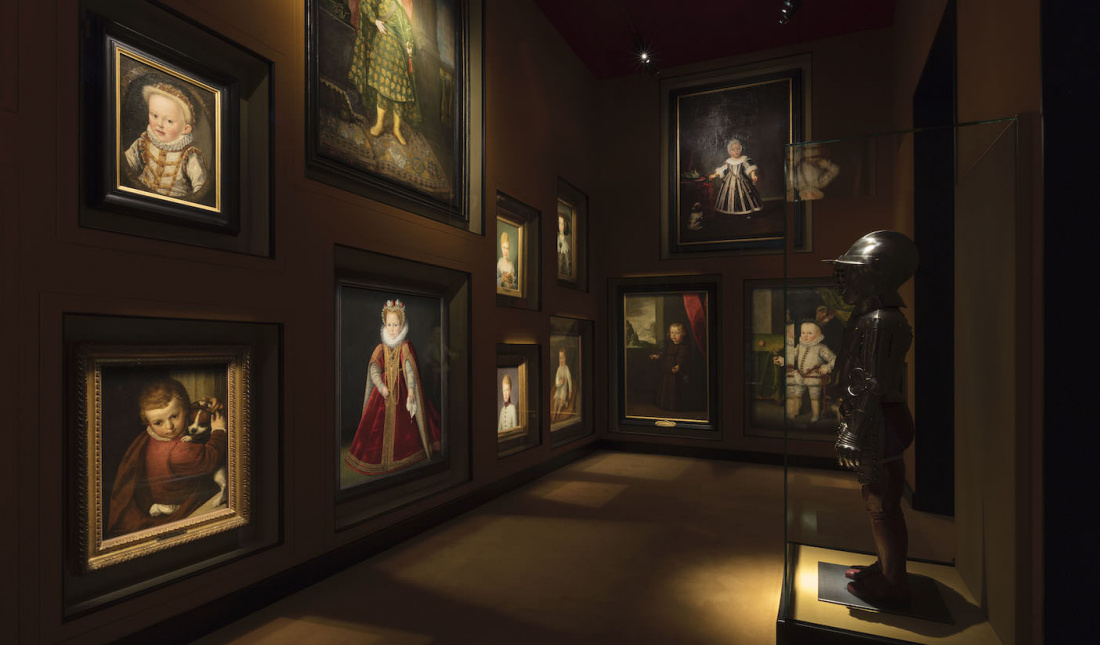
There are counterexamples. Wes Anderson and Juman Malouf's Spitzmaus Mummy in a Coffin and Other Treasures, first assembled from the Kunsthistorisches Museum and Naturhistorisches Museum in Vienna and later restaged at Fondazione Prada in Milan, showed how a museum can thicken looking without suffocating it.[3][4] The objects were not marched into place by the usual academic bureaucracy of period, school, and approved interpretation. They were grouped by visual kinship, material rhyme, scale, colour, motif, oddity. Green spoke to green. Boxes conversed with boxes. Miniatures found each other across centuries.
That is not the abolition of context. It is the restoration of sequence. First the eye is allowed to wander, compare, recognise, become curious. Only then does knowledge deepen the encounter. Even the decision to push labels into a separate booklet was telling. One had to look before one could outsource the work of seeing. The exhibition trusted association, adjacency, and formal intelligence. It behaved less like a moral instruction manual and more like a civilised room in which things had been placed by someone with judgment.
The lesson is not that every museum should become a Wes Anderson set, God forbid. The lesson is that arrangement itself can think. A room can make an argument without shouting one. It can invite attention without pre-chewing it. It can let objects acquire meaning through relation, silence, and tension rather than through paragraphs of institutional throat-clearing.
The best rooms in the best museums still know this. They have a certain hush. Not reverence in the sugary sense, but order. They understand that explanation is a servant, not a master. A label may introduce. It must not interpose.
Art does not need a chaperone. It needs a viewer who has not yet been interrupted.
Sources
[1] Susan Sontag, Against Interpretation (essay first published 1964; collected in Against Interpretation and Other Essays, 1966): a foundational critique of reducing art to decipherable content, and a defense of recovering the sensuous life of the work.
[2] John Berger, Ways of Seeing (1972): still indispensable on the historical and ideological framing of images, and therefore useful precisely because it helps show the difference between opening a work up and replacing it with commentary.
[3] Hibou Pèlerin, “Den Herzschlag des Museums spüren,” Schweizerisches Nationalmuseum blog (2019): on the Vienna version of the Anderson/Malouf exhibition, its cabinet structure, visual ordering principles, and the decision to move object legends into a separate booklet.
[4] Whitewall, “Wes Anderson’s Cabinet of Curiosities Comes to Life at Fondazione Prada” (2019): on the Milan installation at Fondazione Prada and its expansion of the original wunderkammer logic.