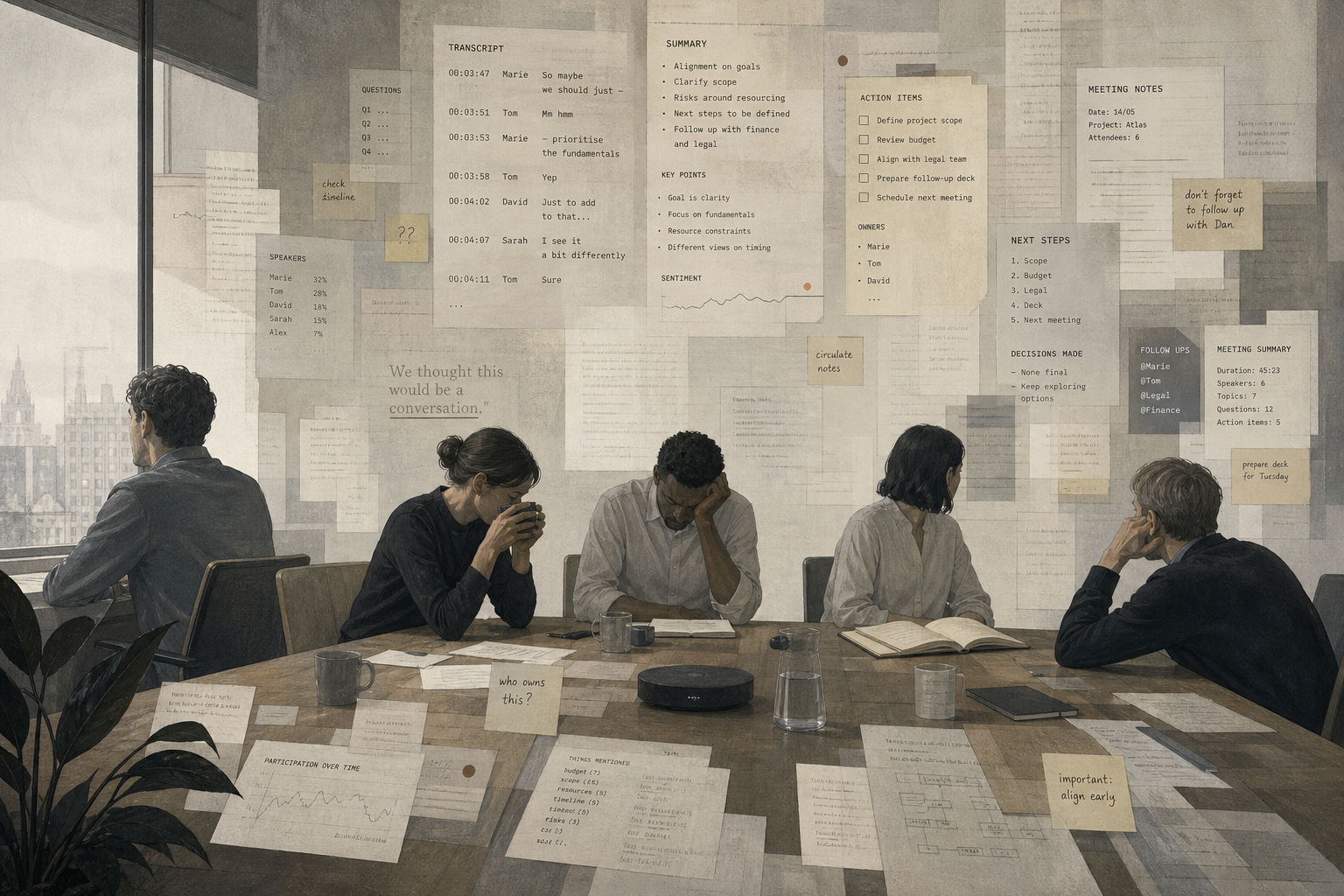
One of the stranger things now being sold to office workers is the right to attend a meeting without really attending it. Google Meet will now “take notes for me”, produce a “Summary so far” for late arrivals, email the recap afterwards, and even improve the notes with screenshots of presented content.[1] Notion sells AI Meeting Notes that “transcribe conversations, summarize key points, and surface insights automatically”.[2] Slack offers thread summaries, channel recaps, and meeting notes, while citing an internal pilot in which users saved an average of ninety-seven minutes a week.[3] The specialist firms are blunter still. Otter says it turns every meeting into decisions, action items, and insights.[4] Fathom opens with an even cleaner proposition: “Never Take Notes Again” — and thirty-eight minutes saved per meeting on average.[5]
A clerical nuisance has become a software category.
The product being sold is not memory but absolution. You may drift, arrive late, glance at your mail in the middle, forget what was decided, and still receive the purified remains in your inbox. The new office luxury is no longer the corner room. It is the privilege of not listening too carefully.
This is marketed as liberation. It is, in fact, a rearrangement of responsibility. Attention is not an administrative layer wrapped around the meeting. Attention is the meeting. Once responsibility for remembering is outsourced, responsibility for thinking begins to slide with it.
The software is trying to solve the wrong embarrassment
Offices do, of course, have a real problem. Too many meetings are shapeless, over-attended, badly chaired, and called partly because the organisation no longer knows how to decide in writing. Everyone knows this. What the new note-taking layer offers is a way to avoid the humiliation of that diagnosis. Instead of cancelling the meeting, shortening it, or forcing one adult to own the outcome, the firm installs a ghost writer.
That is why the sales copy is so revealing. The promise is not merely accuracy. It is emotional relief. Fathom says you can stay focused on the meeting because it captures the details for you. Otter says you can ask questions across your meetings and connected apps. Slack wants to keep everyone “in the know” without anyone having to go back through the actual thread. Notion wants the agent working while you sleep. The rhetoric is always the same: do not worry, the machine will carry the burden of continuity.
There used to be a secretary, a project manager, or one poor junior condemned to write minutes. The arrangement was inefficient and often unfair, but it had one virtue. Someone in the room was clearly responsible for deciding what mattered. A human note-taker had to rank, omit, infer, and occasionally miss the point. That partiality was not a defect. It was judgment.
Machine notes are sold as a triumph over human limitation. In practice they often erase the very friction that forces seriousness. If nobody has to decide what matters in the room, the room has already become less exact.
Searchable memory changes the room before it changes the archive
The second-order effect is more interesting than the first. Once people know a meeting will become transcript, summary, action list, and future query surface, they start speaking for retrieval. Half-formed thoughts are trimmed into exportable sentences. Disagreement becomes tidier. Jokes grow more careful. The room begins to talk in bullet points because it knows it will be turned into them anyway.
Even the product documentation quietly admits the problem. Google says administrators can require explicit consent before note-taking, recording, or transcription begins, and notes that internal participants can stop the feature at any time “to ensure that any confidential or sensitive discussions aren't part of the meeting summary”.[1] Quite. If the tool itself requires an escape hatch from its own memory, then permanent capture is not the neutral workplace default its marketing sometimes pretends it to be.
Otter now offers an MCP server so ChatGPT, Claude, and related tools can access meeting knowledge directly.[4] Fathom advertises that your meeting data can live inside ChatGPT and Claude too.[5] This is the next turn of the screw. The meeting is no longer merely something that happened. It becomes a mine. Speak once, be searched later. Every uncertain sentence waits around as future material for a model, a manager, or a compliance instinct with too much time on its hands.
Some of this will be useful. I am not sentimental about paper notebooks and heroic forgetfulness. Client calls, technical handovers, interviews, board meetings, or legal discussions often do need a record. A decent transcript can rescue detail that would otherwise rot. Fine. The vulgarity lies in turning that exception into the office default and then pretending nothing social has changed.
Bad meetings become easier to tolerate, which means they survive
This is the part the productivity sermon skips. The tools do not mainly reduce meetings. They anaesthetise them. A bad meeting with no note-taker is visibly wasteful. A bad meeting with instant recap, searchable transcript, synced action items, and an AI chat layer now looks like knowledge work. The bureaucratic corpse receives better lighting.
Slack’s internal pilot boasts about time saved after the fact.[3] Fathom boasts about follow-up work eliminated after the fact.[5] Otter boasts about hours recovered after the fact.[4] None of this touches the prior question: why were these people gathered in the first place, and why did the organisation need a memory prosthesis to make the hour defensible?
The deeper managerial temptation is obvious. If every conversation becomes legible, searchable, and summarised, the company can pretend that more communication equals more clarity. It does not. Usually it means the opposite. Real clarity tends to arrive from fewer people, stronger ownership, shorter loops, and the occasional severe memo sent before anyone books a call.
Some conversations should be allowed to disappear
Offices once understood, however imperfectly, that not every exchange deserved to become institutional memory. A brainstorm in rough weather, a tentative disagreement, an unguarded strategic hesitation, a colleague trying out a thought before it hardens — these things can be valuable precisely because they are not yet ready for storage. Total recall flatters management and deforms candour.
The sensible policy is stricter than the current fashion. Use AI notes where an actual record matters. Keep them off by default for recurring internal meetings. Never let them replace a designated human owner. Do not transcribe brainstorms unless you want brainstorms to become theatre. If no one is responsible for writing the decision down in plain language after the call, the problem is not note-taking software. The problem is that the meeting should not have happened.
The modern office keeps trying to automate its way around adult habits: preparation, brevity, attention, ownership, silence. That is why these tools are arriving so quickly. They do not merely save time. They preserve a broken social form by making it easier to endure.
A meeting that needs a ghost writer in order to count as work is usually the problem.
Sources
[1] Google Meet Help, “Take notes for me in Google Meet - Computer”: feature description, consent settings, optional screenshots, sharing controls, and post-meeting recap flow.
https://support.google.com/meet/answer/14754931?hl=en
[2] Notion AI product page: AI Meeting Notes, enterprise search, and data-handling claims.
https://www.notion.com/product/ai
[3] Slack AI product page: thread summaries, channel recaps, meeting notes, and internal pilot claim of ninety-seven minutes saved weekly.
https://slack.com/intl/en-gb/features/ai
[4] Otter home page: meeting summaries, action items, insights, MCP server access for ChatGPT and Claude, and reported hours saved per week.
https://otter.ai/
[5] Fathom AI Notetaker home page: “Never Take Notes Again”, bot and no-bot capture, ChatGPT/Claude access, and time-saved claims.
https://www.fathom.ai/