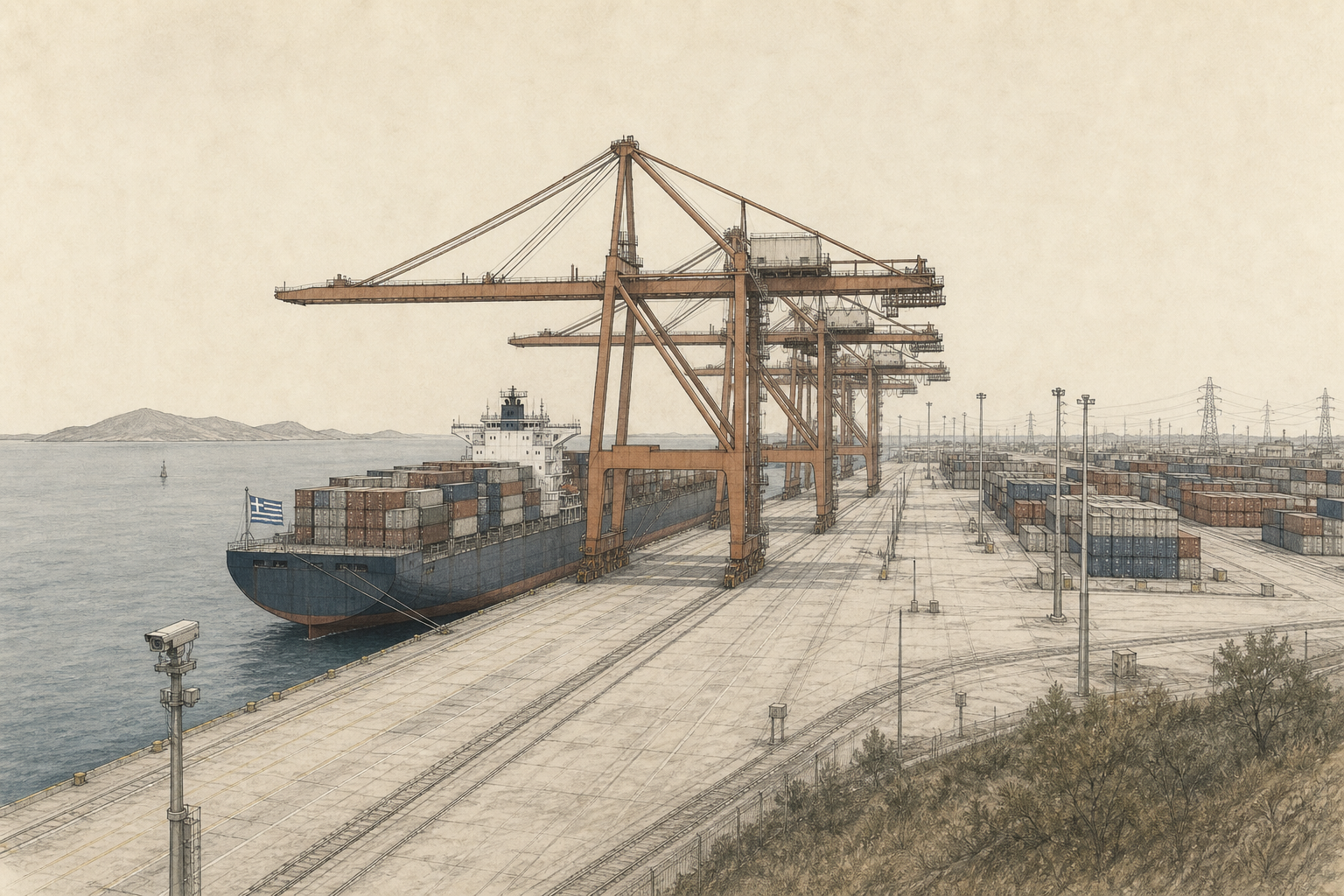
Europe still enjoys the old maritime theatre: famous ports, venerable owners, handsome tonnage tables, and the vague civilisational comfort of knowing that ships continue to arrive. But shipping power has moved. The romantic statistic is ownership. The harder statistic is system control.
UNCTAD’s 2025 maritime review captures the asymmetry rather well. Greece remains the world’s largest ship-owning nation by carrying capacity, with 16.4 per cent of the global fleet. That sounds like maritime authority. Yet China accounted for around 55 per cent of world shipbuilding output in 2024, 74.4 per cent of contracted gross tonnage that year, and 63.7 per cent of the global orderbook at the start of 2025. Six of the ten leading shipyard groups were in China. One side owns a great many ships. The other side is increasingly deciding what ships get built, when they get delivered, and what the next fleet will look like.
This is not a bookkeeping curiosity for men in crested blazers. It marks a deeper change in where maritime power actually lives. In an era of route disruption, sanctions, port fees, industrial subsidies, and military tension around chokepoints, control of the wider logistics stack matters more than the old prestige of beneficial ownership. The empire is no longer only in the hull. It is in the shipyard queue, the cranes, the terminal software, the financing terms, the bunkering network, and the rail slot inland.
Ownership is the nostalgic metric
Ownership still matters, of course. Freight income is real money, and large fleets still confer influence, expertise, and political weight. Greece is not a decorative footnote. But ownership has become a lagging indicator of maritime power in the way that owning apartment deeds is not the same thing as controlling the cement plant, the grid connection, and the planning office.
The ship is only one layer of the system now. The more decisive question is who controls renewal. If you dominate shipbuilding output, dominate new contracts, and sit on most of the orderbook, you are not merely serving today’s trade. You are pre-shaping tomorrow’s. You decide where capacity expands, which technologies scale first, how quickly fleets can adapt to new fuel regimes, and who waits at the back of the yard like a nervous customer in a provincial tailor.
That is why the seemingly vulgar American turn toward port fees and penalties on Chinese-linked or Chinese-built shipping is more instructive than many of the grander speeches on de-risking. Washington has grasped, however crudely, that maritime trade is no longer neutral plumbing. It is strategic industry. If the United States is trying to weaponise hull origin, yard origin, and cargo-handling equipment, it is because those layers now sit much closer to real leverage than the old liberal fantasy of anonymous ships serving a frictionless global market.
Maritime power has moved inland
There is a second illusion here, and Europe suffers from it badly. It still tends to treat ports as naturally sovereign assets: put enough concrete at the waterfront, keep the paperwork tidy, and history will kindly continue. History, regrettably, has taken other interests.
UNCTAD’s 2025 data show the centre of gravity shifting across the wider operating geography. Comparing the first half of 2018 with the second half of 2024, Europe’s share of container ship port calls fell from 21 to 17 per cent, while Asia’s rose from 59 to 63 per cent. For tankers, Europe fell from 24 to 18 per cent, while Asia rose from 54 to 61 per cent. As of June 2025, seven of the ten most connected countries in liner shipping were in Asia; the top four were China, the Republic of Korea, Singapore, and Malaysia.
Read that properly. The system is not simply becoming more Chinese in an ownership sense. It is becoming more Asian in its routing logic and more Chinese at its industrial core. The ship may carry a Greek beneficial owner, a Liberian flag, a Korean insurer, a Singaporean stop, and a European destination. But the strategic terrain now lies in the integrated web that determines how fast capacity can be added, how resilient routes remain under stress, and which region gets to set the practical terms of movement.
Ports, in other words, are no longer endpoints. They are interfaces. The winning regions are those that understand this with sufficient vulgarity. They do not merely host ships. They connect yards, fuel, customs, data systems, inland freight, industrial policy, and geopolitical patience into one organism. Everyone else gets a waterfront and a nostalgia industry.
Europe lives on the shoreline of its own problem
The European case is especially revealing because the continent remains intensely maritime in practical terms while often sounding curiously post-material in its policy language. Eurostat says maritime transport accounted for 67.0 per cent of EU freight transport performance in 2024. Road took 25.7 per cent. Rail managed 5.4 per cent. So the sea still does most of the heavy lifting for Europe, yet the inland machine remains much thinner and more fragmented than the rhetoric of strategic autonomy suggests.
This matters because a port without a disciplined hinterland is not serious leverage. It is a wet front door. If boxes cannot clear efficiently, if data systems remain fractured, if rail corridors remain too limited, if energy bunkering and terminal equipment remain strategically exposed, then the port becomes a beautifully photographed point of dependence rather than an instrument of command.
Europe is still rich in maritime remnants: shipowners, insurers, legal services, engineering knowledge, old port prestige, and the manners of a continent that once treated oceans as routes rather than scenery. But remnants are not a system. A fleet-owning class is not enough. The new contest runs through shipyard capacity, port community systems, customs digitisation, cranes, yard automation, corridor integration, and energy infrastructure. The glamorous parts of maritime capitalism are increasingly the least sovereign parts of it.
The next struggle is over the interface
None of this means Europe must somehow out-China China across every layer. That would be both impossible and faintly ridiculous. The task is stricter. Europe has to stop flattering itself with the statistics that belong to the previous era and build competence where the next era will punish weakness.
Three priorities suggest themselves.
First, treat ports as inland systems rather than maritime monuments. Freight rail, customs data, terminal software, and clearance speed are strategic assets, not administrative aftercare.
Second, recover selective industrial capacity around the maritime stack: repair yards, specialised shipbuilding niches, cargo equipment, fuel infrastructure, and the financing machinery that keeps those sectors from becoming museum exhibits.
Third, think continentally about maritime relationships with Asia. Europe should be building hard commercial and infrastructural literacy about the ports, yards, and corridor states that now shape the operating system of trade, instead of treating the region as a distant supplier base plus a moral weather report.
The old European fantasy is that prestige at the shoreline still counts as sovereignty. It does not. In the coming order, the winners will be those who govern the interface between sea, industry, data, and inland movement. The rest will go on owning impressive fleets inside someone else’s system.
Sources
UNCTAD, Review of Maritime Transport 2025: Overview — used for global fleet size, top ship-owning nations, and the Greece ownership share.
https://unctad.org/system/files/official-document/rmt2025overview_en.pdf
UNCTAD, Review of Maritime Transport 2025, Chapter II — used for China shipbuilding output, contracted tonnage, orderbook share, leading shipyard groups, and the summary of 2025 U.S. port-fee measures aimed at Chinese-linked or Chinese-built shipping.
https://unctad.org/system/files/official-document/rmt2025ch2_en.pdf
UNCTAD, Review of Maritime Transport 2025, Chapter IV — used for Europe versus Asia port-call shares and the June 2025 liner shipping connectivity rankings.
https://unctad.org/system/files/official-document/rmt2025ch4_en.pdf
Eurostat, Freight transport statistics - modal split — used for the 2024 EU freight transport performance shares by maritime, road, and rail.
https://ec.europa.eu/eurostat/statistics-explained/index.php?title=Freight_transport_statistics_-_modal_split
Image: original editorial illustration commissioned for HW, showing a Greek-flagged container ship within the larger port system of cranes, stacks, rail lines, and terminal infrastructure.
https://unctad.org/system/files/official-document/rmt2025overview_en.pdf