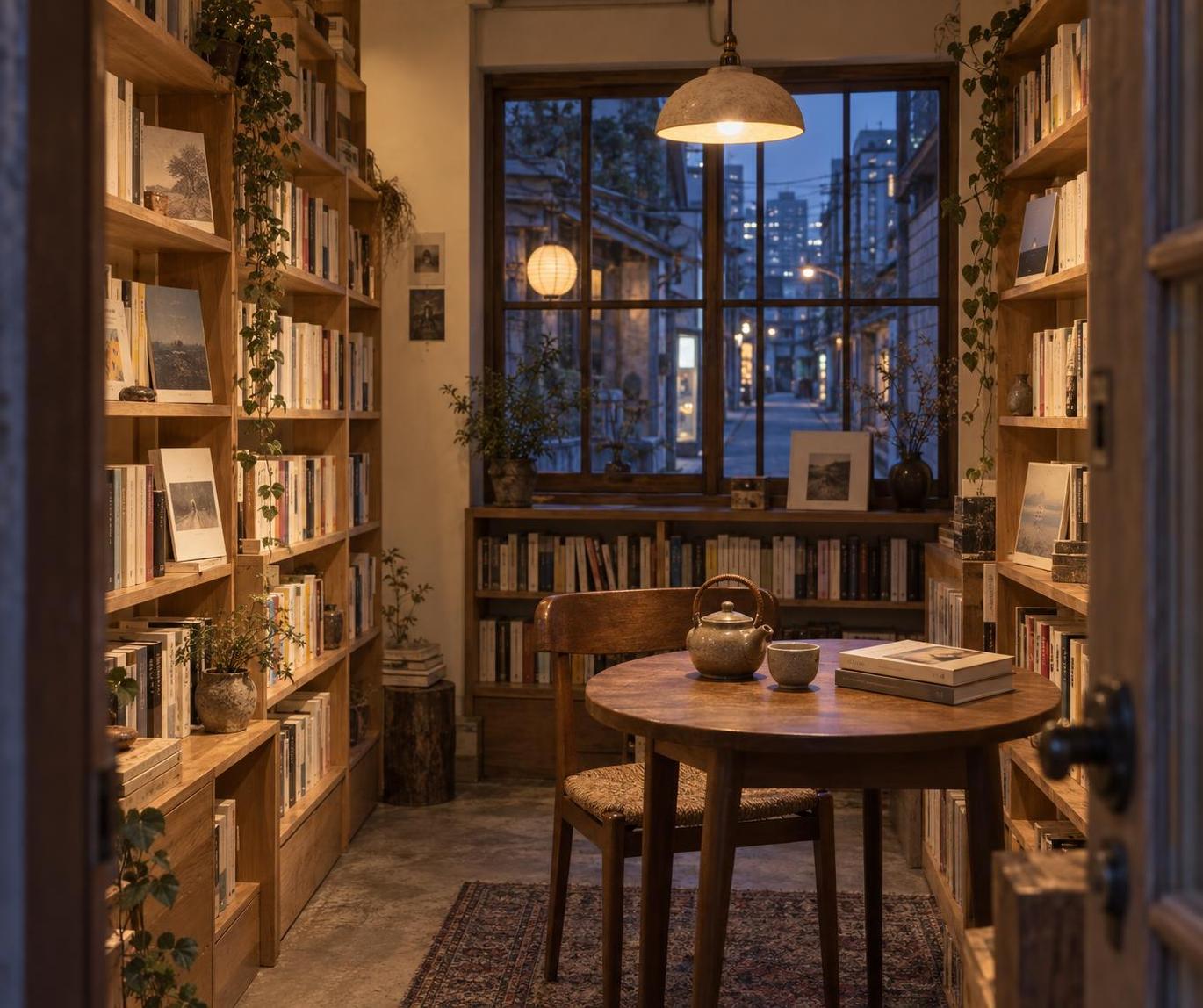
The most surprising cultural statistic in East Asia this decade is that South Korea — the country that gave the world the smartphone-native teenager, the twelve-hour high school day, and a national reading rate that has been sliding for a generation — has quietly grown a physical independent-bookshop layer from roughly one hundred shops in 2015 to more than eight hundred by early 2025. The count is not maintained by the government. It is maintained by a small Seoul design studio that treats a national database of neighbourhood bookshops (dongnae seojeom, “the bookshop of the neighbourhood”) as a civic project. Its number has crept upward through the pandemic, through the interest-rate spike, through the collapse of two of the country’s three chain retailers, and through the year that short-form video became the dominant recommendation engine of every publisher in Seoul.
This is not a rebound. It is a new layer. And it is worth understanding, because it is one of the very few civilizational counter-movements of the twenty-twenties that is neither sentimental nor state-mandated, and that arrives from a country the West insists on reading purely through K-pop and semiconductors.
The mechanism sits in a boring 2003 statute
The unglamorous truth is that the small shop did not return to Seoul because Koreans suddenly rediscovered slowness. It returned because a piece of price regulation quietly removed the reason it had to die.
South Korea passed a Fixed Book Price system in 2003 and tightened it substantially in November 2014. In its current form, no retailer — not the online giant Yes24, not the department-store chain Kyobo, not a corner shop — may sell a new book at more than ten percent below the publisher’s printed price, with an additional five percent permitted in secondary benefits such as points or coupons. Fifteen percent is the ceiling. That is it. A book that carries a cover price of eighteen thousand won costs, at worst, roughly fifteen thousand two hundred won anywhere in the country. The economic geometry that killed the Anglo-American independent bookshop in the 2000s — deep, permanent, undercutting discount from platforms with negative operating margins — simply does not exist in Korean retail law.
This is not a curiosity. It is the load-bearing wall of everything that follows. The moment the price gap between a shelf in Hongdae and a cart on Yes24 stops being forty percent and becomes zero, the small shop has a different question to answer. It no longer has to justify itself against a cheaper option. It has to justify itself against a lonelier one. That is a competition small shops can actually win.
Then the municipalities noticed
From roughly 2017 onward a wave of local ordinances passed at municipal and provincial level in Korea to formally recognise, subsidise, and defend the small bookshop. Seoul’s metropolitan government passed its own Bookshop Support Ordinance in 2018. Districts inside Seoul — Mapo, Jongno, Seongdong — layered their own programmes on top: partial rent subsidies, event grants, a small annual per-shop operating stipend when the shop hosts a certain number of author events. Gyeonggi Province did the same at the provincial level. As of the last count, more than fifty local governments had passed comparable ordinances.
None of these amounts alone is large. A monthly rent subsidy of a few hundred thousand won will not build a chain. But layered over the fixed-price backdrop, they are enough to keep a shop of two hundred to eight hundred titles solvent when it is run by one owner with one adjacent income stream. The point is not the size of the transfer. The point is that a democratic society at the municipal level has decided that a bookshop per neighbourhood is a piece of public infrastructure worth topping up, and has said so in law.
The contrast with Anglo-American bookshop policy is not subtle. In New York and London, the small bookshop is protected largely by rich landlords, personal inheritance, and Instagram. In Seoul it is protected by statute. This is not an aesthetic difference. It is a civilizational one.
What these shops actually are
A dongnae seojeom is not a small version of Barnes and Noble. That distinction matters, because the American mental image of “the small bookshop” is a shrunken chain: everything, but less of it. The Korean form is a curated shop. Two hundred to eight hundred titles at any moment, chosen. Poetry only. Feminist theory and Korean film history only. Translated Japanese literature only. Children’s picture books only. A room in Mangwon that sells only books about walking. A shop in Yeonnam-dong that only stocks first editions from the small presses of the last decade.
This is a structurally different proposition. A curated shop does not lose the volume war to online because it is not playing the volume war. It competes on a form of knowledge that Yes24’s algorithm cannot replicate, because the algorithm has no editor and no shame. What it sells is a room whose stock has been thought about.
Most of these rooms are also hybrid by design. A shop that opens at noon and shuts at eleven will be, on any given evening, part reading room, part coffee bar, part wine bar (the newer subculture, chaekmaek — books and beer — has spread from Hongdae to at least half a dozen provincial cities), and part small event venue. Author evenings for advances of forty people. A poetry reading whose entire audience will buy the book because the author is standing there and the book is on the table.
The economics of this is not the economics of a bookshop as it existed in 1998. It is closer to the economics of a village pub with a very specific taste in reading, which happens to sell what it reads.
The Han Kang moment did not create the layer, but it hardened it
When Han Kang was awarded the Nobel Prize in Literature on the tenth of October 2024, the first Asian woman to receive it, the immediate short-term effect on Korean publishing was almost cartoonish. Her novels sold out at Yes24 and Kyobo within twenty-four hours. Publishers reprinted overnight. The Vegetarian, already twenty years old in Korean, went back onto every front table in the country. Within a month, Korean literary translation into English, French, and Japanese had jumped noticeably in publisher forward lists.
What the small bookshop layer did with that moment is more interesting than the moment itself. The dongnae seojeom network did not chase the traffic. It absorbed it. Small shops that had been quietly selling forty copies of Human Acts a year discovered they were the natural rooms in which to hold the conversation the Nobel had opened. Reading groups formed around Han Kang that then re-formed around Bora Chung, Cho Nam-joo, Hwang Sok-yong, Park Sang-young, and the current generation of writers translated by Anton Hur, Deborah Smith, and Chi-Young Kim. A cultural moment that in a chain-dominated retail environment would have vanished into one quarter of higher revenue instead thickened the small-shop reading layer for at least two years.
This is the useful pattern. A country whose reading depth has been quietly pre-built at the small-shop level can convert a spike of attention into structure. A country whose reading is entirely intermediated by algorithm cannot. The Nobel did not create the layer that received it. It found it already standing.
A country that reads less, and yet
The awkward complication is that overall Korean reading rates continue to decline. The Ministry of Culture, Sports and Tourism’s biennial National Reading Survey has shown adult reading rates fall from roughly seventy-two percent in 2013 to around forty-three percent by 2023: the share of adults who read at least one book (paper or ebook, non-textbook) in the previous year. Average number of books read per adult per year has fallen alongside. On any headline measure, Korea is reading less.
And yet the physical bookshop layer keeps growing. This apparent contradiction is the interesting part. It is telling us that reading depth and reading breadth are decoupling. The median Korean reads less than they did fifteen years ago. But the minority that does read is choosing, in unusual numbers, to buy paper books in small rooms curated by human beings, to attend author evenings in those rooms, and to read in those rooms with strangers who read the same things. What Korea is producing is not a nation of readers. It is a much smaller layer of serious readers with an unusually generous physical infrastructure.
This is closer to what a mature literary culture actually looks like than the mass-market model the Anglo-American book trade has assumed since paperback. Most people in most countries never read many books. What matters is whether the ones who do have somewhere to go, somewhere to gather, and something to buy at a price that keeps their small rooms open. In Seoul that is now the case in a way it is not the case in London, Paris, or New York.
What did not happen elsewhere
A brief international comparison sharpens the point. Between 2010 and 2020, the American Booksellers Association independent membership recovered from a long slump into the low two thousands, largely on Amazon backlash and demographic gentrification. The United Kingdom’s independent bookshop count crept back above one thousand for the first time in a decade in 2022, mostly because Waterstones under James Daunt began operating more like a chain of independents. France, protected by its own fixed-price law (the loi Lang of 1981) and by a state subsidy for independent bookshops, sustained a network of roughly three thousand five hundred booksellers, of which about six hundred are meaningful independents.
None of these approaches the Korean rate of expansion in relative terms. Korea is a country of about fifty-one million people. Its independent bookshop layer has multiplied by roughly eight times in a decade. That is not a Western recovery pattern. It is closer to a village-square rebuild.
The pattern that most nearly matches it is Japan, where the small independent shop was never displaced to the same extent, and where Machi no honya (“the town’s bookshop”) initiatives from around 2020 have begun to add specialised curated shops in Kyoto, Fukuoka, and the outer wards of Tokyo. Taiwan is running a smaller but similar experiment. The East Asian pattern, in other words, is real, quiet, and largely unread by Anglo-American commentary.
The Taoist read
The temptation, at this point in an essay of this kind, is to elevate the story into a homily about slowness. That would be inaccurate. Nothing about the Seoul small-bookshop layer is slow in the way European nostalgia would like it to be. These shops are open late, they sell coffee and craft beer, they run three events a week, they livestream their author evenings on Instagram and YouTube, and their owners often work a second job. This is not a Buddhist retreat network. It is a working urban layer.
What is Taoist about it is subtler and more instructive. What the Fixed Book Price Act does is a form of wu wei at the level of the state: it does not build bookshops, subsidise readers, or lecture the population about literacy. It removes the artificial pressure that would have crushed the small shop, and then lets the small shop find its own level. The municipal ordinances are the second layer, thin support at the neighbourhood scale, again not building anything, just topping up what the population has already begun to grow. The state acted mostly by subtraction. It stopped the price undercutting, and it stopped enforcing an efficiency logic that regarded the small shop as a rounding error. What grew back is not an artifact of policy. It is what the culture wanted to do when the pressure came off.
This is the deeper lesson. Anglo-American commentary tends to treat cultural infrastructure as a matter of individual heroism (the plucky bookseller, the philanthropist, the artist-founder) or of grand programmes (the National Endowment, the Arts Council). The Korean case suggests a third possibility, one that older civilizations tend to know: sometimes the most powerful cultural intervention is the removal of a market distortion, followed by the quiet honouring of what people begin to make on their own. Water finds its level once the dam is opened. The Fixed Book Price Act opened a dam. The bookshops came back.
What Europe should notice
The unpleasant reflection this forces on European book policy is that the loi Lang, the German Buchpreisbindung, and the Dutch Wet op de vaste boekenprijs all exist for exactly this reason, and yet none of these countries has produced an eightfold expansion of small bookshops in a decade. The instrument is not enough. What Korea did was add, on top of the fixed-price mechanism, a serious municipal ordinance layer, a genuine curated-shop culture, and a reading public willing to walk to a small room. Europe has the price law. It has an older curated-shop tradition. It has, in most of its cities, the walkable urbanism. What it lacks is the honest municipal courage to top up small rooms in cash, and a young generation willing to open them.
This is not a failure Europe should be comfortable with. Amsterdam, Milan, Berlin, and Antwerp could add a hundred small curated bookshops in five years if the political will existed at the district level, and they would fill within a year. The instruments are already sitting on the shelf. The question is whether any European capital wants to build a village-square rebuild for the reading minority, or whether it is content to remain, in Bernanos’s phrase, a “civilisation of comfort against every kind of inner life.”
The narrow street north of the Han
At eleven o’clock on the hilly side street north of the Han, the woman who sold twelve books will close the wooden shutter, wash the barley-tea pot, turn out the pendant lamp, and post a photograph of the day’s shelf to about nine hundred followers. Tomorrow she will do this again, and so will roughly eight hundred others across the peninsula. None of them will be featured in an international magazine profile this year. None of them will scale. That is precisely the point. What they are quietly reconstructing is not a business model. It is the physical layer on which a serious reading culture rests: small, curated, walkable, defended by law from being priced out of existence, and honoured by the district office in small cash sums that any European council could match tomorrow if it chose to.
The West spent twenty years being told that the small bookshop had to die because the internet had made it obsolete. It did not have to die. It had to be un-crushed. Korea is the country that noticed, and Korea is the country whose reading minority now has, per capita, one of the densest independent-bookshop layers in the world.
The rest of us should notice too, and then we should get on with copying it.
Sources
Korea Publication Industry Promotion Agency (KPIPA), annual Publishing Industry White Paper and quarterly publishing statistics: source for Korean publishing market size, publisher counts, and the effect of the Fixed Book Price system on retail concentration.
kpipa.or.kr
Ministry of Culture, Sports and Tourism, Republic of Korea, biennial National Reading Survey: source for the decline in adult reading rates from roughly seventy-two percent in 2013 to about forty-three percent in 2023.
mcst.go.kr
Dongnae Bookstore (dongnaebookstore.com), independent national database of Korean neighbourhood bookshops maintained by the design studio Perceptron: source for the count of independent bookshops rising from approximately one hundred shops in 2015 to more than eight hundred by early 2025.
dongnaebookstore.com
National Law Information Center, Republic of Korea, Publication Culture Industry Promotion Act (2003, amended November 2014): source for the current Fixed Book Price ceiling of ten percent price discount plus five percent secondary benefit.
law.go.kr
Seoul Metropolitan Government, Ordinance on the Support of Bookshops (2018) and subsequent Mapo, Jongno, and Seongdong district ordinances: source for the municipal subsidy layer that has developed on top of the national price regime.
legal.seoul.go.kr
The Korea Herald, Korea JoongAng Daily, and Hankyoreh reporting on the Han Kang Nobel Prize (October 2024) and the subsequent Korean-literature translation surge: source for the immediate stock-out at Yes24 and Kyobo and the reprint response.
koreaherald.com
Nikkei Asia and South China Morning Post on the East Asian small-bookshop pattern, including Japan’s Machi no honya initiatives and Taiwanese curated-bookshop growth: source for the regional comparison beyond Korea.
asia.nikkei.com
American Booksellers Association annual membership figures, the Booksellers Association of the United Kingdom and Ireland, and Syndicat de la librairie française: source for the Anglo-American and French independent-bookshop counts used in the comparison.
bookweb.org