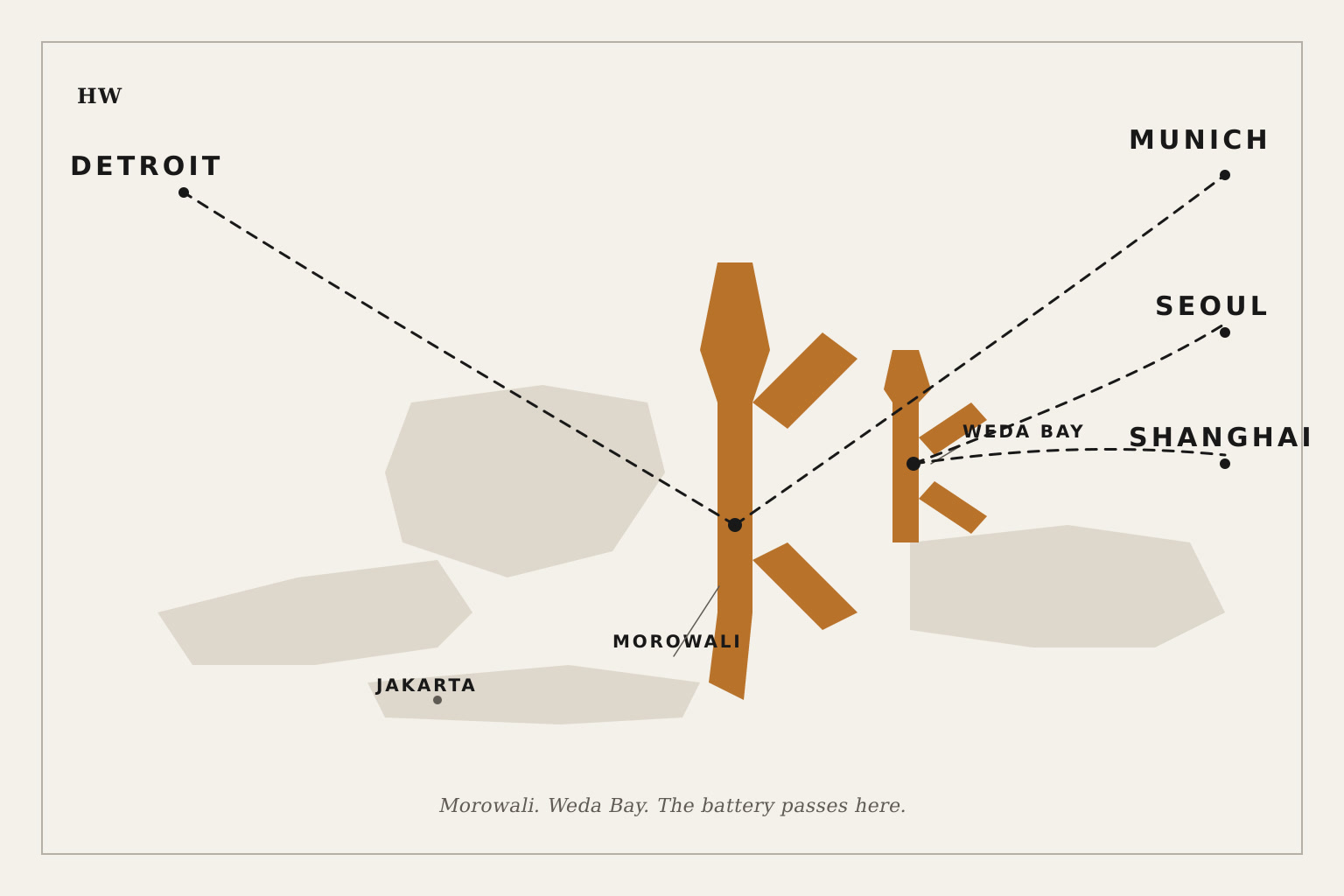
Consider one province, then two islands. Central Sulawesi hosts the Indonesia Morowali Industrial Park, an ash-coloured city of smelters and jetties on a coast that a decade ago mostly grew coconuts. Two thousand kilometres north-east, on the western fringe of Halmahera in the province of North Maluku, the Indonesia Weda Bay Industrial Park does more or less the same thing, on a bigger scale, with a bigger footprint on the sea. Between them, on a good week, Weda Bay alone produces around a sixth of the world’s nickel. Together with the other Indonesian smelters, they push the country’s share of global nickel supply above sixty per cent, up from roughly a third at the start of the decade.
This is not a mining story of the old kind. The battery in a European electric car is not fed by Indonesian ore in the way the smoke of Victorian England was fed by Welsh coal. It is fed by a very specific chemical intermediate — nickel sulfate, or the mixed hydroxide precipitate known in the trade as MHP, produced in high-pressure acid leach plants that only three or four consortia in the world know how to run at scale. Almost every one of those plants sits inside the Indonesian archipelago, and almost every one of them was built by a Chinese firm.
Who built the downstream
Tsingshan Holding Group, the private nickel giant led by Xiang Guangda, put more than fifteen billion dollars into Indonesian nickel infrastructure across a decade of quiet capital deployment. Huayou, GEM, and the battery manufacturer CATL followed. Weda Bay Industrial Park itself is a joint operation between Tsingshan and the French miner Eramet, with Tsingshan running the metallurgy and Eramet running the shareholder-relations story in Paris. The result is that Indonesia’s downstream is neither Western nor sovereign nor accidental. It is a Chinese industrial deployment on foreign soil, executed with a discipline and a speed no Western consortium currently possesses.
None of this happened by market accident. It began in 2020, when then-president Joko Widodo banned exports of raw nickel ore. Foreign smelters that wanted the metal had to come and build inside Indonesia. Almost no Western smelter came. Chinese firms did, aggressively, and were welcomed. Six years on, Indonesia is not simply a large producer of nickel; it is the only place in the world with a working, industrial-scale battery-grade nickel refining cluster, and the operating knowledge of that cluster sits inside Chinese engineering teams.
The Prabowo turn
President Prabowo Subianto inherited this arrangement in October 2024. He has not reversed it. He has done something more interesting: he has begun charging rent for it.
In April 2025, Jakarta replaced its flat ten per cent royalty on nickel ore with a progressive schedule of fourteen to nineteen per cent, indexed to the average London nickel price of the previous month. Crucially, the new schedule was extended past the ore itself to cover nickel sulfate and MHP — the actual battery precursors, previously sheltered as encouraged downstream products. In parallel, the 2026 mining quotas for nickel ore were cut by roughly a third, foreign-exchange retention rules were tightened so that a larger share of export proceeds had to remain in Indonesian banks, and enforcement of environmental and licensing rules against foreign-run plants became noticeably less indulgent.
The Chinese Chamber of Commerce in Indonesia responded with a rare public complaint, warning that comprehensive nickel-ore costs had risen by as much as two hundred per cent and that smelting margins were being squeezed by roughly three hundred dollars per tonne. The South China Morning Post described Chinese investors as spooked; the Fulcrum research group in Singapore has begun openly using the word “nationalism” for what a year ago was called “downstreaming”. In late May 2026, Fortune reported the mood in Beijing as one of hostile takeover across coal, palm oil, and nickel.
The vehicle for the takeover, if that is the right word, is a state investment holding called Danantara. In April 2026, Prabowo used it to break ground on thirteen new natural-resource processing projects worth roughly seven-point-two billion dollars, and Danantara’s executives now speak of a portfolio of eighteen downstream projects worth about thirty-four billion dollars, with nickel at the centre. The same month brought the announcement, at Morowali, of a twenty-billion-dollar joint venture with China’s CATL, South Korea’s Hyundai Motor Group, and LG Energy Solution. Prabowo has, in effect, invited the same Chinese firms and the same Korean carmakers to keep building, but on terms drafted at his desk and priced against his sovereign wealth vehicle. The metal stays in Indonesia. So does more of the margin. The engineering remains largely foreign, but the equity table is being rewritten.
The Western embarrassment
This creates a specific and undiscussed problem for the two political economies that were meant to be leading the energy transition.
The United States Inflation Reduction Act contains a provision, the “Foreign Entity of Concern” rule, that denies EV tax credits to vehicles whose critical minerals were extracted, processed, or recycled by companies with meaningful Chinese ownership or state ties. Applied strictly to nickel, the rule excludes essentially every functioning battery-grade refinery on earth. Almost all of them sit in Indonesia. Most of them are run by Chinese firms. The Treasury has already begun to negotiate its way through this contradiction through quiet threshold exemptions and joint-venture technicalities, because the alternative is that the American EV cost structure collapses on paper.
The European Union’s Critical Raw Materials Act is not so much strict as decorative. It sets targets for domestic extraction, processing, and recycling of strategic materials by 2030 — forty per cent of processing, ten per cent of extraction. Applied to nickel, these numbers are a fantasy that everyone in the sector is too polite to name. There is no European HPAL plant of scale. There is no European engineering consortium currently able to commission one. The Finnish and Norwegian smelters that do exist run mostly on Russian and African ore under the old sulfide chemistry, and are structurally too small to matter for battery-grade demand. Europe is trying to write itself a strategic autonomy for a material whose autonomy sits on the other side of the world, in industrial parks built by Chinese firms on Indonesian coasts.
The benchmark broke, and no one built a new one
The most subtle piece of the story is what happened to the price. On the night of the eighth of March 2022, the London Metal Exchange’s nickel contract stopped working. Tsingshan itself was short an enormous position — between one and two hundred thousand tonnes of the metal — against the physical market that Tsingshan itself was flooding. When Russia invaded Ukraine and nickel prices spiked, the short position exploded. The LME halted trading and retroactively cancelled roughly four billion dollars of trades. Its own independent review, published in 2023, concluded politely that the market had failed its participants.
LME nickel volumes never fully recovered. What was, for half a century, the reference price for the metal is now the reference price for one grade of the metal — London Good Delivery class-one cathode — that does not correspond to what battery makers actually buy. Battery-grade nickel sulfate and MHP are increasingly priced in Chinese and Indonesian bilateral contracts, with Shanghai Futures Exchange nickel and a scattering of index-provider assessments filling the gap. This is a benchmark migration at least as consequential as anything happening in oil or copper, and it has been almost invisible in European strategic discussion. If the material sits inside Indonesia and the price is set in Shanghai, then the metal is no longer a Western asset in anything except paperwork.
What seriousness would require
Seriousness on this file would begin with three admissions and one refusal.
The first admission is geographical. There is no near-term alternative to Sulawesi and Halmahera. Philippine and Papuan lateritic deposits exist, but the plants that could process them do not, and would not, within a decade of Western state-backed capital. Any friendshoring plan that does not accept Indonesian ore as its base is not a plan.
The second admission is metallurgical. HPAL is not something Western consortia can commission from scratch in the timeframe of the transition. Whatever the Draghi report and the Critical Raw Materials Act pretend, Europe will not build a battery-grade nickel industry on its own soil this decade. It can, at best, negotiate a place at the Indonesian table on Prabowo’s terms, in equity partnerships with Danantara, alongside Chinese engineering firms it has spent the last three years denouncing.
The third admission is legal. The Foreign Entity of Concern language in the American IRA and the equivalent moral posture in Brussels is a promise to consumers, not a policy. It will either be quietly gutted through exemptions or it will strangle the transition it was written to protect. Choose one, but stop pretending to do both.
The refusal is the Taoist part. Do not treat Prabowo’s royalty schedule and quota cuts as a hostile act, as Beijing has begun to. Indonesia is doing what any state with a chokepoint on the periodic table would eventually do: it is charging for it. That charge is not the problem. The problem is that Europe and America have both spent the past decade writing legal instruments as though the material would remain politely priced in London.
The closing line
The battery for the German car, the Michigan pickup, the Seoul crossover, and the Shanghai sedan will, on any realistic timeline of this decade, pass at some point through a plant on Sulawesi or Halmahera whose engineers speak Mandarin, whose royalty schedule is indexed in Jakarta, and whose price is settled in Shanghai. The Chinese built the plants. Prabowo now sets the terms. Everyone else is downstream of a downstream that was built while they were arguing about labels. The transition, as it is actually shaped by the geography of nickel, arrives through one archipelago, on someone else’s clock. Europe has responded so far by writing a target.
Sources
South China Morning Post, Indonesia’s nickel rule changes are spooking Chinese investors — on the mood shift in Beijing over Prabowo’s royalty and quota policy.
scmp.com / Week Asia
Korea Times, Chinese firms warn Indonesia’s nickel quotas, tax hikes threaten investment — for the 200 per cent ore-cost figure, the $300/tonne smelting margin, and the China Chamber of Commerce in Indonesia complaint.
koreatimes.co.kr
Business Indonesia, Prabowo launches IDR 116 trillion downstreaming push with 13 new projects — on the April 2026 groundbreaking and Danantara’s coordinating role.
business-indonesia.org
VOI (Voice of Indonesia), Danantara boss: 6 Hilirisasi Era Prabowo projects ready to ground breaking — on the $20bn Morowali JV with CATL, Hyundai Motor Group, and LG.
voi.id
Observer Research Foundation, Indonesia’s Nickel Strategy: Downstreaming and Development — for the progressive 14–19 per cent royalty, its extension to MHP and nickel sulfate, and the EU Critical Raw Materials Act framing.
orfonline.org
China-Global South Project, Indonesia’s Nickel Ambitions Collide With Chinese Investors’ Expectations — on the sixty per cent global-supply figure and the tension between Jakarta and Beijing.
chinaglobalsouth.com
Dialogue Earth, Beneath Indonesia’s big EV dreams loom local costs — for the Weda Bay share of global nickel and the environmental and social footprint of the Halmahera cluster.
dialogue.earth
Tri Bhakti, Future of Indonesian Nickel in EV Battery Production — for the Tsingshan $15bn cumulative investment figure and the Excelsior Nickel Cobalt project.
tribhakti.com
Fortune, Indonesia jolts China with ‘hostile takeover’ of key commodities — for the framing from Beijing’s side and the coal/palm-oil/nickel package.
fortune.com
London Metal Exchange, Independent Review of Events in the Nickel Market in March 2022 (final report, January 2023) — on the cancellation of roughly $4bn of trades and the structural aftermath for the benchmark.
lme.com / independent review
Image: original editorial diagram for HW.