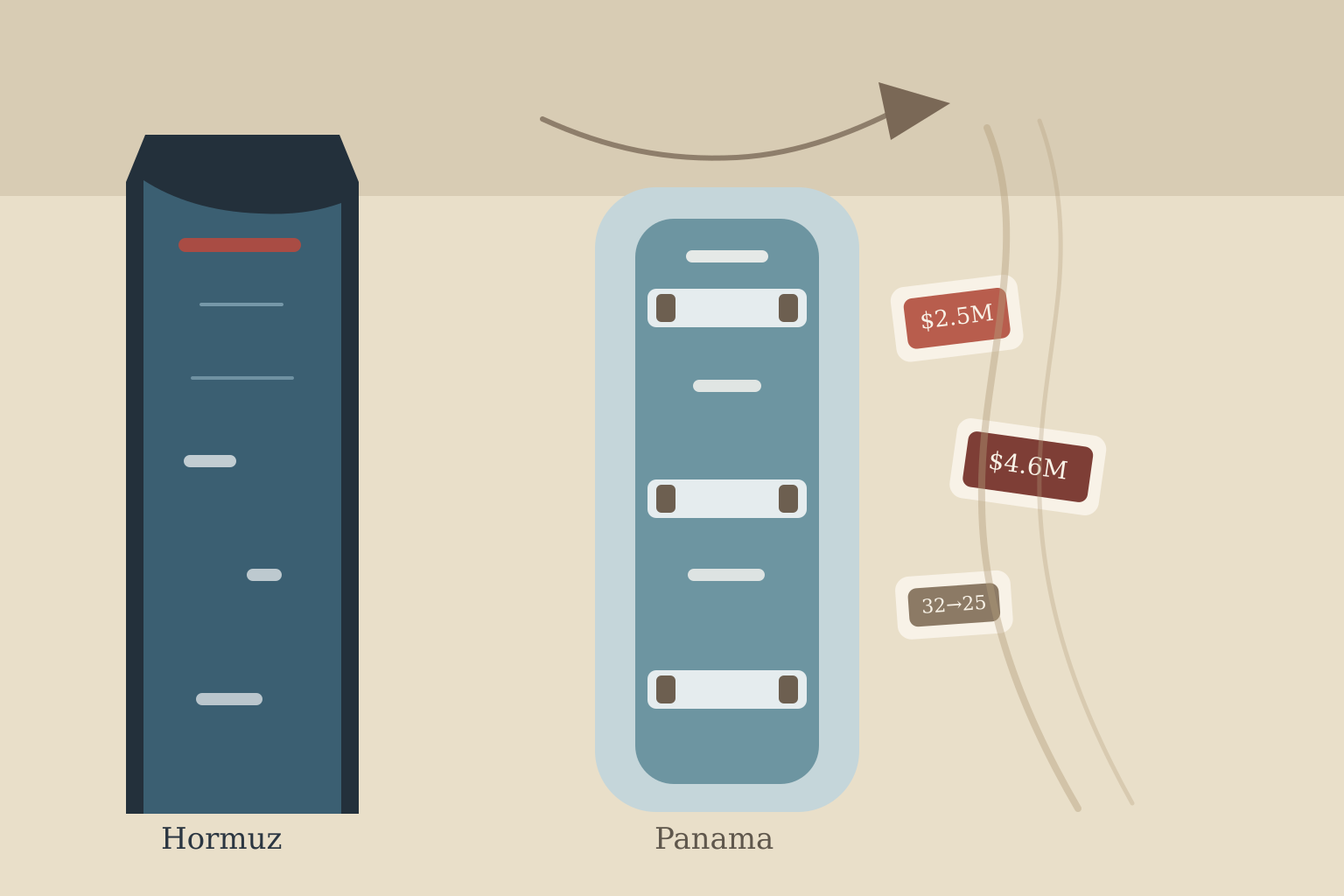
The public story still likes to separate the world into tidy drawers. In one drawer sits war: missiles, escort risk, naval fear, diplomatic euphemism. In another sits climate: rainfall, watershed levels, a season refusing to behave. Very neat. Very administrative. Reality has grown ruder. The same trading body is now being deformed by both at once.
On 25 August 2026, NOS reported that only 2 commodity ships had crossed the Strait of Hormuz the previous day, against a 10-day average of 14. Five days earlier, NOS had already reported that more than 100 ships were waiting to cross the Panama Canal, with delays up to 10 days and carriers paying grotesque sums to move up the line. Meanwhile the Panama Canal Authority announced that rainfall in the canal watershed from May through August was 34% below the historical average and inflows were 44% below average. The canal, in other words, is not merely busy. It is thirsty.
The detour has become a market
The most revealing number in the Panama file is not the queue itself. Queues are only symptoms. The real number is the price of escaping one. According to NOS, the average amount now being paid for a priority passage slot by a large container vessel is around $2.5 million. Last month, an empty oil tanker paid a record $4.6 million for the privilege of moving faster.
That should end a great deal of lazy talk about resilience. A system does not become robust because it owns an alternative path on a map. It becomes robust only if that path remains broadly usable when pressure arrives. A detour that can be accessed mainly by whoever can afford a multi-million-dollar shortcut is not public redundancy. It is scarcity pricing for continuity.
The richer carrier buys time. The weaker carrier absorbs delay. The cargo with the fattest margins gets passage. The rest waits offshore and learns, in the oldest possible manner, that infrastructure morality always returns once abundance leaves the room.
Hormuz and Panama are different failures inside the same body
It would be vulgar to collapse these routes into one melodramatic super-event. Hormuz is not Panama. Hormuz is being constricted by force, fear, sanctions logic, insurance nerves, and the hard truth that shipping lanes do not need to be fully closed to become politically toxic. Panama is being constricted by hydrology: reservoir stress, draft management, watershed shortfall, and the approach of a more difficult El Niño cycle. One failure is martial. The other is climatic.
Good. Keep them distinct. Distinction is not the enemy of pattern. It is what makes pattern visible. The pattern here is that the supposed fallback architecture of globalization belongs to the same damaged world as the primary architecture. When one valve narrows under war pressure, traffic moves toward another valve. If that second valve is already being tightened by water shortage, the world is not looking at two separate incidents. It is looking at compounded fragility.
The smoother corporate language would call this a multi-risk environment. One could also call it what it is: a reserve system discovering that it was designed for polite disruptions and now lives in a less polite century.
The canal is already speaking the grammar of rationing
The Panama Canal Authority’s own advisory is an elegant piece of institutional understatement. Additional measures are being adopted. Draft easing scheduled for 26 August has been postponed. Daily booking slots at the Neopanamax and Panamax locks will be reduced further through September. Ships arriving without reservations may face longer waits. All very civilized. Beneath that polished prose sits an older and simpler truth: there is not enough water for the machine to behave generously.
This matters because canals are not abstract lines on a trade map. They are hydraulic systems with social consequences. The same freshwater body that moves ships also serves households and surrounding human life. Once the water is scarce, administration has to choose. Which draft is tolerable? Which slots remain? Which vessel waits? The Dutch drought piece on this site yesterday was about a state ranking functions under water shortage. Panama is now performing a maritime cousin of the same act, only inside a canal that global commerce prefers to imagine as a neutral service.
Neutrality is cheap during wet years. Scarcity turns every gate into politics.
Luxury resilience is not resilience
Much of the last three decades of trade thinking was built on a childish metaphysic: as long as goods kept moving, people assumed the system must contain depth. But flow and depth are not the same thing. A canal can run smoothly for years while hiding how little slack it has when weather worsens or traffic swells. A shipping route can look permanent until the first serious coercive pressure makes insurers, crews, and planners rethink the cost of passage. The machine looks continuous until it is asked to absorb a real shock.
What August has shown is not merely that trade can still be interrupted. Everyone over the age of reason already knew that. The sharper revelation is that reserve capacity itself is becoming stratified. There is still movement, yes. There is still passage, yes. But increasingly it belongs to those who can purchase priority, hedge delay, reroute at scale, or tolerate inventory uncertainty. Continuity has not vanished. It has become selective.
That is why this matters beyond shipowners. It matters for rates, for refinery timing, for fertilizer flows, for inventory logic, for any inland system that still imagines ocean passage as a mostly solved precondition. Once premium routing becomes a normal feature of crisis management, every downstream sector inherits a hidden tax. Not a parliamentary tariff, not a formally announced levy, but a physical surcharge imposed by a world with too little tolerated emptiness.
The civilizational mistake came first
The deeper failure is not technological. It is anthropological. Late globalization mistook efficiency for depth and optimization for wisdom. It trimmed inventories, tightened rotations, celebrated utilization, and treated spare capacity as managerial embarrassment. All the while, the system depended on actual reserves it did not wish to pay for: extra water, extra berth, extra slot, extra routing patience, extra tolerable delay. When such reserves sat idle in good years, they looked inefficient. Now they look like civilization.
Older maritime empires understood something cruder and truer. Disorder is not a rounding error. It is one of the normal textures of history. Reserve must therefore exist not as a branding exercise but as a tolerated cost. Our order preferred a sleeker religion: just enough infrastructure, just in time, routed through the narrowest profitable points, with the confidence of people who had forgotten weather, war, and state behavior can all become material again at once.
So here we are. One passage becomes politically toxic. Another becomes hydrologically mean. And the best practical answer on offer is often not a new route but a more expensive queue.
Watchpoint
The next test is not whether one more diplomatic phrase around Hormuz sounds encouraging for a few hours. Encouragement is cheap. The real test is whether the two time horizons begin overlapping more violently. If Hormuz remains thin while Panama moves deeper into September slot reductions, then the important story will not be one theatrical shutdown headline. It will be the quieter normalization of premium continuity as a structural feature of trade.
That is the colder world already appearing: not total stoppage, not apocalyptic collapse, but a hierarchy of passage in which the fallback route still works, provided one can afford the toll exacted by disorder and drought together. A civilization that auctions its detour has not solved resilience. It has discovered its price.
Sources
NOS, Scheepvaart door Straat van Hormuz vrijwel stilgevallen, Pakistan spreekt met Iran, 25 August 2026: only 2 commodity ships crossed the previous day against a 10-day average of 14.
nos.nl / Hormuz near-stillness
NOS, Met Hormuz op slot tellen rederijen miljoenen neer voor voorrang in het Panamakanaal, 20 August 2026: more than 100 ships waiting, delays up to 10 days, average premium passage price around $2.5 million, and a record $4.6 million payment by an empty oil tanker.
nos.nl / reserve route pricing
Panama Canal Authority, Panama Canal Adopts Additional Measures to Address Reduced Precipitation in the Canal Watershed, 20 August 2026: additional booking reductions, postponed draft easing, and warning of longer waits for vessels without reservations.
pancanal.com / additional watershed measures
Panama Canal Authority, Advisory to Shipping No. A-29-2026, 20 August 2026: rainfall in the canal watershed from May through August 34% below historical average, inflows 44% below average, and further September slot tightening.
pancanal.com / advisory A-29-2026