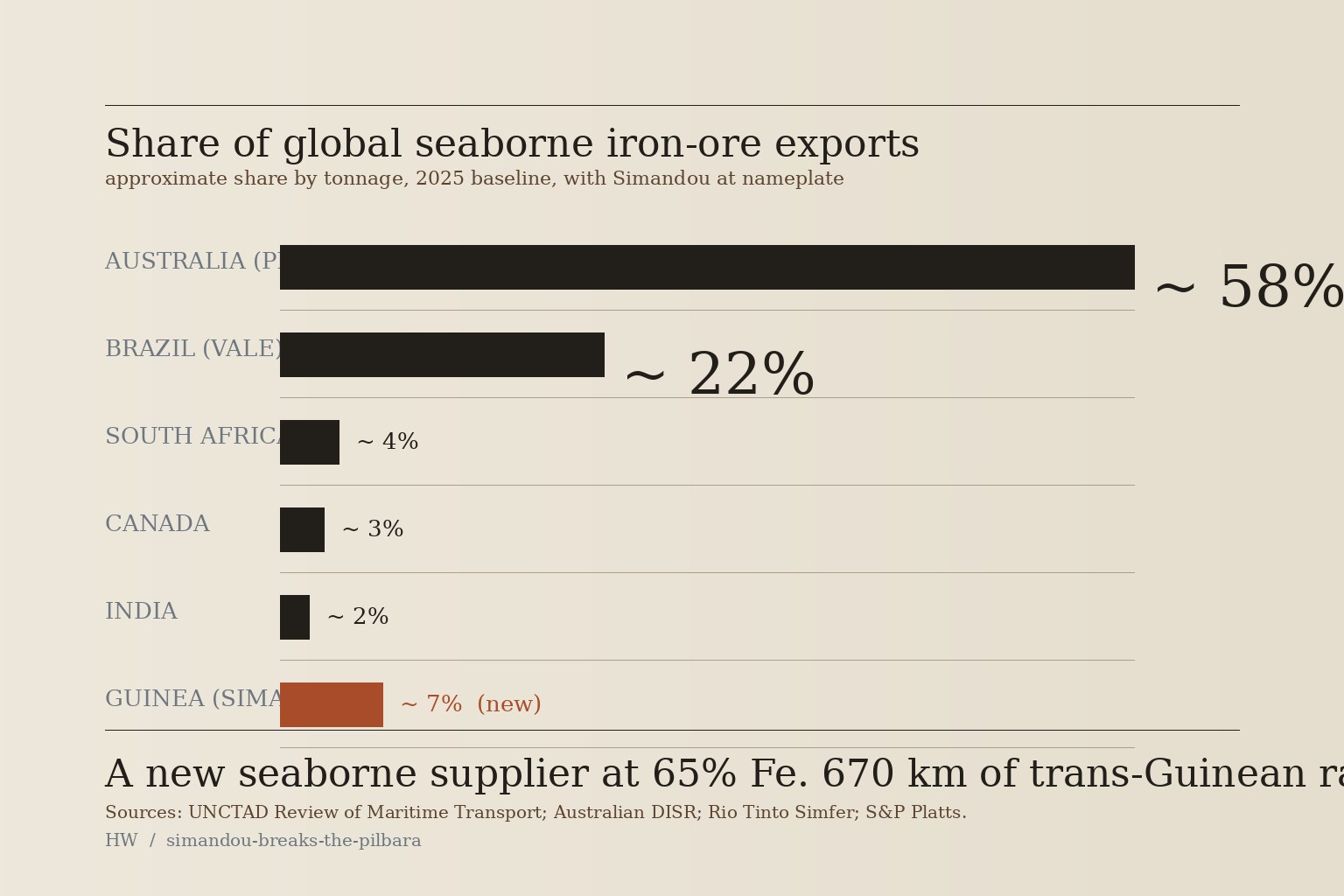
Iron ore is the quiet metal of the modern economy. It is dirtier than lithium, less photogenic than copper, and almost never debated in parliaments. It is also, by seaborne tonnage, the largest commodity trade in the world. Roughly one and a half billion tonnes of it cross oceans each year, a flow greater than the entire tonnage of all petroleum and refined products moved by sea. About sixty percent of that trade comes from one place: the Pilbara, a hot, red, hundred-and-sixty-thousand square kilometre province in Western Australia from which BHP, Rio Tinto, and Fortescue together ship close to nine hundred million tonnes of iron ore every year, almost all of it to China.[1][2]
That arrangement — one buyer, one coast, three sellers — has governed world steel pricing since the end of the long-term benchmark system in 2010. Chinese steel margins swing by Pilbara shipping schedules. Capesize freight rates orbit around Port Hedland. Half the global dry bulk fleet exists, in effect, to serve a two-thousand kilometre triangle between northwest Australia, Qingdao, and the Strait of Malacca. It is one of the most concentrated commercial dependencies the industrial world has ever accepted.
Beijing has not accepted it for a long time. What it has done about it is Simandou.
What is actually being built
The Simandou range is a ridge of hills some seven hundred kilometres inland from the Guinean Atlantic coast, in a corner of West Africa that has produced bauxite, coups, and almost nothing else of global economic consequence. Beneath it sits an iron-ore body of a quality that effectively does not exist elsewhere at commercial scale: direct-shipping hematite grading between sixty-five and sixty-six and a half percent iron, against a Pilbara average now hovering around sixty-two percent and sliding. Grade is the single variable that decides how much coke a blast furnace must burn to make a tonne of pig iron. Each extra percentage point of iron content is, by a reasonable rule of thumb, three to four percent less coke, three to four percent less CO2, three to four percent less slag to dispose of. For a Chinese steel sector that must now hit a 2030 carbon-intensity target it cannot plausibly reach on Pilbara ore, that difference is strategic, not marginal.[3][4]
The deposit was mapped by Rio Tinto in the mid-1990s. It then sat for nearly thirty years, serving as an unusually elegant case study in how to lose a deposit through legal theatre: a litigation storm between Rio, BSG Resources, Vale, three Guinean governments, and the United States Department of Justice, during which no ore moved and most observers concluded the ridge would stay in the ground indefinitely.
What finally unlocked it was not Western investment banking or an Australian major’s risk committee. It was a Guinean junta in a hurry, a Singapore-registered shipping group with Chinese capital, and the industrial-policy patience of the government of the People’s Republic.
The project is split in two along the ridge. Blocks 1 and 2, on the northern side, are held by the Winning Consortium Simandou — a vehicle controlled by the Singaporean shipping and bauxite group Winning International together with Shandong Weiqiao and the state-adjacent Chinese group China Hongqiao, plus the Guinean state. Blocks 3 and 4, to the south, are developed by Simfer, a joint venture between Rio Tinto and a Chinese consortium led by Chinalco (Aluminum Corporation of China), with the Guinean state again at the table. Together the two concessions will, when ramped, produce roughly one hundred and twenty million tonnes of iron ore a year: five to seven percent of all global seaborne iron trade, from a single African country.[5][6]
The ore is the easy part. The infrastructure is the real work. A single-track electrified heavy-haul railway, six hundred and seventy kilometres long, runs from the ridge west through tropical mountains, savannah, and swamp to a brand-new deepwater port at Morebaya on the Atlantic coast south of Conakry. The railway crosses dozens of rivers, two mountain ranges, and a stretch of Fouta Djallon so logistically unforgiving that French colonial engineers abandoned similar routes a century ago. The port required dredging a channel through soft estuarine mud deep enough for Chinamax dry bulkers of four hundred thousand deadweight tonnes — the largest ships ever built for a single commodity. The whole railway-and-port corridor is being delivered on an engineer-procure-construct basis mainly by Chinese state contractors (China Railway, China Communications Construction, China Harbour Engineering), financed in a stack that leans heavily on Chinese policy banks, and operated going forward under a shared infrastructure arrangement co-managed by the Simfer and Winning consortia alongside a Guinean compagnie du corridor.[6][7]
First ore has been scheduled, slipped, re-scheduled, and slipped again, which is normal for a project of this scale. The current operating target is first commercial shipments through 2026, ramp to roughly sixty million tonnes a year across the ridge by 2028, and the full one hundred and twenty million tonnes a year by the end of the decade. Each of those milestones will be fought over and probably missed by months. None of them will be missed by years.
Why this is not just another mine
The world is littered with large iron-ore projects. What makes Simandou structural rather than incremental is the combination of four facts.
First, the grade. Pilbara ore is slowly declining in quality as the giants mine deeper into their original deposits; what was sixty-four percent Fe in the 1990s is sixty-two percent today and, on current trajectories, closer to sixty percent by the 2030s. A new seaborne supply at sixty-five-plus percent does not merely add to the market: it rewrites it. Blast furnaces blended on Simandou ore need less coke, which means less metallurgical coal, which means a different set of mines in Queensland and Mongolia become less essential. The chain reaction travels further than iron ore itself.
Second, the ownership. Unlike the Pilbara, where the ore is dug by Australian majors and sold at arm’s length to Chinese buyers, Simandou is being developed inside the Chinese industrial chain. Chinalco is a Chinese state-owned enterprise. Shandong Weiqiao is the aluminium arm of the world’s largest private aluminium producer, closely coordinated with Beijing on strategic sourcing. The Winning side moves bauxite into Chinese smelters that themselves answer to the China Nonferrous Metals Industry Association. A material share of Simandou output will never see a spot price in any meaningful sense; it will move at internal-transfer prices within an integrated Chinese value chain. That matters because the Pilbara’s pricing power was always a function of the fact that its ore had to be sold. Simandou ore does not have to be sold. It only has to be smelted.
Third, the logistics. The Morebaya port and the seven-hundred-kilometre railway are not just a greenfield mine’s access road. They are the backbone of a wider Chinese West African logistics corridor whose next layers are already being discussed: a bauxite spur from Boffa, a potential rail extension into Mali to pick up iron and gold, interconnection with the planned Lobé iron-ore project in Cameroon on the other side of the Gulf of Guinea. For the first time, there will be a modern heavy-haul rail-and-port system on the Atlantic face of West Africa that is engineered, financed, and increasingly operated to Chinese standards. Once that exists, more commodities begin to find their way to it.
Fourth, the state capacity. Guinea’s military government has done something post-colonial Guinean governments had conspicuously failed to do for forty years: it has forced the operators to actually build the railway and port on a schedule. By revoking concessions that sat idle, by inserting the state as a direct equity holder, and by threatening to seize mines that did not deliver infrastructure, Conakry has borrowed a page from the Chinese state-capitalist playbook. The result is unsentimental and effective. The ridge that lay dormant through three decades of Western ownership is now a construction site.
What happens to the Pilbara
The Pilbara does not collapse. It is too large, too close to Asia, and too well-run for that. BHP and Rio Tinto will go on shipping their eight hundred million tonnes a year, and Fortescue will go on fighting for the margin at the low-grade end. But three things change at once.
The price-setting function shifts. For twenty years the marginal Chinese importer has been a Pilbara buyer. From 2027 onwards the marginal importer will increasingly be a buyer blending Simandou high-grade with Pilbara mid-grade, and the index that matters will be the discount applied to the Pilbara product, not the premium above it. The era of Pilbara producers writing the headline price ends when a credible alternative sixty-five-percent product exists in volume. One hundred and twenty million tonnes a year is credible volume.
The freight geography shifts. A full Simandou at nameplate adds roughly ten thousand Capesize voyages a year on the West Africa – East China arc — a route some three times longer than the Pilbara-to-Qingdao triangle. The world dry bulk fleet, which effectively over-sized itself for Pilbara distances, suddenly has a reason to exist on longer legs. Chinese shipbuilders in Shanghai, Dalian, and Qingdao — already dominant in Capesize construction — will be the direct beneficiaries. Australian ports lose some marginal tonnage. The Cape of Good Hope and the Strait of Malacca both see meaningfully more traffic. Insurance pools, bunker contracts, and crew supply quietly rotate towards West African nodes.
The political economy of Australian iron shifts hardest of all. Pilbara royalties are a load-bearing beam of the Western Australian state budget and a significant minority of the federal budget’s commodity-tax base. A fifteen percent squeeze on the realised price per tonne — well within the range of what analysts expect once Simandou is at nameplate — translates into tens of billions of Australian dollars of foregone revenue over a decade. Canberra has spent four years treating the iron trade as a diplomatic buffer in its relationship with Beijing; the leverage of that buffer is about to be worth measurably less.
What this says about the next phase of trade
Simandou is not an isolated event. It is one of a family of African commodity corridors in which China has quietly made itself the organising state capacity: the Lobito corridor from the DRC copperbelt through Angola to the Atlantic, the Mombasa – Nairobi standard-gauge railway, the Lagos – Ibadan line, the Boffa – Kamsar bauxite stack, the proposed Mtwara and Bagamoyo port complexes. Taken individually, each one is a mine or a line. Taken together, they constitute the construction of a parallel African raw-materials system that is engineered, financed, dispatched, and increasingly standardised through a non-Western industrial grid.
The point is not that China now “owns” Africa, which is the lazy framing. The point is more interesting and harder to reverse: for the first time since the late nineteenth century, there exists an operational heavy-industrial logistics system in the Atlantic bulge of Africa that is not primarily a continuation of a European colonial geometry. Freight does not flow north toward Rotterdam and Antwerp. It flows east, by sea, toward Shandong, Jiangsu, and Fujian. The accompanying law — concession terms, dispute resolution, standard clauses, arbitration seats — is slowly tilting in the same direction.
European and American industrial strategists have spent the last five years announcing initiatives — Global Gateway, Partnership for Global Infrastructure and Investment, the Lobito concession — that imagine a Western re-entry into African critical minerals and bulk commodities. The budgets of those initiatives are small, their execution slow, and their timeline measured in press releases rather than ore trains. Meanwhile, in the Simandou valley, a Chinese-built railway is being commissioned. The map does not wait for the communiqué.
The quiet shape of the next decade
Taken seriously, Simandou tells a specific story about the coming decade in bulk commodities and heavy industry.
The Pilbara stays large but stops being decisive. Australia remains the biggest single exporter of iron ore for the rest of the decade. It stops being the price-setter.
African infrastructure follows the ore. One serious heavy-haul rail-and-port system in West Africa, delivered to Chinese design standards, becomes the scaffold for the next five commodity corridors, not just one. The marginal cost of the sixth project is a fraction of the first.
Steel decarbonisation runs through Guinea. China’s 2030 steel-sector carbon targets are much more achievable with Simandou in the blend than without it. European and Japanese steelmakers that want low-emission steel will quietly end up buying African high-grade ore too, through blended cargoes they will prefer not to describe clearly.
Guinea becomes something new. A small, poor, repeatedly unstable state becomes the location of a materially important twenty-first century industrial asset, co-managed by a Chinese consortium, an Anglo-Australian major, and a military government that has learned the uses of leverage. The eventual political economy of that arrangement will not resemble any Western textbook. It will resemble, more than anything, nineteenth-century mining Chile under better engineering and worse rainfall.
The seaborne map lengthens. The world’s single largest dry bulk trade quietly adds thousands of kilometres of average voyage distance. Shipping, bunkering, insurance, and ship finance follow. Over a decade, this is a quiet revaluation of maritime geography on the order of a mid-sized canal opening.
The hidden piece, again
Every age thinks its own commodity decisions are made at the top of the stack: in the boardroom, the finance ministry, the central bank. The structural ones are almost always made somewhere further down, in the layer that nobody writes about until it is already working. In the 1920s it was the Mesabi iron range in Minnesota. In the 1960s it was the Pilbara itself. In the 2020s it is a ridge of green hills in southeast Guinea whose name most European chancelleries still cannot reliably pronounce.
The chip wars, as before, will keep producing the headlines. The iron war has already been fought and quietly lost on one side. A railway through the Fouta Djallon decides, in a way no summit communiqué ever will, the price per tonne of the slab that becomes the next generation of ships, bridges, wind-turbine towers, and bomb casings.
A ridge of hills. A single-track railway. A deepwater port cut from estuarine mud. One hundred and twenty million tonnes a year, moving east. The next decade of the heavy economy, decided underneath a canopy of palm oil trees that most readers of this page will never see.
Sources
[1] United Nations Conference on Trade and Development, Review of Maritime Transport (2024–2025 editions): iron ore as the largest dry bulk seaborne trade by tonnage and the Australia-China arc as the dominant single commodity route in global shipping.
unctad.org / Review of Maritime Transport
[2] Australian Government, Department of Industry, Science and Resources, Resources and Energy Quarterly: Pilbara export volumes, grade trajectories, and Chinese import share of Australian iron ore.
industry.gov.au / Resources and Energy Quarterly
[3] International Energy Agency, Iron and Steel Technology Roadmap and 2024–2025 updates on China’s steel decarbonisation pathway: the structural importance of blast-furnace charge grade and the direct link between ore iron content, coke consumption, and CO2 intensity per tonne of pig iron.
iea.org / iron and steel technology roadmap
[4] S&P Global Platts and Fastmarkets MB iron-ore benchmark coverage: Pilbara mid-grade and Simandou high-grade specifications, including the discount-to-premium structure in the 62% / 65% Fe indices.
spglobal.com / commodity insights
[5] Rio Tinto investor materials and media releases on the Simfer joint venture, Simandou blocks 3 and 4 development, railway and port scope, and ramp schedule.
riotinto.com / Simandou
[6] Caixin Global and SCMP coverage of the Winning Consortium Simandou, China Hongqiao, Shandong Weiqiao, and the Chinalco-led stake in Simfer, including policy-bank financing structure and the role of Chinese EPC contractors on the trans-Guinean rail-and-port corridor.
scmp.com / china business
[7] Reuters and Bloomberg reporting on Guinea’s military government under the National Committee of Reconciliation and Development, the renegotiated Simandou convention, concession terms, state equity, and the Morebaya port design parameters.
reuters.com / business
[8] United Nations Economic Commission for Africa, Africa Mining Vision implementation reports, and Jeune Afrique coverage of regional corridor planning in Guinea, Mali, Cameroon, and Angola: the wider shape of the parallel African raw-materials logistics system within which Simandou is one node.
uneca.org