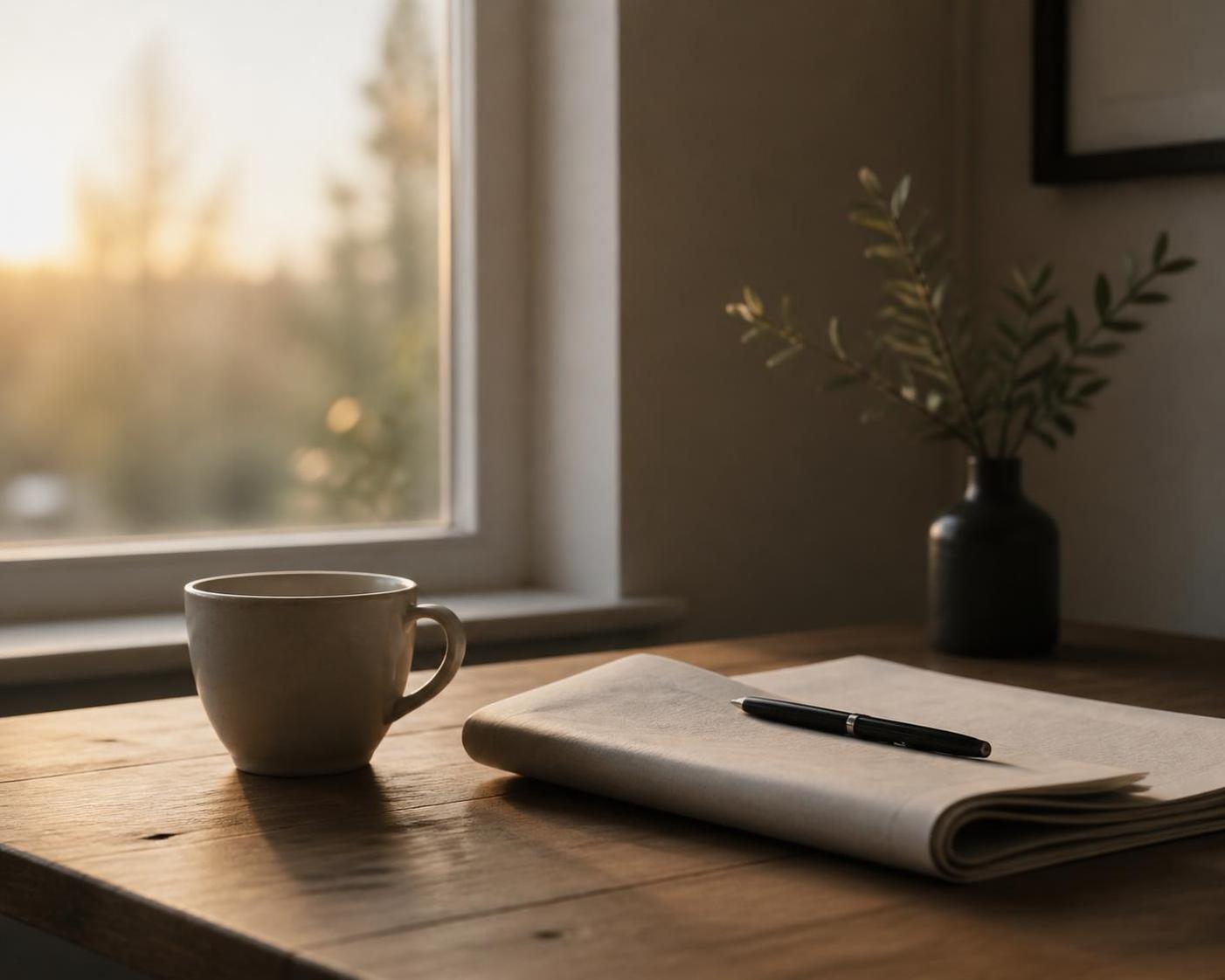
The morning table by the window has one duty before all others: it should not panic. The day outside may already be full of ministries, shipping lanes, drone footage, market futures, and the usual choir of experts clearing their throats in public. None of that is the room's business in the first ten minutes. The room's business is light, temperature, proportion, and the old courtesy of letting a person arrive before the century starts prosecuting them.
A table fit for this hour requires almost nothing. A ceramic cup, because the hand deserves weight before argument. A folded paper, because news should first present itself as an object rather than a seizure. A pen, because one should be able to answer the morning in one's own sentences before being dragooned into other people's. That is all. Once these three things are in place, the room stops being storage and becomes a kind of magistrate.
Most people now meet the day through a glowing rectangle that wakes already hysterical. Messages before breath. Headlines before posture. Somebody else's alarm before one's own inner weather has had time to report for duty. It is a barbarous arrangement, and one pays for it all afternoon. The body may be upright, but attention has already been outsourced. A good morning table refuses that sequence. First the cup. Then the room. Then perhaps the page. Only after that does one admit the wider machinery.
The newspaper, for all its senility and vanities, still has one moral advantage over the screen: it sits there and waits to be opened. It does not thrust itself through the keyhole. It does not strobe or vibrate or claim urgency because a junior editor somewhere mistook traffic for history. A folded paper on the table is a negotiable thing. You may choose to read it now, later, or not at all. The paper still remembers that attention belongs to the reader. The screen, more and more, assumes the opposite.
The pen matters for the same reason. It reminds the room that consciousness is not merely receptive. One line in the margin, one date, one phrase copied down before the article has finished patronising you, and the balance changes. The room becomes reciprocal. You are no longer only receiving the world. You are marking it, resisting it, or occasionally correcting the pompous bastards who wrote it.
Morning light helps, but not in the sentimental way lifestyle magazines pretend. One does not need the theatre of a Tuscan kitchen or a haiku-worthy curtain. One needs only enough light to distinguish the grain of the table from the folded edge of the paper and to keep the cup from looking like a prop. The room should feel used, not staged. A small stain in the wood is better than marble virtue. A chair that has been sat in honestly is better than decorative purity. Civilisation does not survive by pretending no one lives in it.
There is also a political lesson hiding in this little arrangement. A person who begins the day at a table before the news is harder to govern by agitation. Not immune, of course; that would be childish. But harder. The mind has already touched one real surface, held one warm object, made one mark of its own. It enters the public storm with at least a little ballast. Without such ballast, the day becomes whatever the first loud voice declared it to be.
This is why I prefer the morning table to almost every other domestic scene. It is not a shrine, not a productivity altar, not an Instagram lie about “slow living”. It is simply the smallest workable border crossing between private order and public noise. The customs officers are a cup, a folded paper, and a pen. If they do their job properly, half the world's nonsense is delayed at the frontier.
Keep the first ten minutes for the room. The headlines can wait at the door like everyone else.