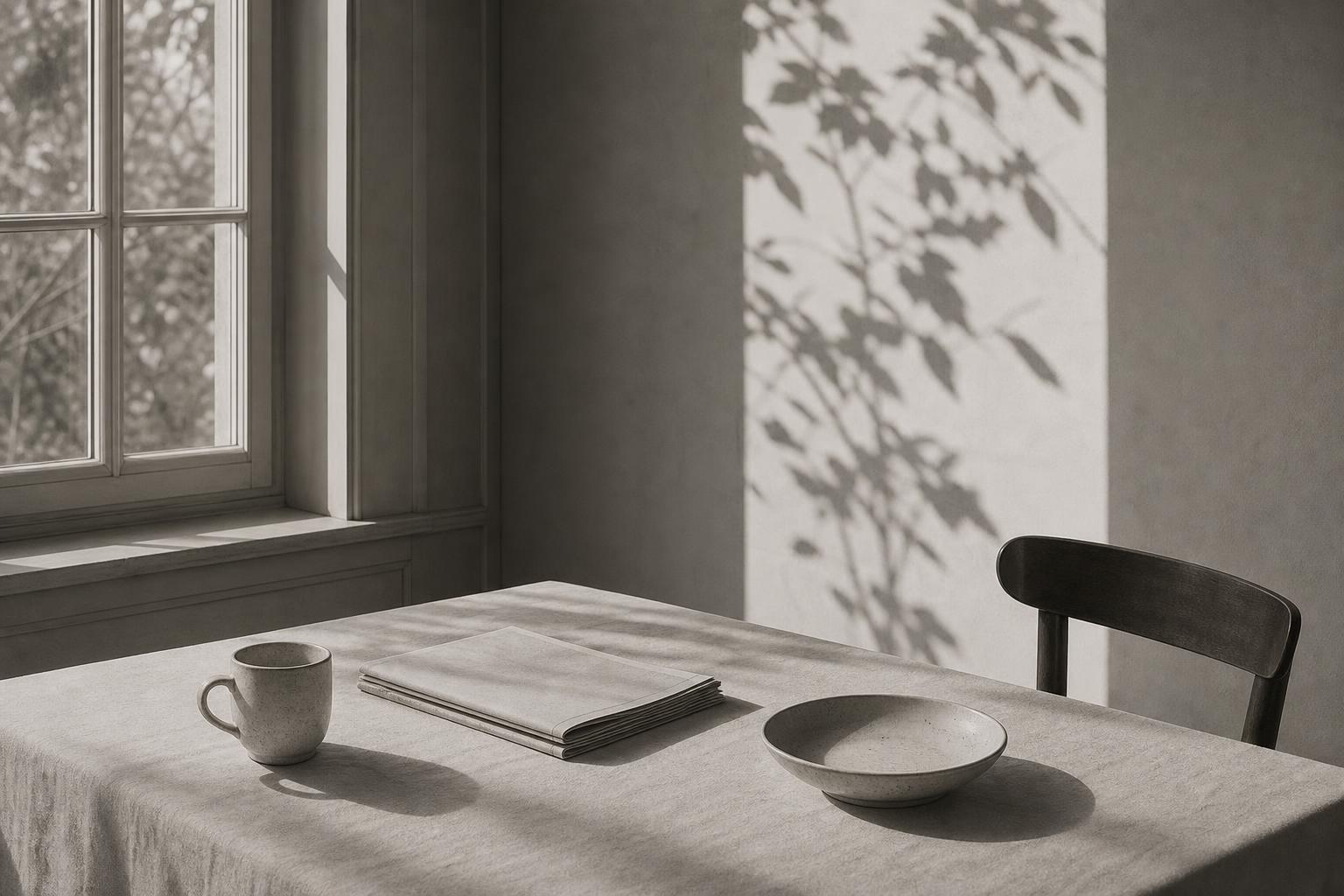
Every serious room has one object that reveals immediately whether the people living in it are governing themselves or merely camping among possessions. Very often it is the table.
Not the dining table under theatrical strain at eleven in the evening, burdened by bottles, declarations, and one guest too many. I mean the table before noon: the small republic of cup, plate, newspaper, notebook, fruit, crumbs, ash, light. The table at that hour is diagnostic. It shows whether a life has structure without needing to announce a lifestyle.
Modern domestic culture has done its best to ruin this understanding. It photographs rooms as if they were waiting to be sold, or else as if every object were a cry for help from a personality desperate to be called curated. But a good table is not curated. It is governed. There is a difference. One is visual vanity. The other is a working arrangement between attention and use.
The table before noon should not be spotless in the hotel sense. That would be sterile, and slightly suspect. But it should show evidence of intelligent sequence. Someone sat here. Someone read something worth reading. Someone drank something properly hot. Something was written down before the world began shouting its nonsense through wires.
I have always distrusted houses in which every surface is either decorative or abandoned. Decoration alone produces dead rooms. Abandonment produces moral leakage. The civilised interior lives somewhere in between: a place where objects are allowed to work, but not to decay into background sludge.
This is why the Sunday table matters. It is the place where private order resists both negligence and performance. A ceramic cup, because not every liquid deserves plastic humiliation. A folded paper or a notebook, because the day should pass through language before it passes through apps. Perhaps flowers, if one is not sentimental about them. Perhaps a knife, an orange, a pot of jam, a plate with the remains of breakfast, if breakfast was made by someone who understands that nourishment need not arrive wrapped like industrial evidence.
Such details are small, yes. So are valves in a heating system and bearings in a train axle. Civilisation often survives in the maintenance of modest things. It is one of the great idiocies of our age that people can speak grandly about values while living among surfaces that suggest total surrender to drift.
The table before noon is therefore not just furniture. It is a measure of whether the household still knows how to begin. If the room can think before lunch, there is hope for the people in it. If not, the rest of the week will probably be a compost heap with Wi-Fi.