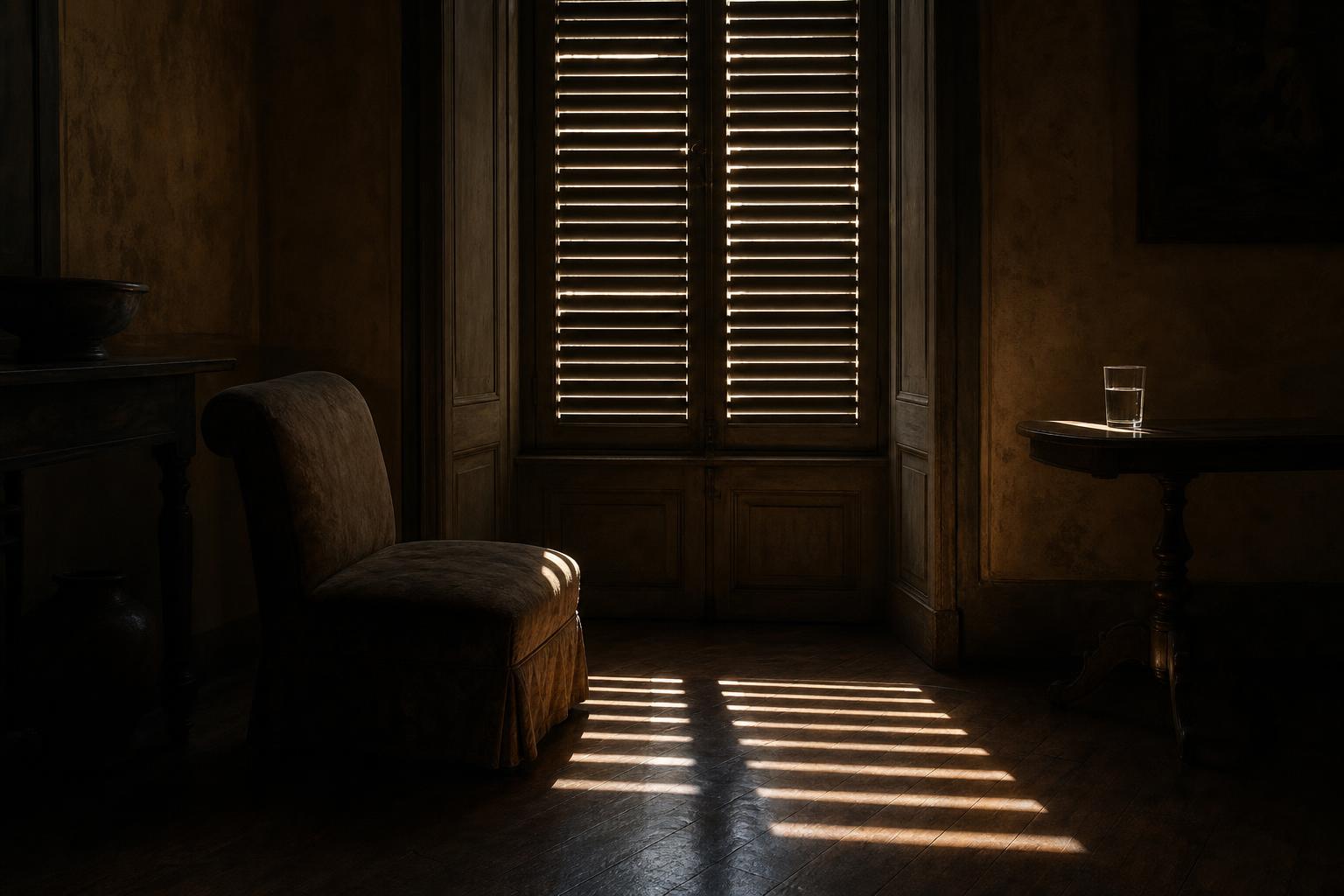
Around two in the afternoon in a real summer, a serious room does something very small and very old: it closes. A shutter is drawn. A blind is lowered. A curtain that has spent the morning politely aside is released, and the room, for perhaps two hours, agrees not to argue with the sun. The wooden floor cools half a degree. The glass of water on the small table becomes the most important object in the house. Everything else recedes.
This is not sleep, though sleep may happen in it. It is not laziness, though the productivist mind will read it that way. It is a form of intelligence about heat, light, and the human day — one that most of the Mediterranean, most of North Africa, most of the Levant, most of South Asia, and much of southern China have quietly held for centuries, and that the northern-European working mind, addicted to the vertical eight hours, has never been able to take seriously without embarrassment.
The shuttered hour is a decision the room makes on behalf of the person inside it. In the good version, one does not have to muster willpower. The building itself insists. Thick walls, small windows, deep loggias, cane shutters, tiled floors, a fan turning at half speed, a bowl of fruit on a marble slab — the architecture is doing the argument for you. All you have to do is stop.
In the bad version, which is now most of northern Europe, the architecture is against you. Vast glass, no shutter, no eave, a thin brick wall, a sealed unit, a floor that swallows heat, a room that pretends to be the same room in February and in July because that is more efficient for the developer. In such a room the shuttered hour is impossible. One can only sit in the glare and pretend to work.
I take this loss more seriously than it sounds. A civilisation that has forgotten the hour of pause has usually also forgotten a few larger things: that the body has a rhythm, that the day has a shape, that time is not liquid capital to be pumped into whatever container is open. When Justus's grandparents' generation closed the shutters in Wilrijk in the afternoon of a hot day, they were not being quaint. They were doing what people who understand summer have always done. The generation that ridiculed them for it now buys expensive Italian linen sheets, expensive Japanese fans, and expensive Mediterranean holidays, in order to purchase back — as luxury — what was once ordinary domestic competence.
The Taoists would recognise this instantly. The shuttered hour is wu wei in domestic form: yielding to what the day is doing, so that when the day softens again, one is intact. Water finds its level. The room lowers itself. The mind, in the darkened afternoon, does not do less; it does differently. It broods, associates, drifts, and often, without being asked, delivers by six o'clock the sentence one could not force out at two.
There is also, if one lets it, a mild sensuality to the shuttered hour that decent northern Protestantism has always distrusted. The half-light. The bare arm on the cool sheet. The distant voices in the street muffled by the wooden slats. A room in the middle of the afternoon, closed against the heat, is one of the few places in modern life where nothing is being sold to you, no notification is being answered, and no one, briefly, expects anything. That is not a small resource. A civilisation that has abolished it has abolished something more than a habit.
One does not need shutters carved by an ancestor in Puglia to practise this. Any half-serious northern room can be persuaded to try. Draw the blind at two. Do not answer the message. Do not open the machine. Move the chair back a metre from the window. Pour water into a plain glass. Let the light in the room become narrow, striped, sculptural. Read three pages of something old, or none. Wait. Around four, when the vertical hour has passed and the light on the floor has softened, open one shutter again, and start the second half of the day as an adult.
The room, in July, has more wisdom than the calendar. Let it close when it needs to close.