Heat is easiest to manage before it fully enters the room. Once the air has thickened, the blinds are still up, the table is carrying yesterday's residue, and every soft surface has begun hoarding warmth, people start behaving theatrically. They complain, they drift, they buy some little machine with blue lights, they speak as if the weather has committed a private insult. But most summer domestic misery is not fate. It is lateness.
The room before heat is therefore a test of adulthood. Not because anything heroic is required, but because sequence is. One closes what should be closed early enough, opens what should be opened while the air is still useful, clears what will feel intolerable later, and stops acting surprised by the fact that July behaves like July. People who can plan a holiday six months ahead somehow fail to understand that shutters, windows, cloth, and surfaces also belong to time.
Modern domestic culture has produced two equally foolish responses. The first is passive surrender: let the room bake, then mutter darkly through the afternoon as if one were trapped in history. The second is gadget piety: a worship of expensive cooling devices, humming purifiers, and app-managed consolation, all purchased to avoid the embarrassment of simple household judgment. Both responses confuse equipment with stewardship.
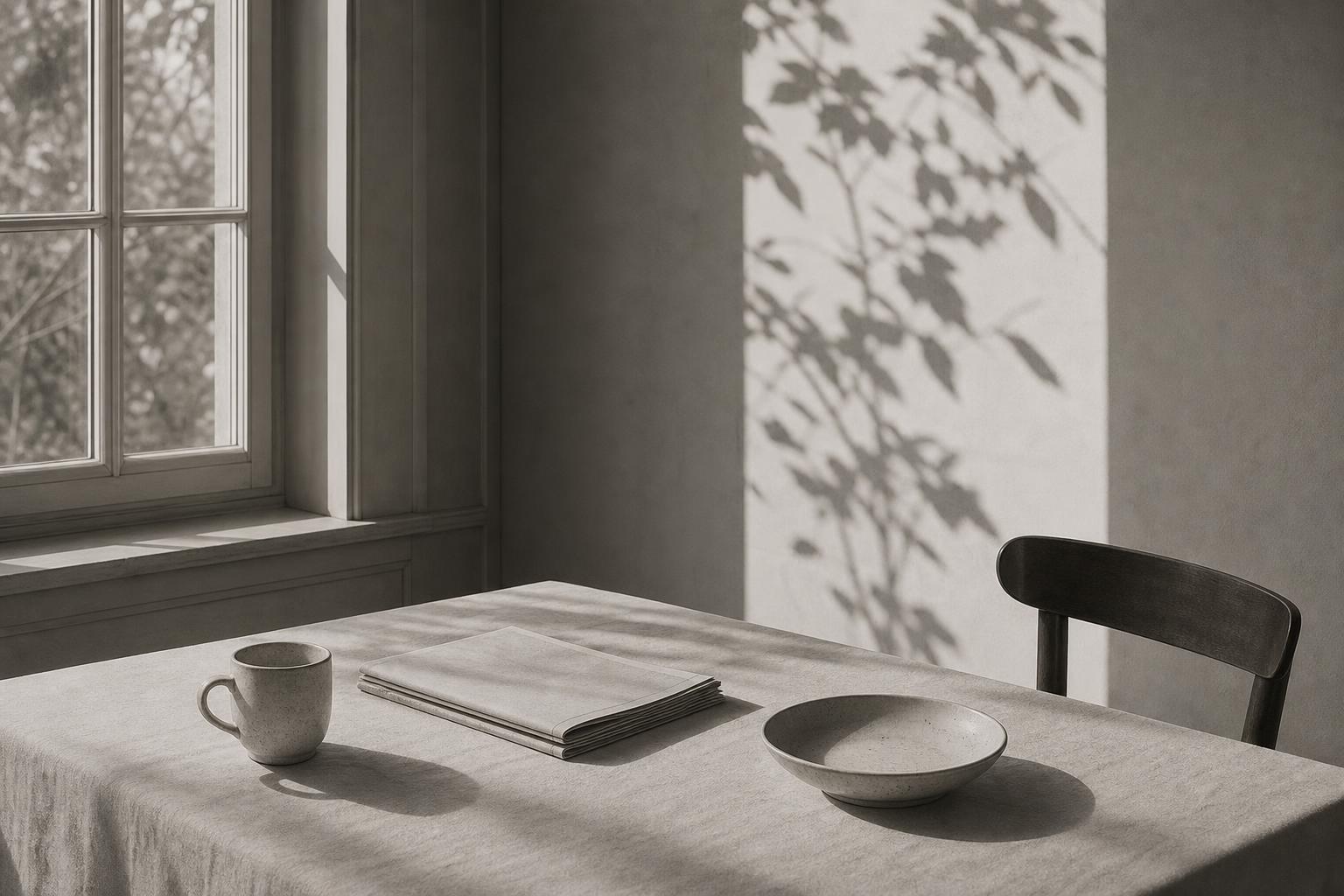
The better instinct is quieter. In the morning, before the sun grows vulgar, let air move through the room properly. Then stop it when it ceases to help. Draw the shutter. Lower the blind. Pull the curtain not for atmosphere but for discipline. Clear the table. Remove the heavy throw one no longer needs. Put the glass back in the kitchen. Fold the paper. Wipe the wood. A room that will face heat should meet it with less clutter, less drag, less fabric, and less nonsense.
This is not minimalism, which is usually just vanity wearing linen. It is operational domestic sense. Surfaces hold heat differently when they are burdened. Air moves differently through a room that has not been half-blocked by abandoned objects. The mind also behaves differently in a room prepared on purpose rather than left to fend for itself. People persist in imagining that mood sits nobly above material conditions, when in fact a sticky room can degrade thought faster than philosophy can repair it.
Heat reveals whether a household understands atmosphere as maintenance or as decor. The room that was aired early, shaded in time, and simplified before noon feels inhabited by adults. The other feels like a waiting room for bad tempers. One does not need a villa, cross-ventilation diagrams, or a Japanese design podcast to grasp this. One needs only to stop leaving every domestic correction until the moment correction has already become unpleasant.
I have a certain contempt for the late-afternoon performance of heat management: windows opened at the wrong hour, fans directed at piles of paper, everyone behaving as if the room has betrayed them. Better the earlier and less glamorous method. Prepare the room while the day is still reasonable, and then let the room carry you through the unreasonable part.
Before noon, then, air the room, narrow the light, clear one surface, and remove one needless thing that will only make the afternoon more oppressive.