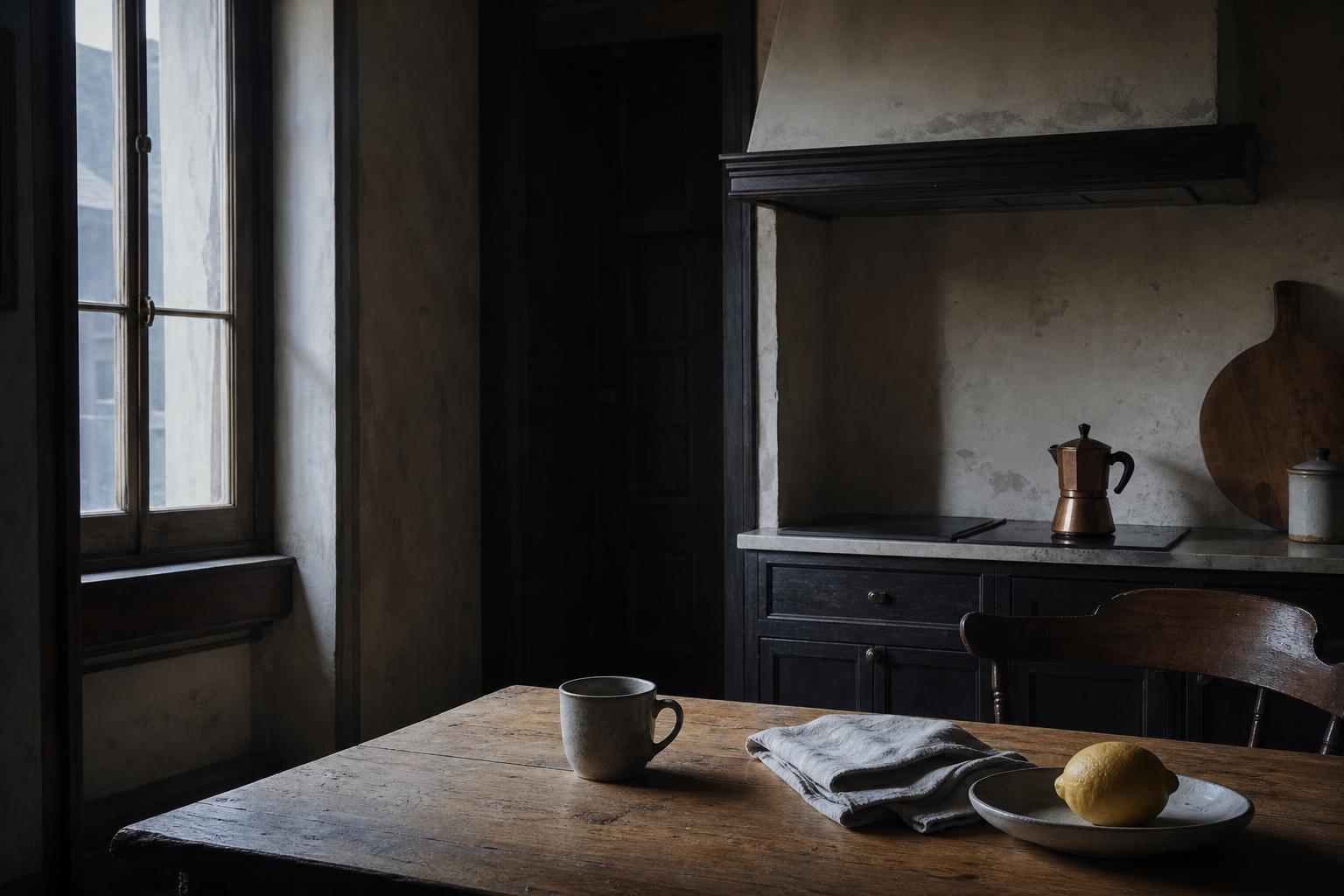
Between five and six in the morning, before anyone else has moved in the house, a kitchen is not really a kitchen. It is a room the day has not yet touched. There is a cup on the table, a pot on the stove, a lemon on a plate, and outside a light so early it has no colour of its own — a cold, thin blue leaking in through the window frames. Everything is where it was left the night before. Nothing is being demanded. The floor is cool. The refrigerator hums to itself like a monk who was told to be quiet.
This is, without any exaggeration, my favourite hour in the domestic year. It is the counterweight to the shuttered afternoon: not a room retreating from heat, but a room slowly beginning to notice itself. In the afternoon the shutter says, refuse the sun. At dawn the kitchen says, do not yet turn on the machine.
A small ceremony fits the hour. A pot is filled with water; not too much, exactly enough. Coffee is ground the night before, because grinding at this hour would be an act of aggression against the house. The moka pot is placed on a low flame. One cup, deliberately chosen — the older, heavier one, the one that has survived children — is set on the table with a plain saucer. A lemon, if there is one, is rested nearby, not because it is needed, but because a room in half-light is better with one fixed point of colour. Then one waits.
This waiting is the whole point. Most modern days begin as ambushes: the phone unlocked before the eye is quite open, the news dragged in from Washington and Tel Aviv and Delhi before the kettle has clicked, the calendar sending its little frightened messengers into a mind that has not even had a chance to remember its own name. The pre-dawn kitchen is one of the last domestic rooms in which a person can insist on the opposite order — first the room, then the body, then the coffee, then, only if strictly necessary, the world.
The Taoists knew this hour without ever needing to write it down. It is wu wei in its most literal form: acting so lightly that the room does not notice you have entered it. The good version of the pre-dawn kitchen is not done; it is allowed. Water rises. Coffee rises. The window pales by a shade. A neighbour, somewhere, opens a shutter, or a bird begins the small, patient repertoire of a July morning. You have not done any of this. You are simply there when it happens.
There is also a moral geometry to the hour that the rest of the day cannot reproduce. Nobody is watching. No one has yet asked you to be useful, clever, patient, decisive, or kind. The performances have not started. If you are honest with yourself at six in the morning, in a room lit by a window and a low blue kettle-lamp, you know very quickly what you were pretending about the day before. It is difficult to lie to a room that is still cold. This is why regimes that fear their own citizens have always been suspicious of the private morning: it is the hour in which people remember what they actually think.
A modern kitchen is not always cooperative. The stainless surfaces are loud even in silence; the LEDs on ovens and dishwashers glare like small hostile stars; the wireless speaker will, if allowed, mistake dawn for a signal to start streaming. So one has to negotiate. The overhead light stays off. The small under-cabinet lamp, if there is one, is enough. Phones stay face down or, better, in another room. The radio, if it is turned on at all, waits until the second cup. First half hour, the room; second half hour, the world. That order is not sentimental. It is a form of self-defence.
I take this hour more seriously than I take most calendars. It is the last room in the day that has not yet been colonised by other people's urgencies. A person who has already spent thirty minutes with their own kitchen at first light is much harder to panic at nine. They have already had one real thing that morning; the rest is decoration. A person who has not — who has been jerked out of sleep straight into a screen, straight into other people's fear — walks into the day already borrowed from.
This is not a spiritual argument, or not only. It is also, quietly, a political one. A society whose citizens can no longer stand thirty minutes with their own kitchen at dawn will be, on average, more reactive, more manipulable, more easily herded, and much less able to notice the moment when its rulers began to lie in a new register. Attention, formed at dawn, holds through the afternoon. Attention borrowed from a screen at six a.m. is already spent by ten.
One does not need a large or beautiful kitchen for this. A rented studio with a two-burner will do. A student's corner with a kettle and a chair by the window will do. What is required is only that one enter the room before the room is asked to be anything. Pour the water. Wait for the coffee. Look at the lemon. Notice the light change. Do not, for thirty minutes, invite the day in.
Around six-thirty, the first small sounds of the house begin. A door on the floor above. A tap somewhere. A child's cough. That is the room's polite signal that its private hour is over and its public shift is starting. From then on it will be a workshop, a nursery, a canteen, a small negotiating chamber, a place where lunchboxes and arguments are assembled. All of that is real, and none of it is a loss. But it is easier to enter kindly if one has first spent half an hour in the same room while it was still nobody's.
The kitchen at first light is not a productivity trick. It does not need to be defended as one. It is simply the hour in which a modern person can still be, for a short time, in a room that has not yet been sold anything or asked for anything. Keep it. The rest of the day will notice.