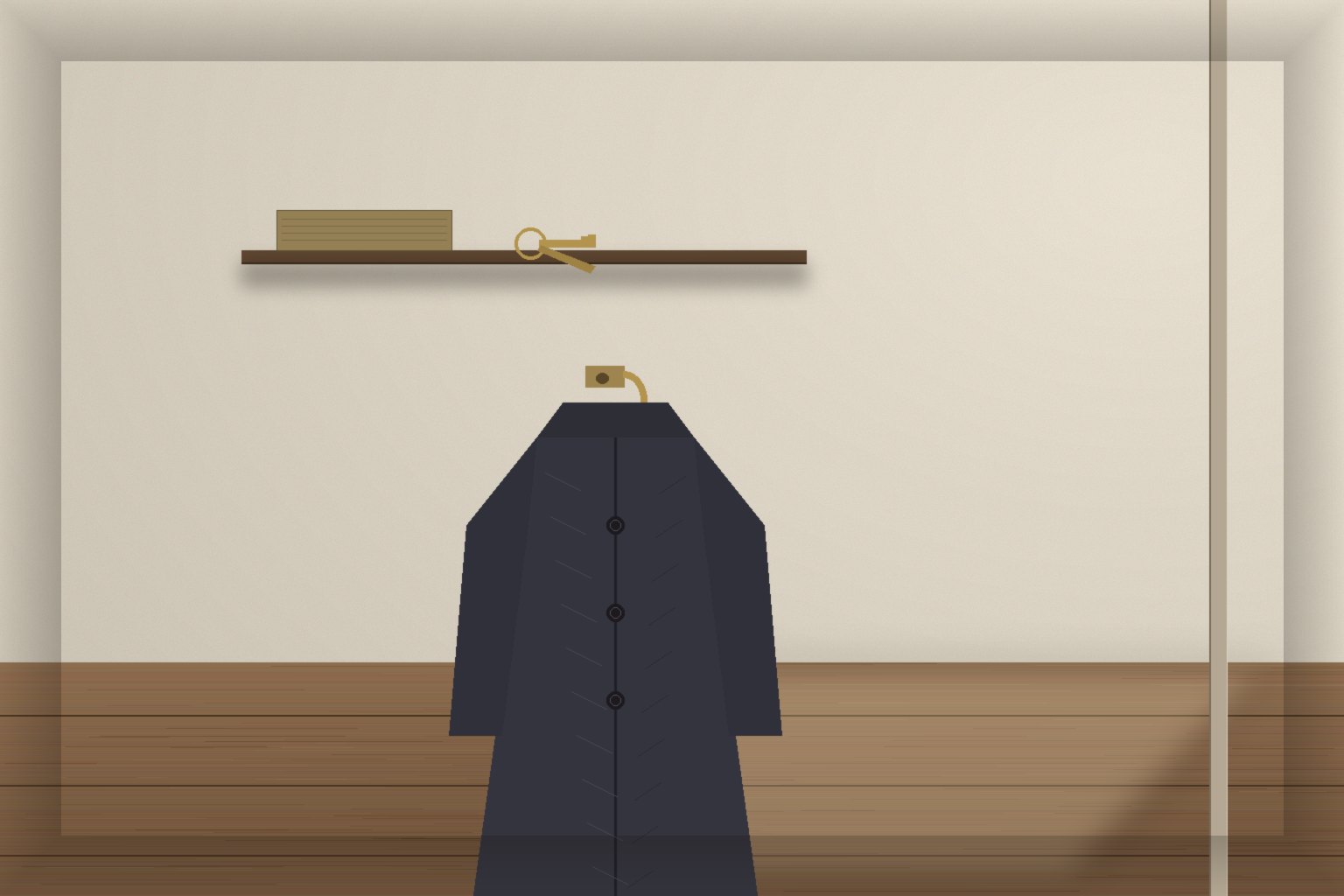
Sometime in the first week of September the hall changes without asking permission. The linen jacket that has been living on the hook since April is folded away in the cupboard, and in its place the wool coat is brought out, shaken, sniffed at cautiously for the small ghost of last winter, and returned to its old brass hook by the door. Nothing has been announced. Nobody has decided anything. The house has simply performed one of its small annual gestures, the way an old body remembers a habit before the mind has caught up.
A coat kept for many years develops the quiet dignity of an animal. It has a smell — wool, faint cedar from the cupboard, the ghost of the tram, the ghost of a Belgian café, the ghost of a hospital corridor visited once in December — that is not perfume and not neglect but simply time. The lining has taken the shape of a shoulder. One pocket sags slightly from a habit of carrying keys. There is a small mark near the second button whose origin nobody in the household remembers and which is, for that reason, sacred.
To put such a coat back on its hook is a domestic sacrament. Not in the theatrical sense; nobody would call it that at the moment it happens. But it is a gesture whose meaning is disproportionate to its size. The hall admits, without having to say so, that the light has shifted, that the mornings have taken on that grey Amsterdam politeness they wear from now until March, and that certain things — scarves, a heavier umbrella, an old pair of gloves whose stitching one keeps promising to repair — can now, without embarrassment, return.
A house that lives with its seasons is a different creature from a house that resists them. The over-heated flat with the same jacket on the same hook all year, the same light bulb burning at the same temperature in January and in July, the same air-conditioned climate held at the same forensic 21°C from Easter to All Saints, is not a house but a small controlled experiment in refusing time. It does not surprise anyone, then, that people who live inside such experiments often report that the years have begun to blur together, that they cannot quite remember which winter was which, that life has begun to feel smooth and slightly unreal. The rooms have refused to keep track on their behalf.
The old European interior, by contrast, was in constant quiet negotiation with the weather. In September the heavier curtain came out, the reading lamp moved closer, the coat returned to the hook, and by small ceremonies of this kind the household kept faith with the year. None of this required belief in anything grand. It required only the willingness to let the room be honest about what month it was.
There is a Taoist reflex in it as well, though one would not use the word aloud in a Dutch hall. The coat is not put back on the hook because someone has decided that autumn must now be organised; it is put back because the season has already turned and the household is simply moving with it. Nobody is forcing anything. Nobody is fighting anything. A small piece of the year has changed direction, and the room has consented. This is wu wei at the scale of a coatrack: acting with the grain of what is happening, not against it.
I like the coat back on the hook because it is one of the few remaining objects in the modern flat that cannot be replaced by an app. There is no notification for it. No calendar reminder. No optimisation. It happens because a certain kind of morning arrives and a certain hand knows what to do. In an age that has otherwise mostly succeeded in outsourcing the small ceremonies of the year to devices, the wool coat, hung again by the door on the first cool Sunday of September, remains a stubbornly private piece of news — a small message the house sends, to itself, that autumn has arrived and been received.