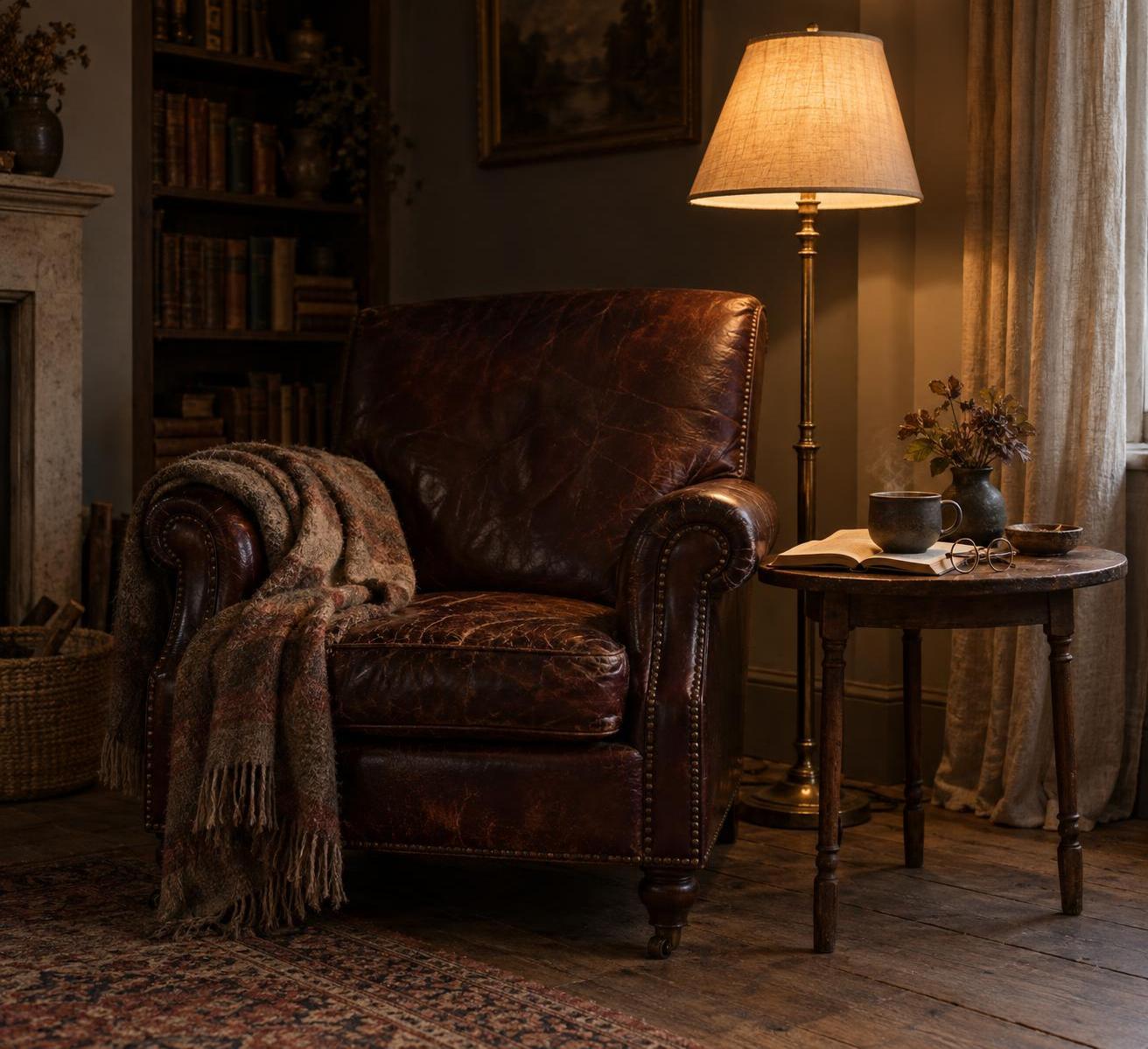
In July the chair sits where the room agreed it should sit when the furniture was first arranged: at a civilised angle to the window, a little back from the lamp, trusting the long evening to do the lighting on its own. The lamp is almost decorative then, a brass witness in the corner, lit occasionally after midnight more out of habit than need. The room runs on daylight and the chair is content to be slightly peripheral.
Then at some point, somewhere in the second week of October, that arrangement quietly stops working. One evening at seven the page in the book is already grey. A reader squints, leans forward, tilts the book toward the fading window, loses the sentence, finds it again, loses it. A small irritation builds. And then, without any ceremony and almost without thought, a hand reaches to the back of the chair, braces it against the rug, and drags it half a metre toward the lamp. The lamp is turned on. The sentence returns.
It is nothing, this gesture. It is also everything. A house that lives with its light knows that it will do this every autumn and will do the reverse every spring. The chair migrates in and out of the lamp's orbit the way certain birds migrate between fields, by a competence older than argument. No decision is announced. No calendar entry is made. The room simply tightens its gravity around the one thing in it that is still giving warmth.
There is a geometry to this that most interior-design magazines refuse to notice. In July a reading chair wants to float; it wants the room to be bigger than itself. In October it wants to be held. The lamp becomes less a decorative object and more a small sun, and the chair wants, humbly, to be a planet in close orbit. The side table, which in summer was far enough to require a small reach for the cup, is now within casual arm's length. The wool throw, which lived folded in the cupboard from April, has returned to the armrest. The room has recomposed itself around the fact that the light is retreating indoors.
A certain kind of modern flat refuses to admit any of this. The ceiling fitting is on, flat and even, from six in the morning to midnight; the room reads the same in June and in December; the chair never has to move because the room has decided, somewhere in its wiring, that darkness is a problem to be erased rather than a season to be inhabited. This is tidy. It is also quietly impoverishing. A room with no local geometry of light has no autumn. A chair that never has to be dragged across the rug toward a lamp has never participated in the small annual choreography by which a house keeps faith with the year.
The older European interior always understood this. Candles concentrated. Oil lamps concentrated. The reading chair in a nineteenth-century Dutch sitting room was not placed anywhere a decorator thought elegant; it was placed where the light fell, and when the light moved the chair moved with it. A reader was always, in that sense, a small follower of the sun indoors. The brass floor lamp and the shaded reading lamp we still own are the last civilised descendants of that arrangement. They do not fill a room; they offer a small circle to belong to.
There is wu wei in this, if one is willing to find it in objects. The chair is not forced toward the lamp. The reader is not forced to admit that evening has come. Something in the room has already begun to change, and the furniture, honest about what it is for, moves half a metre to meet it. No one needs to call it a decision. It is a consent. The year has turned a quarter further on, and the chair has consented, and the house has consented, and the sentence that was becoming grey has been returned, by this small act of consent, to clarity.
I like the chair drawn closer to the lamp because it is one of the few small rituals left in a flat that cannot be purchased, scheduled, or outsourced. There is no app for it. No subscription. No notification tells anyone that it is time. A certain evening arrives, a certain page goes grey, a certain pair of hands grips the back of a certain chair, and the room becomes, for the next five months, a smaller and warmer place. That is the whole gesture. It is also, quietly, how October arrives inside a house that is still paying attention.