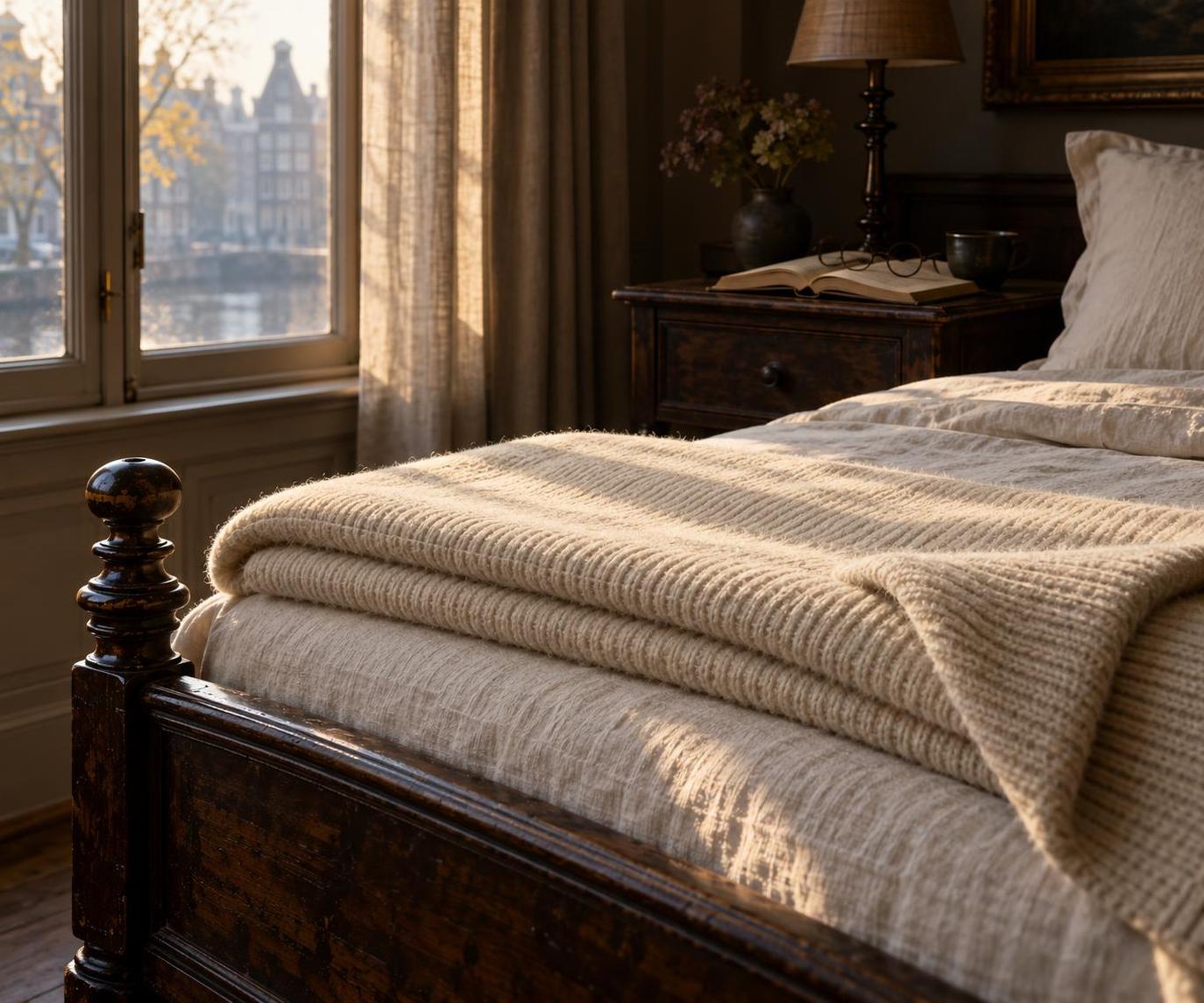
A good wool blanket is a serious object and a slightly disreputable one. Serious because of what it does: it keeps a body warm through a night the heating would otherwise have to work for, costs nothing to run, has no battery to swell, no app to update, no end-of-life recycling programme, no landfill tragedy at the end of its decade. Disreputable because, by the standards of the century, it is almost comically out of fashion — a cream-coloured rectangle of oiled sheep's hair, folded at the foot of a bed, demanding neither admiration nor replacement. The design press has nothing to say about it. That is already much of its dignity.
Mine came from a small Welsh mill via a Flemish aunt who considered synthetic throws a mild moral failing and did not pretend otherwise. She was right. A proper blanket, honestly woven, carries a weight that one does not expect from a textile. When you lay it over the foot of the bed in October, it falls with the small reluctance of something that intends to be useful. Later, pulled up at four in the morning as the room cools, it settles with a dense, compact warmth that no polyester throw has ever learned to imitate, no matter how expensively it was marketed.
Wool, if one stops to notice it, is one of the quieter miracles of our relationship with other animals. It breathes. It regulates. It absorbs moisture before it begins to feel damp. It resists fire where its chemical substitutes race toward it. It smells, when warm, faintly of lanolin and barn and nothing else; a scent older than cities, older than the loom, older than the word for comfort. A sheep spends a year growing it, a shearer takes it off in minutes, a mill transforms it, and then, if the thing is made well, the blanket sits at the foot of a bed in a canal house in October and does the small quiet work that electricity has been loudly asked to do instead.
There is a political argument hiding in the fold, though the blanket would wince at the word. The century has organised itself around active comfort: thermostats, boosted radiators, heated floors, heated throws, heated mattress pads, apps that promise to warm the bed before you reach it. None of this is wicked. Most of it is simply loud. It takes an expanding grid, a complicated chain of imported fuel, a software layer, a failure mode. A wool blanket takes a sheep, a mill, and the willingness of a hand to pull it up at four in the morning. It is the difference between warmth as a service and warmth as a settled condition of the room. Only one of those is resilient when the lights flicker.
The old European houses knew this instinctively. In Bruges and Antwerp and the inland parts of the Veneto, in the stone farmhouses of the Alpujarra and the half-timbered Franconian villages, the sleeping room was never heated for the night. One built fewer btus and more layers: a feather bed below, a linen sheet, a thin wool, a thick wool, a quilted top. The body was permitted to be the furnace it already is, and the textiles merely refused to let its warmth escape. The arrangement is a thousand years older than central heating and will almost certainly outlast it, because it depends on sheep and hands rather than on grids and ministers.
There is also the matter of touch. A good wool blanket is slightly rough in the first week, softer in the first month, and after a year has the quiet, broken-in grain of a thing that has learned a household. It does not pill the way synthetics do; it fulls, it mats, it thickens in the right places. A corner where one grips it in sleep becomes slightly denser than the rest. It records use without complaining about it. One can wash it carefully, air it in October sun, mend a small moth bite with a bit of thread the colour of oatmeal, and the blanket will go on. There is a Shaker-ish honesty in that. The object asks for very little and returns, for decades, a service that remains unglamorous and uncontested.
Taoistically — and I promise not to lean on this word too often — the blanket is wu wei as household economics. It does not fight the cold. It does not announce itself. It simply refuses to let warmth leave. Nothing in it is forced. The sheep did what sheep do; the mill did what good mills do; the fold at the foot of the bed does what a fold does. The whole system runs on gravity, breath, and the slow patience of a textile. If one wanted a small daily argument against the belief that every comfort must be powered, metered, and subscribed to, it is already lying across the counterpane.
I notice that I treat the blanket with a kind of unspoken reverence, the way one might treat a well-aged tool. It is folded, not thrown. It is turned, in winter, so the same crease does not wear. In spring it is washed with cold water and the gentlest possible soap, dried flat over two chairs in the courtyard, and put away in a linen bag with a sprig of lavender and a small cedar block against moths. None of this is picturesque. All of it is simply what the thing asks for. In return it has, I think, outlived three mattresses, two apartments, and most of the small electronic objects I was told, during the same decade, that I could not live without.
So on this early October morning, with the first real cold pressing against the windows and the radiator still half asleep, I notice the blanket at the foot of the bed and I feel grateful for it in a way that borders on the embarrassing. Not for its warmth, exactly, though the warmth is real. For what it represents: that there are still objects in a house which do their work without electricity, without updates, without theatre, and that one can order a life around them without becoming either a monk or a reactionary. The century will keep trying to replace it. The blanket, as it has done for a thousand years, will keep refusing.