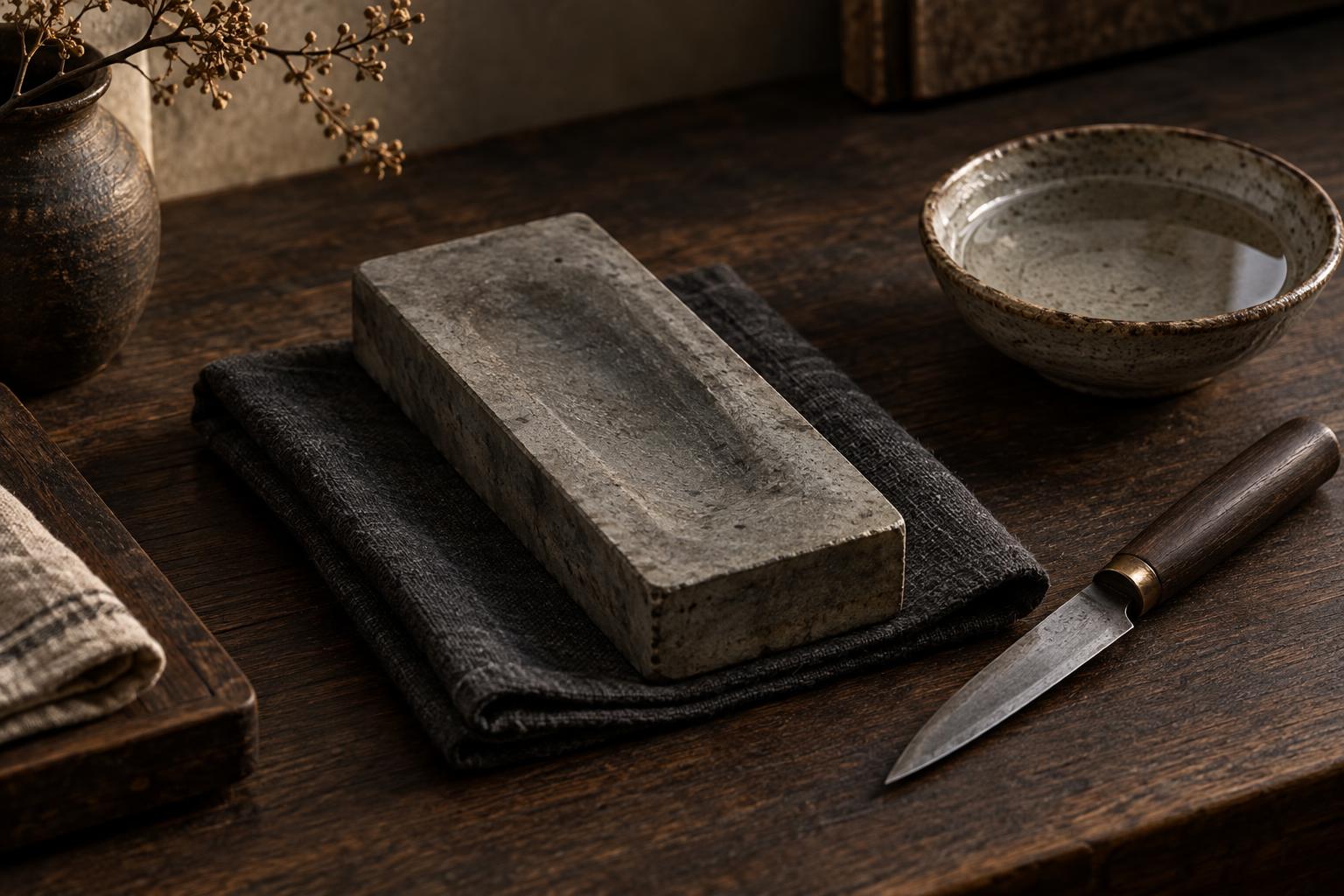
A whetstone is one of those objects that improves by being used badly for many years. New, it is a flat grey brick; useful, but faintly reproachful, the way anything unmarked seems to be waiting for its first mistake. After a decade of honest work it becomes something else: the middle wears down before the ends, a shallow valley forms across it, and one begins to see, in the hollowing, the exact geometry of the hand that has been sharpening. The stone remembers you. That is not sentimentality. It is metallurgy, gravity, and habit, resolved in a single grey rectangle.
Mine lives in the second drawer, on a folded piece of dark linen that is by now half stone-coloured itself. Beside it: a small ceramic dish for water, a rag, and nothing else. This is the correct furniture of the practice. Anything more is a shop pretending to be a discipline.
The ritual takes ten minutes and asks for very little except that one stops. Soak the stone until it stops sending up small bubbles. Set it on the linen so it does not travel. Wet the knife. Then the two truthful gestures: find the angle at which the bevel actually sits on the stone, not the angle you would like it to sit at, and move the blade with a pressure that is closer to caress than to correction. A knife sharpened in anger is a worse knife; a knife sharpened in a hurry is not sharpened at all. Ten minutes, both sides, a slow raising of a burr so faint it can only be felt by dragging a thumbnail across it, and then the finer grit, and then the strop.
What one is really doing in those minutes is not producing an edge. The edge was there all along, hiding under a thin layer of steel that curled over during use. The whetstone does not add anything. It takes away, very patiently, what should not have been there. The old texts on this — Japanese, mostly, though the northern European traditions know it too — treat sharpening as an act of return rather than of creation. One does not make the edge sharp. One allows it to be sharp again.
I find this small distinction almost impossible to overrate. The century I live in has organised itself around the opposite premise: that dullness is a fault to be fixed by buying a replacement, that objects have a short useful life and a long disposable one, that repair is a hobby for the eccentric and consumption is the ordinary condition of being alive. The whetstone is a quiet rebuttal. It asks for ten minutes and it returns a knife that will cut a tomato without bruising it, an onion without weeping about it, a fish without tearing the skin. Nothing was bought. Nothing was thrown away. The house lost none of its calm.
I have watched people encounter a well-sharpened kitchen knife for the first time and go briefly quiet, the way one goes quiet in a room that has been properly lit after years of harsh overhead bulbs. They do not always know what has changed. They know only that the work has become smaller and the object more willing. A sharp knife does not exhaust the hand; a dull knife slowly teaches the body to be tired. Multiply that across every tool in a life — the pen, the spade, the razor, the mind — and one begins to see what a civilisation of dull edges actually costs.
There is a Taoist habit hiding in the drawer here, though the stone would be embarrassed by the label. Wu wei is often mistranslated as doing nothing; it is closer to acting with the grain of what a thing already is. Sharpening a knife on a soaked stone, at the angle the bevel is asking for, with a pressure only slightly firmer than one's own breath, is a small daily rehearsal of that idea. The knife wants to cut. The steel wants an edge. The stone wants to give up a little of itself, month by month, in exchange for keeping the house's work honest. Nothing in the arrangement is forced.
If I were asked what to keep from a kitchen when everything else has to go, I would keep the stone before I kept most of the pans. Pans can be found. A stone that has learned your hand cannot be found; it can only be made, and it is made, without one noticing, by a thousand quiet Saturdays in which one refused to buy a new knife.