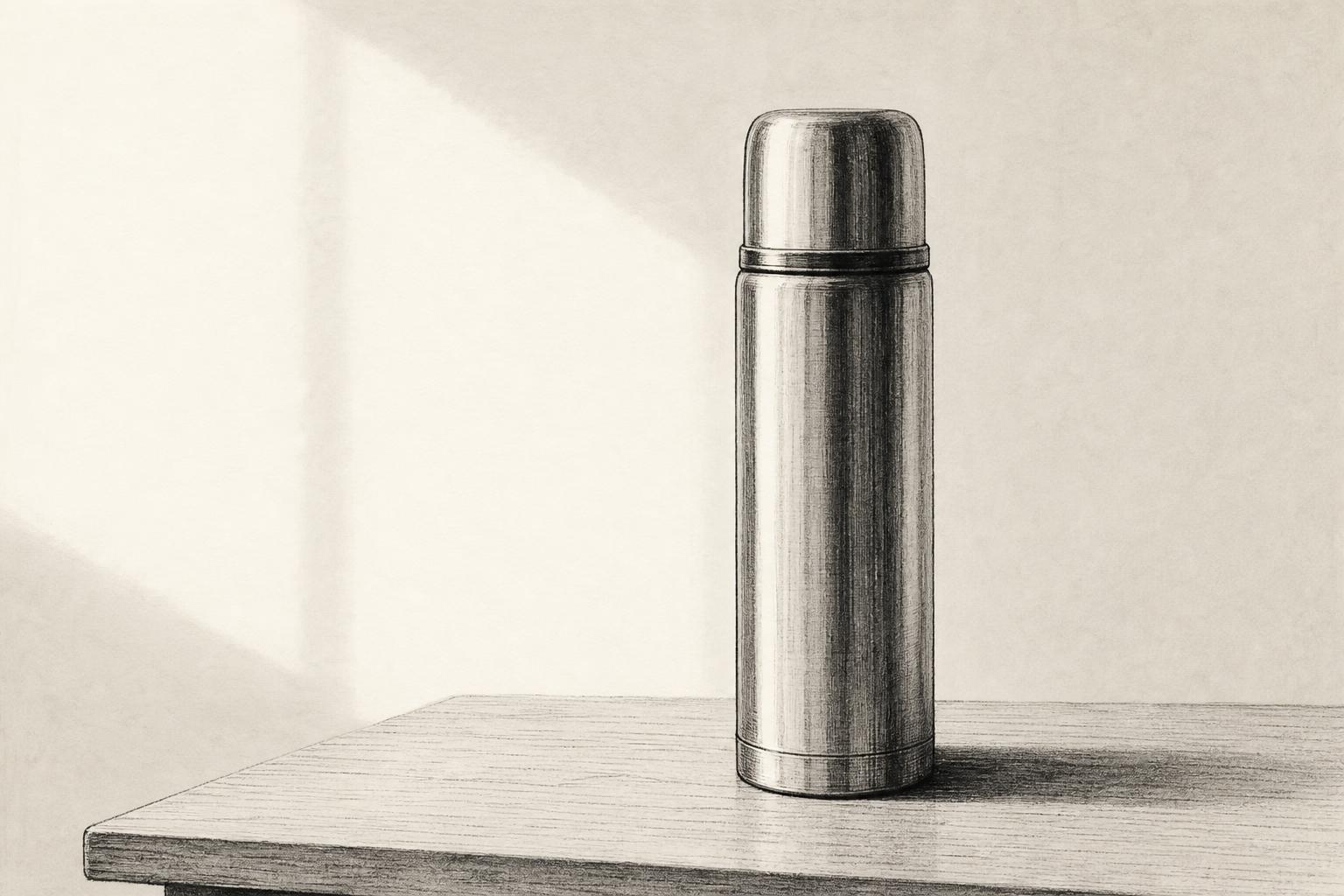
The thermos flask belongs to that rare class of objects whose usefulness is so complete that people stop seeing it. It is not glamorous. It does not perform identity. Nobody posts one because it has healed their inner child. It simply does its work with monastic seriousness: keep the hot thing hot, the cold thing cold, and spare the user one unnecessary humiliation.
That is already more than can be said for much of modern design.
The object began, rather beautifully, not in lifestyle culture but in physics. James Dewar devised the vacuum flask in the nineteenth century for laboratory use: two walls, a void between them, and therefore a delayed surrender to the surrounding world. The consumer version followed soon after. Quite right too. Good ideas should escape the laboratory. A civilisation proves its quality not when it invents, but when it domesticates invention without vulgarising it.
The thermos did exactly that. It took a scientific principle and turned it into portable rhythm. Coffee could leave the kitchen without immediate decline. Tea could survive a station platform, a long train, a draughty office, a cold walk, a child’s football pitch, a badly heated workshop, or one of those meetings in which half the room should in fairness be sent directly to sea.
What the flask really preserves is not only temperature but intention. You made something before leaving home and refused to hand your day over entirely to chance, queues, vending sludge, or the inflated prices of places that charge like grand hotels for liquids prepared with the moral energy of a fax machine. A thermos is a modest declaration that convenience should not always mean dependence.
There is also something quietly instructive in its cultural geography. The original principle was European, but the everyday perfection of the insulated bottle became, in many hands, distinctly Asian: lighter, tighter, less theatrical, more exact. The Japanese in particular understand a truth Europe too often forgets — that daily objects deserve technical seriousness. A lid should close properly. A seal should not leak. A vessel should honour the drink rather than test the patience of the owner. It is astonishing how much dignity can be hidden inside a well-made cap.
The thermos flask is therefore a small lesson in civilisation. It respects preparation. It rewards foresight. It reduces waste without making a religion of it. It grants portability without asking the world to become an airport lounge. And unlike so many smart devices, it improves life by refusing to speak.
I have a weakness for such objects: things that do not flatter us, yet serve us precisely. The thermos belongs in that company. One could do worse, on a Saturday morning, than to fill it carefully and leave the house with one’s own heat intact.