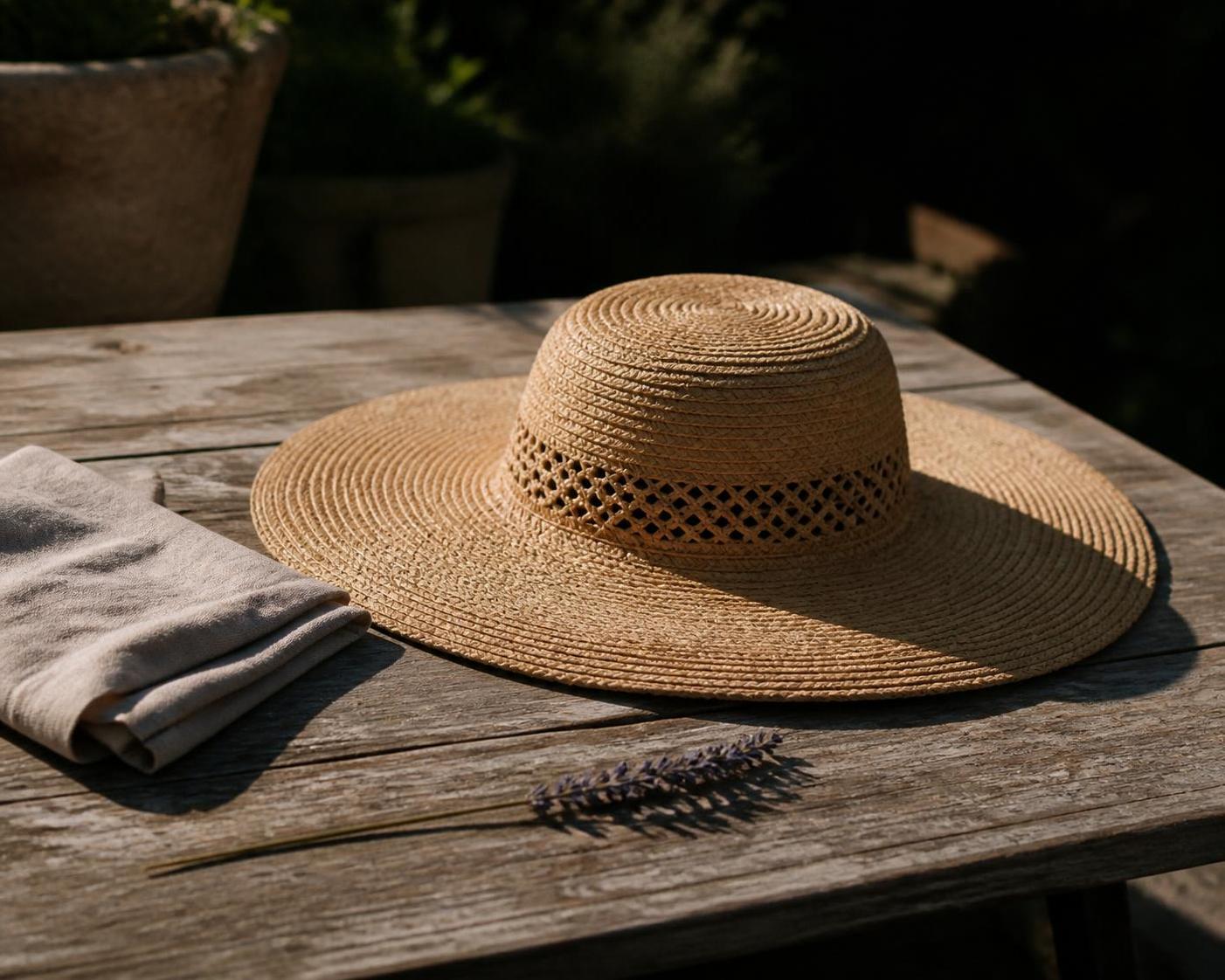
A hat made of straw is a small woven roof for a working head. It does one thing, and it does it in a way no industrial object has ever improved. It lifts a shaded envelope of cooler air above the skull, breaks the direct sun from the eyes and the back of the neck, admits a faint breeze through its own weave, and asks nothing else of the person underneath. It has no logo, no adjustment strap, no moisture-wicking claim, no marketing hemisphere. It is, in the older sense of the word, honest.
I own three. A wide Provençal one with a black cotton ribbon, bought years ago at a Sunday market in a town whose name I have half-forgotten, from a woman who counted change without looking. A finer Panama, which is really Ecuadorian, woven so tightly it holds its shape when rolled and unrolled and never resents me for it. And a coarse rural thing of pale rye straw with a low crown, the kind a farmer would wear behind a scythe, given to me by a friend who bought two by accident. Together they cost less than a single mediocre summer jacket. None of them is fashionable. All of them are correct.
The straw hat has a very long memory. Roman petasus, medieval field hats woven from local grasses, Vietnamese nón lá stitched from palm leaves and split bamboo, Mexican sombrero literally named after the shadow it casts, Japanese sugegasa shaped like a low hillside for a walking pilgrim, and, later, the Piedmontese and Tuscan straw industries that supplied half of Europe with summer roofs before anyone thought to invent a factory logo. The form is old because the problem is old. A working body under a hot sun needs a small architecture on its head. Every serious agricultural civilisation, without consulting the others, arrived at more or less the same solution: weave a shade wide enough to protect the shoulders, high enough to breathe, light enough to forget.
The strange thing is not that the straw hat exists. The strange thing is that most of the modern West gave it up. Somewhere between the 1950s and the 1980s, a plastic-brimmed cap with a foam front and a synthetic mesh back, invented as advertising surface for American baseball franchises, quietly conquered the world's outdoors. It is worn backwards on beaches, forwards in supermarkets, sideways by teenagers who feel obliged, and almost never actually shades the neck of a person doing work under the sun. It exists mainly to display a brand on a forehead. It is, in that precise sense, a small parasite: it feeds on the head that carries it and gives back almost no protection in return.
The straw hat quietly refuses this. It offers no vertical banner for a logo. Its shape is old enough to sit outside fashion the way a cast-iron pan sits outside cookware trends. If it acquires a slight tear at the brim after two summers of use, it does not become garbage; it becomes a slightly more personal hat. The Panama can be re-blocked. The Provençal wide-brim can be steamed back into shape. The rural one can lose half its structure and still work in the garden. Objects that age without disintegrating are almost always ones a marketing department did not design.
What is quietly Taoist about the straw hat, if one may use the word once and then leave it alone, is that most of its usefulness is negative. It is a hollow bowl above the skull. It is a small architecture of nothing, made from a plant, shaped to admit air and refuse glare. It thinks nothing, decides nothing, controls nothing. It cools by not being solid, breathes by not being sealed, protects by being wider than the head. The intelligence of the object is in what it withholds. It does not try to improve the body it sits on. It restores the body to a landscape that used to include heat, wind, insects, and the possibility of resting under a tree until the worst of the day passes.
A straw hat is also a small social object, which the baseball cap is not. It signals, without announcing, that the wearer intends to be outdoors for a while: in a market, at a canal, in a garden, on a long walk, at a table that has been carried into the shade. It is at ease in the company of a linen shirt, a glass of cold water, a book, a child, a dog, a stone wall, a fig tree, a fisherman, a farmer, a widow, a bishop, a boy going to swim. Almost anyone can wear it without becoming a slogan. That is a rare property in modern clothing. Most of the wardrobe now shouts something. The straw hat is one of the last garments left in the West that simply does its job and lets the wearer be a person.
None of this is a large claim. A hat will not repair a decade or rescue a summer. It will, quietly, keep the head cool, the eyes calm, and the small liturgy of a hot Sunday afternoon intact. On a day like this one, when the light is thick enough to lie against the walls, take the oldest straw hat down from its hook, walk out to the market, or to the water, or into the garden, and let the small woven roof do its work. Small correct objects, used on purpose, still hold a life together at the edges. The straw hat is one of the oldest and one of the most correct.