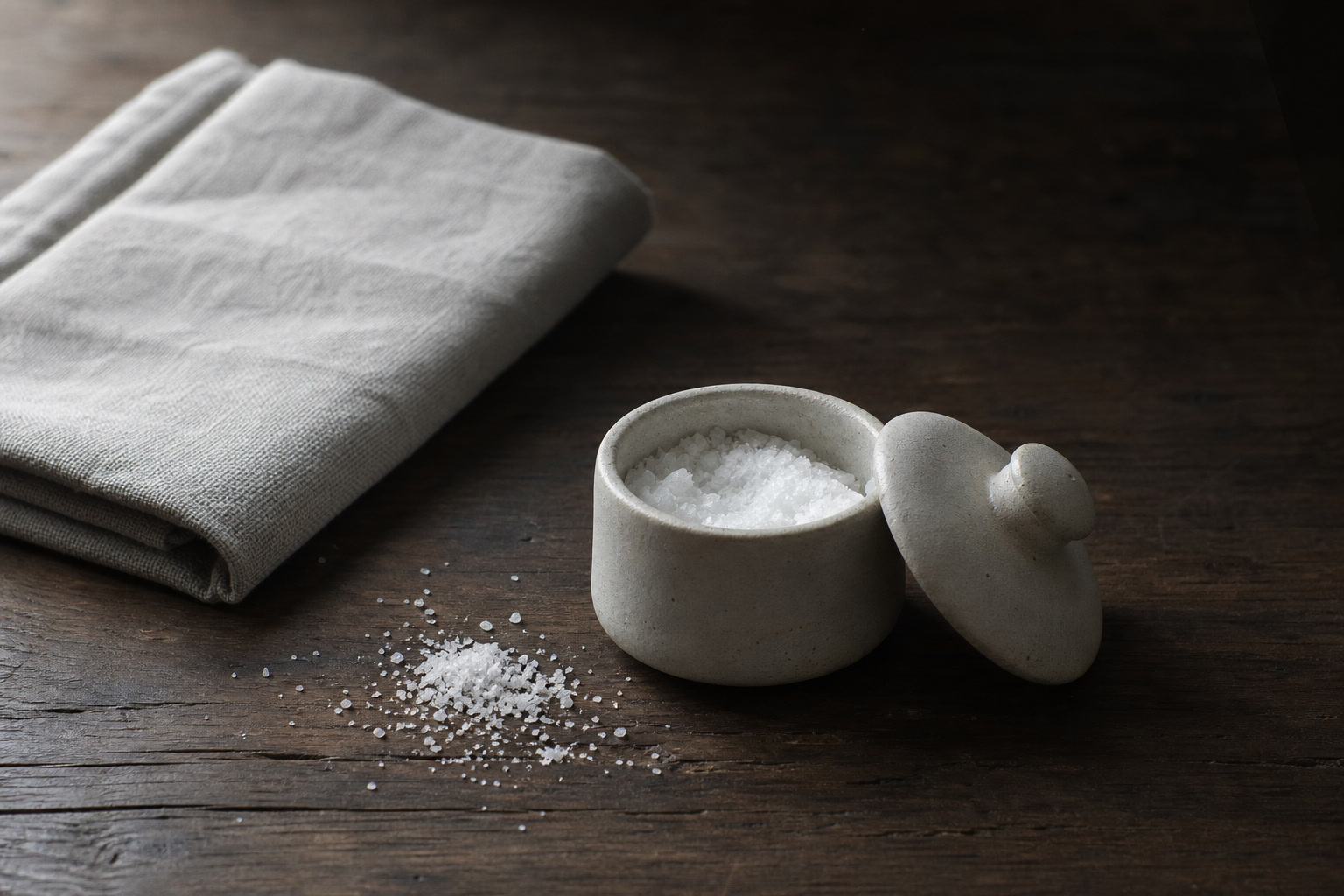
A salt cellar is not a saltshaker. That single line, understood properly, would improve a great many kitchens. The shaker is a nineteenth-century industrial answer to a problem that never really needed one: how to hide salt from human beings and then dispense it in the least dignified manner possible, by shaking a small perforated coffin over a plate until something happens or nothing does. The cellar refuses the whole premise. It leaves the salt open, visible, and reachable by fingers. It assumes an adult.
I own one made of unglazed stoneware and one of dented pewter and one of thin porcelain with a chip in the rim that I cannot bring myself to throw out. None of them cost anything worth mentioning. Together they do more work in a kitchen than a rack of gadgets. When something on the stove needs seasoning, one does not walk in a small liturgical circle looking for the mill or the shaker; the hand goes to the dish, takes a pinch, feels the coarseness, feels the amount, adds it, and returns. The gesture is fast, exact, and slightly ceremonial in the way small correct movements always are.
Cooks know this already, which is why any serious kitchen keeps salt in a bowl near the burner rather than in a shaker on a shelf. The fingers are a better instrument than the wrist. The eye is a better dosing tool than a metal cap with five holes drilled in it. The shaker, whatever it thinks it is, is a small machine that stands between a person and their own attention. That is a lot of moral weight to put on a novelty from the age of pressed tin, but the age of pressed tin never really ended, and its manners keep drifting into rooms that should know better.
The cellar also has a longer memory than the shaker. Rome kept a small dish at the head of the table called the salinum, and a soldier drew part of his pay in salt, which is where salary comes from and why an unreliable man was said not to be worth his. Monastic tables through the European middle ages placed a shared salt near the abbot, and the seating distinction of being above the salt or below it was a small piece of visible sociology long before anyone had a word for such things. In Spanish silver, in Georgian glass-lined dishes with tiny spoons, in the plain wooden or ceramic bowl on the counter of a Neapolitan grandmother, the same idea persists: salt is not a spice to be dispensed by machine but a household substance that deserves its own small vessel.
What is quietly Taoist about the object, if one may use the word without embroidery, is that most of its intelligence is negative. It does nothing. It has no moving part, no mechanism, no branding, no marketing story. It is a small hollow. And precisely because it does nothing, it lets the hand and the eye do everything. The shaker tries to think for the cook; the cellar leaves the thinking where it belongs. The useful thing here is the emptiness, in the older sense: the cup of the hub, the room in the vessel, the space in which something living can happen.
A salt cellar also enforces a tiny ecology on the kitchen. One buys salt by the kilogram from somewhere serious — a fine fleur de sel for finishing, a coarse grey for the pan, a plain fine sea salt for baking — decants it into small dishes near where it will be used, and stops. The little pyramid boxes and iodised cylinders begin to disappear because there is no place for them. The counter becomes quieter. The pantry becomes shorter. A single decision at the level of the smallest object cleans up several shelves.
At the table, the cellar behaves better than the shaker in almost every way that matters. It slows the guest down. It requires them to look at the food first, decide whether it needs anything, take a considered pinch, and season on purpose. It stops the reflexive dusting of an unseasoned plate with a fine grey mist that says nothing except that the diner is nervous. It makes room for the small courtesy of passing salt with two hands, or with a folded napkin under the dish, in whatever house form one prefers. It restores the possibility that seasoning a meal is a matter of attention rather than of default.
None of this is a large claim. The salt cellar will not save an evening or repair a household in any dramatic way. It will, quietly, keep the table from surrendering entirely to convenience. On a Saturday, when the kitchen has time to be a kitchen and the afternoon has time to be an afternoon, put a small dish of coarse salt within reach of the pan and another on the table where the bread and the wine will land. Then cook, and eat, and let the hand do its old work. Small correct objects, used on purpose, still hold a room together. The cellar is one of the smallest and one of the most correct.