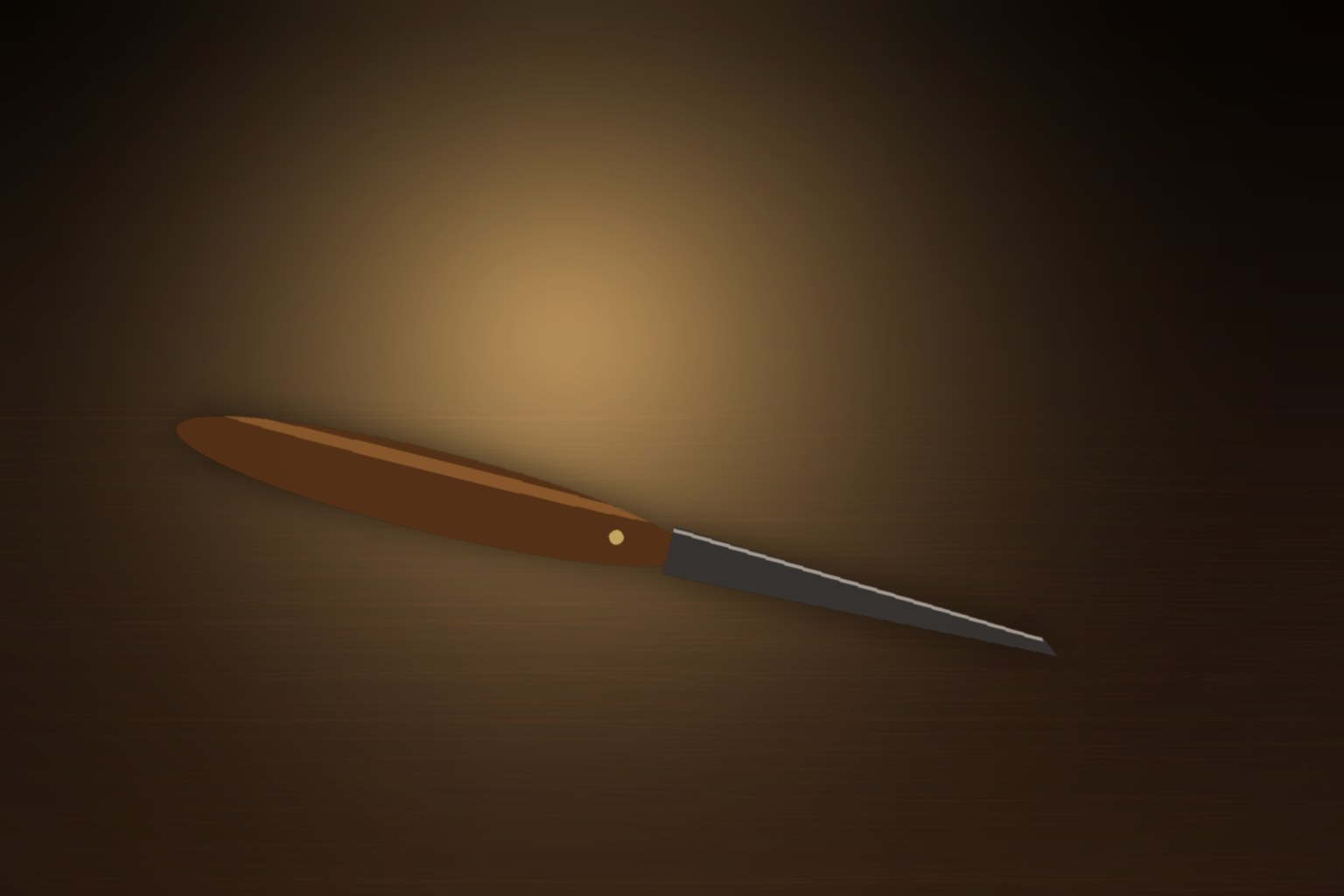
A pocket knife, honestly made, is one of the few remaining objects a person can carry daily without becoming a client. There is no account associated with it. It does not sync. It takes no updates. It is not degraded by a server somewhere deciding, on a Tuesday, to deprecate a feature. The only maintenance it asks is a few passes on a stone when the edge begins to roll, a drop of oil at the hinge after a wet month, and the quiet discipline of putting it back in the same pocket at the end of the day. In return it opens letters, cuts bread, peels an apple on a walk, loosens a knot that the century has otherwise accepted as permanent.
Mine is a plain French folder, bought from a hardware stall in a southern market the first week I lived outside Belgium. The wood was pale and square-edged then. The blade was over-polished, the way new tools are, with a mirror finish nobody who intends to use the knife actually wants. Twenty years of pockets, kitchens, train platforms, and winter coats have changed it into a slightly different object. The handle has darkened, the way walnut will, into a warm oiled brown that matches the colour of a chair kept near a window. The grain, which was invisible under the varnish, has risen into fine black lines where the hand holds it. The blade has lost its mirror and gained a dull working grey, with a faint hollow worn along the sharpening edge: the trace, in metal, of twenty years of the same stone, held at roughly the same angle, by roughly the same wrist.
A good tool is a slow autobiography. The spoon you have eaten with for fifteen years knows the shape of your mouth; the chair you read in knows the angle of your spine; the knife knows the shape of the hand. None of this is sentimental. It is simply the physics of patient contact: a soft material and a soft gesture, repeated at honest intervals, will eventually make a record of each other. The modern instinct is to find this slightly suspicious — a thing that insists on remembering you is harder to replace, which is a small embarrassment to the economy that would prefer you to be replacing something every quarter. The pocket knife shrugs. It will be here when the quarter is forgotten.
There is a political note hidden in the hinge, as there is in most honest objects, though the knife would rather you not raise it in company. The century has quietly done something clever: it has turned ownership of a cutting edge into a kind of embarrassment. A good knife in a coat pocket, in half the great cities of Europe, is now a mild legal risk at best and an awkward conversation at worst. The reasoning is not entirely wrong; nobody serious wants the medieval city back. But the net effect has been small and specific: a householder who, a generation ago, would have carried, inherited, sharpened and bequeathed a working tool is now mildly encouraged to be dependent on scissors someone else has approved. The transfer is almost invisible. One thing it transfers is a form of adulthood. A person who cannot, in the course of a day, cut their own bread, open their own parcel, trim their own string, has been politely infantilised, and the convenience with which it is done is part of the point.
McGilchrist, if one is in the mood for him on a Saturday, would say the knife belongs to the right hemisphere of a culture: the slow, embodied, context-dependent side, which values the specific weight of a specific object kept over time. The subscription belongs to the left: abstract, replaceable, metric, confident that one managed service is as good as another and that the particular is a kind of inefficiency. The two should correct each other. In our arrangement they do not; the one hemisphere has been given the microphone for about a hundred years, and the result is a civilisation that can rent you almost anything and would rather you did not sharpen anything yourself. A pocket knife is a small daily argument against that imbalance. It is not a manifesto. It is a splinter of dignity.
There is also the quieter pleasure of the thing itself. A folding knife opens with a small, satisfied click that the ear remembers the way it remembers a key in a familiar lock. The blade swings out with the particular weight that only metal and wood together can give. Closed, it fits the palm the way a river stone does. In the pocket it is nearly weightless, until one needs it; then it becomes exactly as heavy as it needs to be. The relationship is almost conversational. The hand reaches without looking. The thumb finds the nail groove without being told. The blade comes out, does what blades do, closes again. It is one of the few remaining movements in a day that is wholly between a person and a thing, with no third party listening in, no telemetry, no notification afterwards. In an attention economy that has monetised the pause between gestures, that privacy is itself a small, almost disreputable luxury.
Taoistically, which I promise is the last time I will use the word today, the knife is wu wei made portable. The sharpening is done when it needs to be done, not on a schedule. The oiling is done when the hinge speaks for it. The thing itself does not strive. It becomes useful by remaining what it is, and by being allowed to accumulate the small marks of a life without any pretence that those marks are a feature. The handle will crack one day, probably in a cold winter when the wood has dried past its tolerance. One will replace the scales, or ask a man in a Jordaan workshop to do it for the price of a bottle of wine, and the knife will go on. Nothing in that chain requires an app.
There is a last, small thing worth noting: the knife teaches a particular kind of attention that the century has become very bad at. A dull blade is dangerous in a way a sharp one is not; it slips, it tears, it demands excess force. The person who keeps a knife sharp therefore learns, over years, a quiet surveillance of the edge — a thumb drawn lightly across the back of the blade on a Sunday evening, a glance under a strong light, the small decision that this week it will have five minutes on the medium stone and three on the fine. None of this is heroic. All of it is the slow apprenticeship of a hand to a tool. A culture that has forgotten this has forgotten something quite important, which is that most useful knowledge in a human life is not transferred by argument but by patient contact with a particular thing over a long period of time. The pocket knife is one of the smallest and most faithful teachers of that lesson still available to a householder in a northern city.
So on this cold October Saturday, with the first serious frost whitening the stones of the courtyard and the coats coming back onto the hooks for the season, I notice the knife in the right-hand pocket and feel, as one often feels for well-aged tools, a kind of unobtrusive gratitude. Not for its usefulness, exactly, though the usefulness is real. For what it quietly refuses to become: a service, a subscription, a device, a dependency. It is a piece of walnut, a thin ribbon of carbon steel, and a brass pin. It is enough. It will go on being enough. The century will keep trying to persuade one otherwise. The knife, folded in the pocket, will keep answering by doing nothing of the sort.