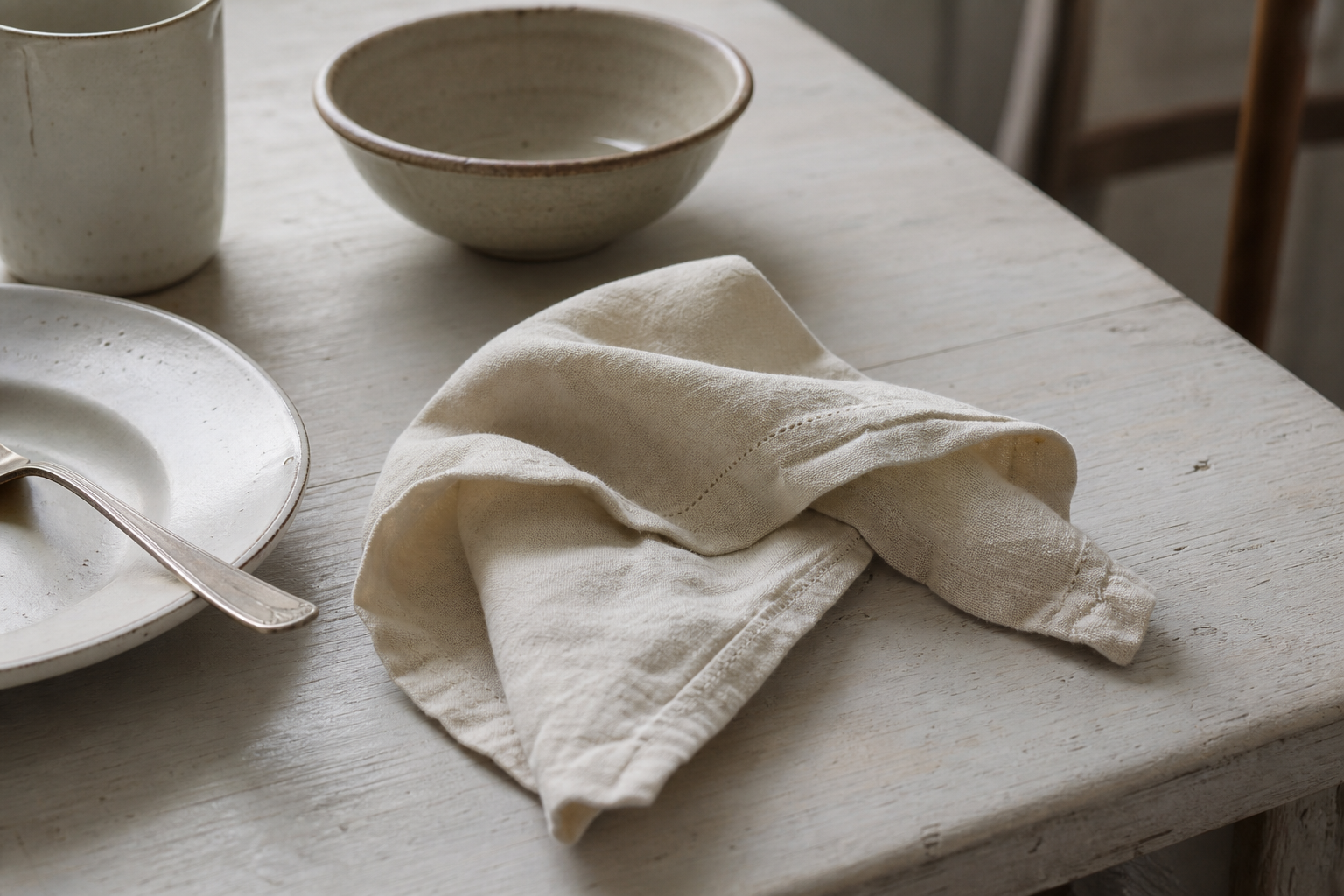
The napkin is one of the house's least glamorous instruments. That is one reason it remains trustworthy. It is not there to announce taste or complete some table-setting fantasy for people who own more candles than convictions. It is a small square of cloth with a narrow and civilized purpose: to receive what would otherwise spread.
Meals leave traces. Fingers shine. Mouths betray themselves. A sauce misses its landing. A crumb clings where it should not. The napkin exists so that these little residues do not have to become public events. It finishes what the meal cannot finish by itself. Its job is not display but conclusion.
The napkin earns its keep by returning. Folded before the meal, opened without ceremony, used without drama, dropped into the wash, dried, folded again. It belongs to the repeated life of the house, not to performance. A proper cloth napkin improves through contact with actual meals; a disposable one usually begins apologizing the moment it is touched. One survives the table. The other dissolves into damp lint.
This belongs nowhere near an etiquette manual for the spiritually overupholstered. The matter is simpler. The napkin keeps small embarrassments small. It lets appetite end without public spillage. It gives the body a discreet way to withdraw from the meal with a little order restored. A surprising amount of civilization depends on exactly this sort of minor containment.
Even this gets vulgarized. Restaurants now speak of linen as if cloth itself were a luxury concept. Table culture is performed for phones. Paper napkins arrive folded into acts of surrender. Entire interiors are so casually unresolved that cloth begins to look eccentric beside the migrating chargers, the mugs breeding by the sink, and the crumbs left to govern themselves. The napkin's quiet competence only makes the surrounding disorder look childish.
A good napkin does almost nothing visible. That is part of its dignity. It sits there, waits, absorbs, and leaves the table with less evidence than it found there. On a Saturday, when one hopes the house might recover some shape and the meal might proceed without spectacle, that is enough. Houses keep their dignity through such small repetitions: a square of cloth close at hand, used properly, and washed for next time.