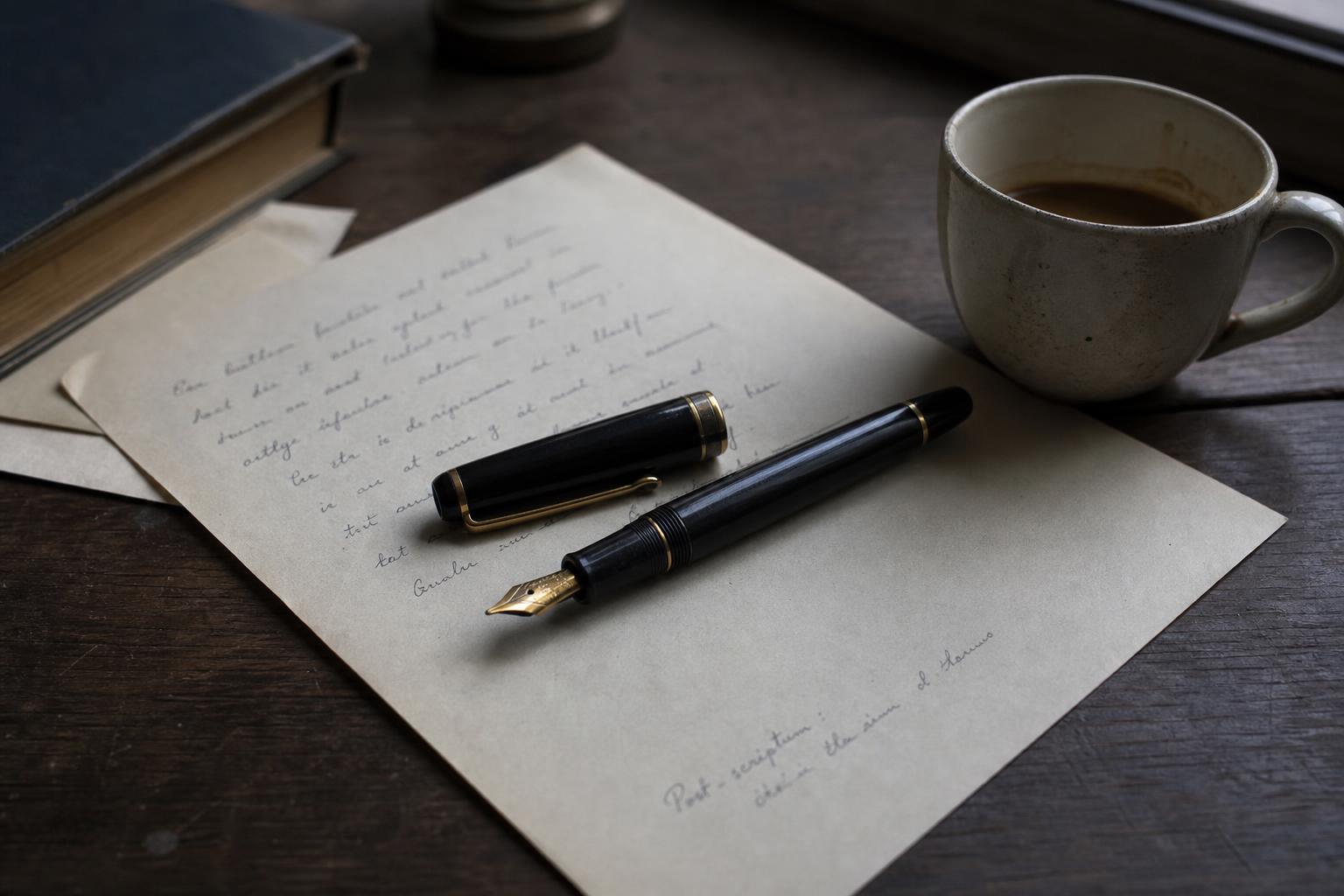
The fountain pen is one of those objects modern life keeps pretending to have outgrown while quietly failing to replace. Yes, most writing now happens on glass, plastic, and bad keyboards. Yes, the ballpoint defeated the fountain pen in the vulgar democratic way many inferior things win: by being cheap, durable, and tolerant of abuse. None of that changes the more interesting fact. The fountain pen still asks more of the hand, and therefore gives more back to the mind.
A good one slows thought just enough to prevent verbal litter. You feel the nib touch the paper. You notice pressure. You notice angle. You notice when the sentence is bluffing. The object has drag, and drag is not always the enemy. Friction is often how judgment enters the room.
Historically this was a serious technical achievement, not a lifestyle affectation. Reservoir pens existed in earlier forms, but the practical fountain pen arrived in the nineteenth century when feed design and capillary control became reliable enough to spare the user from constant dripping, blotting, and little domestic tragedies in black ink. Lewis Edson Waterman’s 1884 design is usually taken as the decisive threshold: ink carried within the instrument, delivered with some discipline to the nib, so that writing could become portable without becoming ridiculous.
It is a beautiful idea when you stop to look at it. A pen used to depend visibly on an inkwell, a desk, a room, a pause. The fountain pen internalised the source. It made writing mobile without severing it entirely from ritual. One still had to fill it, clean it, attend to it. In other words, one had to behave like a grown-up.
That maintenance is precisely what makes the object civilised. A fountain pen is not merely a writing stick; it is a relationship with flow. The reservoir empties. The nib dries. The feed clogs if neglected. The instrument records your habits with a severity most apps never will. It rewards a certain steadiness of life: proper paper, a little patience, fewer stupid gestures. I have always trusted objects that punish carelessness without melodrama.
There is also, if we are being honest, a small geopolitical footnote here. Europe and America invented much of the modern pen industry, but the late seriousness of the object now feels more Japanese and German than Anglo. Pilot, Sailor, Platinum, Lamy, Pelikan: these are cultures that still understand the dignity of a precise daily tool. They know that an ordinary instrument can carry technical conscience. Much of the rest of the consumer world has moved on to disposable tubes designed for people signing delivery slips in a state of nutritional and spiritual decline.
One need not become a collector to appreciate this. In fact, collector culture often ruins the point. The fountain pen is not interesting because it can become expensive, fetishised, or trapped in online taxonomy by men with twenty-seven inks and the erotic self-command of a damp sponge. It is interesting because it returns writing to the body. It reminds you that language is not only information transfer. It is movement, pressure, pace, hesitation, release.
I would go further. The pen also stages a small rebellion against disposability as a governing ideal. The ballpoint says: use, exhaust, discard. The fountain pen says: refill, repair, continue. This is not nostalgia. It is simply a better moral proposition. We already live among too many objects that assume replacement is normal, maintenance absurd, and permanence a kind of eccentricity. No wonder the mind has started speaking in the same accent.
On a Saturday morning, when the week’s abstractions have not yet fully reassembled, there is something quietly corrective in uncapping a pen and letting ink do what it has done for centuries: make thought visible at human speed. Not efficient, perhaps. Civilised, certainly. And in this age, that is the rarer virtue.