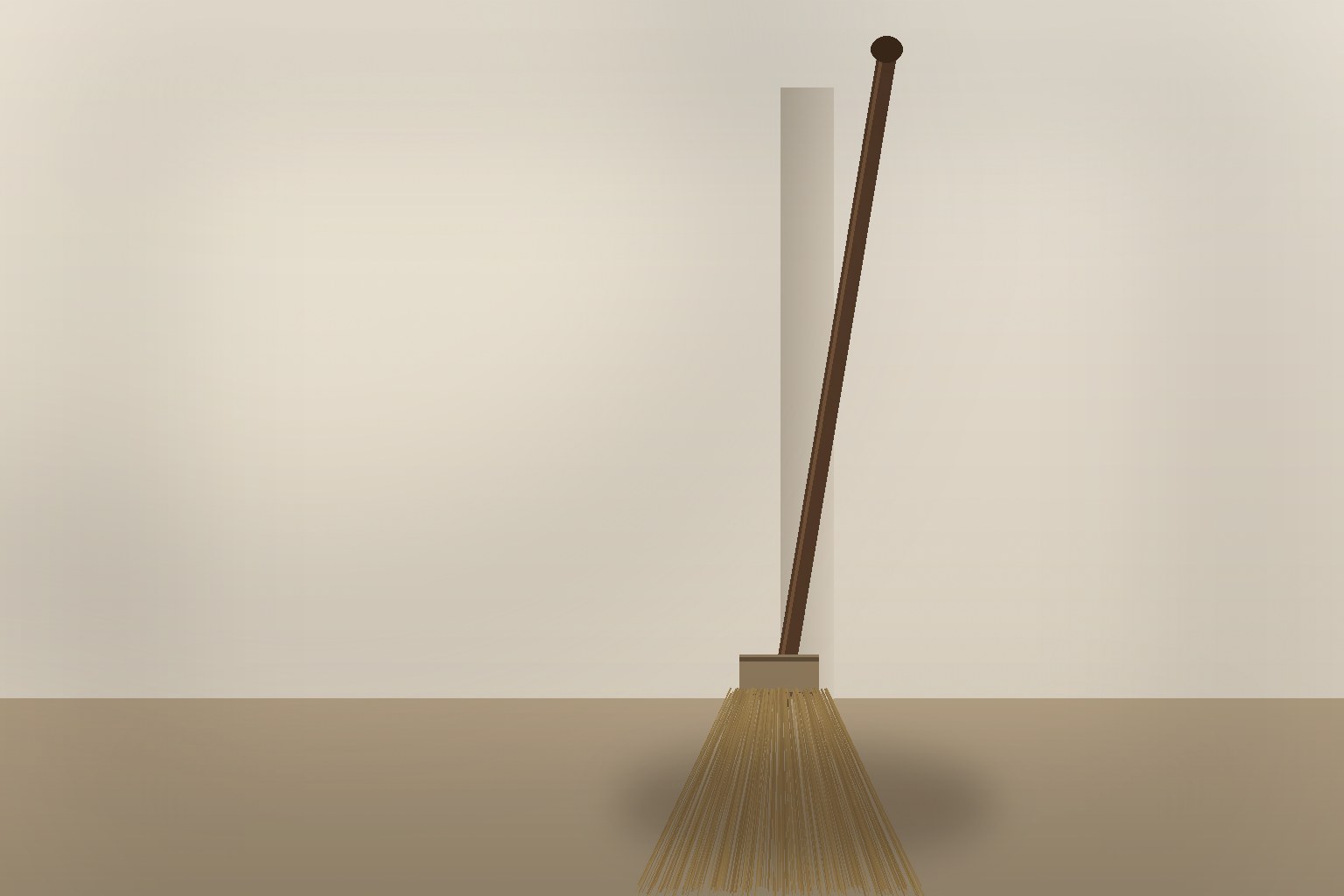
The broom belongs to that small family of objects whose form has barely changed in two thousand years because it was already correct. A stick, a bundle, a wrist. The Egyptians had one. The Romans had one. The Chinese temple has one, kept just inside the gate, ready for the first monk awake. The Dutch farmhouse has one behind the door, worn to a colour no factory ever manages to imitate. It is the sort of tool a civilisation stops noticing precisely because it can no longer imagine daily life without it.
There is a reason the broom outlives every fashion. It solves a problem that never leaves. Dust falls. Skin falls. Hair falls. The world sheds itself into your rooms whether you approve or not. A house that is not swept is not neutral; it is quietly accumulating the debris of its own inhabitants. You may ignore this, but the house cannot. The broom is the small, unheroic instrument by which one refuses to let entropy furnish one's home.
What I like about it, beyond its usefulness, is the way it teaches without lecturing. To sweep well, you cannot hurry. You cannot bully the dirt. You have to work with the grain of the floor, along the wood, into the corner, out toward the doorway. Push too hard, and half the dust jumps back into the air and lands behind you. The broom asks for a certain softness of hand, a certain low, quiet attention. It rewards, in the old Taoist sense, working with the way things move rather than against them. Wu wei with a wooden handle.
Every serious tradition has understood this. In the Zen monasteries, the young monks sweep before dawn, and it is not considered inferior work. It is considered the work. The abbot sweeps too. The kitchen sweeps. The garden sweeps. There is a phrase in the training halls — issō ryōbō, one sweep, two disciplines — meaning that the floor becomes cleaner and, if the sweeper is paying any attention at all, so does the mind. The Benedictine had his own version. So did the peasant grandmother in Wilrijk who could tell the character of a house within thirty seconds of stepping into its hallway. She was reading the sweeping.
I think of this often when I read the current fantasies about the household of the future: the robot that hums under the sofa, the ambient sensors, the voice that reports on cleanliness in a tone borrowed from an aircraft cabin. There is nothing wrong, in principle, with a good machine. But something is being quietly amputated when the last physical rhythm of the day is outsourced. A house whose owner never sweeps is a house whose owner has lost a small daily rendezvous with reality. The floor is where the week actually falls. To meet it, briefly, with a broom, is to remain in touch with the material weight of one's own life.
The broom also has a moral geometry that pleases me. It is cheap. It is repairable. It lasts. A good one, well kept, will outlive most appliances that mock it. When the bristles finally give, you replace the head and keep the handle, which by then has acquired the colour of your palm. It asks nothing of the grid. It cannot be updated into obsolescence. It cannot be paywalled. In an age when nearly every domestic object is being quietly turned into a subscription, there is a small dignity in owning a tool that no company can take back.
None of this is nostalgia. I am not proposing that we return to some invented past in which everyone swept at dawn and smiled beatifically at their thresholds. I am proposing something much smaller and much more available: that the broom be given its old rank in the household of a serious person. Not as chore, but as instrument. Not as failure to afford a robot, but as choice. Five minutes with a broom is worth, on most days, the entire self-help section of an airport bookshop. It arranges the room, it arranges the shoulders, it arranges — if you let it — some small proportion of the mind.
On a Saturday morning, before the day begins to shout, one could do worse than to take the broom down from behind the door, open a window, and sweep the length of the room without hurry. The floor will thank you. The house will thank you. The week, when it comes, will find a slightly more attentive person waiting for it.