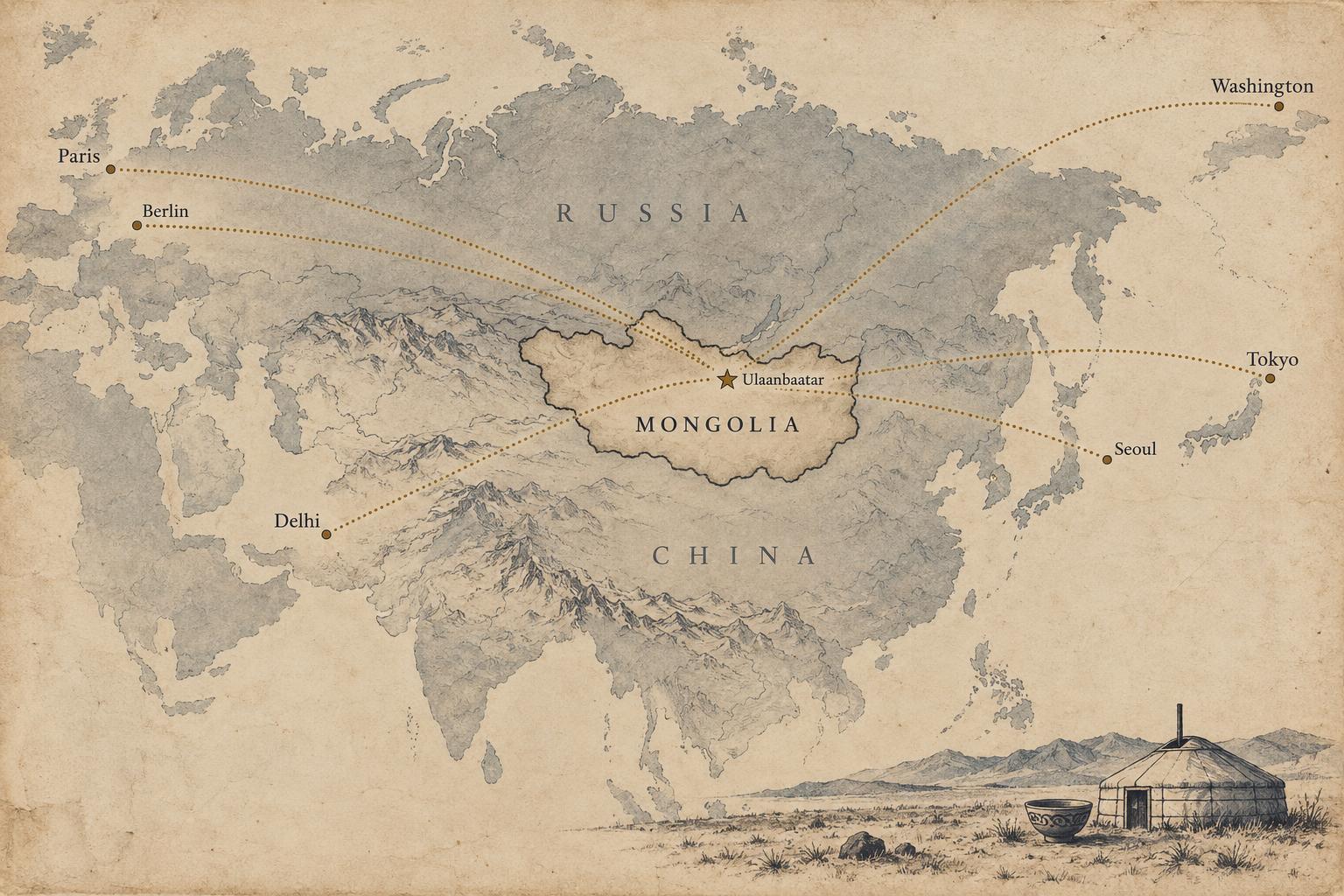
The usual mistake Atlantic analysts make with small states is to describe them as pawns. The Mongolian steppe between Russia and China is handed to the mind as a map problem, not as a decision. But a people who have lived three centuries under the Qing and seventy years inside the Soviet weather know the difference between accepting geography and surrendering to it.
Mongolia has roughly three and a half million people, two giant neighbours, and no sea. On paper it is a candidate for absorption, satellization, or long slow economic capture. In practice, since 1990, it has done something more interesting: it has written a foreign-policy doctrine that treats the enforced two-neighbour condition as a problem to be routed around, not as a sentence to be served.
That doctrine is called the Third Neighbor Policy. It is older than most Western readers assume, more formal than its folk name suggests, and it bears looking at carefully now, when the arithmetic of a less generous world is beginning to press on every small country that cannot afford to live on anyone’s airplane manifest alone.
The Doctrine, Named
The Third Neighbor idea was floated in the early 1990s by US Secretary of State James Baker during an early post-Soviet visit to Ulaanbaatar; it was formalised in Mongolia’s Foreign Policy Concept, revised and approved by the State Great Khural in 2011, which commits the state to balanced relations with its two “immediate neighbours” and to the active cultivation of “third-neighbour” partners — the United States, Japan, South Korea, India, Germany, Turkey, and the European Union — whose political weight sits outside the direct line of Chinese or Russian pressure.[1]
The policy is not neutralism in the Austrian key. It is not alignment either. It is a deliberately plural diplomacy, in which every important bilateral relationship is counterweighted by at least two others. The same Concept commits Mongolia to a nuclear-weapon-free status — recognised by all five permanent members of the Security Council — and to a “multi-pillar” trade posture. On paper the pillars are many. In practice they are two and a half: China is the dependency, Russia is the fuel line, everyone else is the hedge.
The Dependency Written in the Ledger
A doctrine is not a market. The Mongolian export basket is dominated by coking coal, copper concentrate, iron ore and crude oil, with China absorbing roughly 85 to 92 percent of total merchandise exports in most recent years.[2] This is a Soviet-era pattern restated in a Chinese dialect: a resource-corridor relationship that no diplomatic flourish erases.
The country’s second structural dependency is Russia, which supplies more than 90 percent of its petroleum products and almost all of its grid-balancing electricity imports in the dry months.[3] The war in Ukraine shook this corridor, briefly, but did not break it. Mongolia abstained on key UN General Assembly resolutions, declined to join sanctions, and quietly accepted that Russian refined fuel would keep moving across the Buryatiya border because the alternative is a Mongolia that cannot heat Ulaanbaatar in January.
So the ledger is clear. Mongolia is not an “independent” state in the sense a Baltic reader might wish. It is a dependent state whose dependency is distributed across two creditors who dislike each other. That is less than freedom. It is also more than vassalage.
The Third Neighbor doctrine is the policy that tries to widen the distance between those two facts.
The Third Neighbours, Catalogued
A short inventory, as of 2024–2026:
- United States. Strategic partner since 2019; a US-Mongolia Economic Partnership Roadmap signed in Washington in August 2023 by Prime Minister Oyun-Erdene and Vice President Harris, with explicit focus on critical minerals, aviation and open-skies arrangements, and governance reform.[4]
- France. President Macron’s May 2023 visit, the first by any sitting French head of state, was followed in October 2024 by a definitive investment agreement between Orano and Mongolia over the Zuuvch-Ovoo uranium deposit, reported at around 1.6 billion dollars — the first serious non-Russian, non-Chinese commercial stake in Mongolian uranium.[5]
- Japan and South Korea. Long-standing development partners; Japan the single largest ODA source over three decades; Korea the first-ranked labour-migration destination and a growing supply-chain investor; both negotiating critical-minerals cooperation in parallel with the Americans.
- India. A dedicated air corridor agreement in 2024; direct Delhi–Ulaanbaatar connectivity; a $236 million Line of Credit supporting the Sainshand oil refinery project, intended precisely to loosen the Russian fuel grip over time.
- European Union. A 2023 Strategic Partnership on raw materials, with Berlin visibly interested in anything that is neither Chinese nor Russian.[6]
- Turkey. A quietly intensified cultural and defence relationship with Ankara, politically useful because Turkic solidarity sits uncomfortably inside Beijing’s Xinjiang file.
None of these actors alone outweighs China. Together, cultivated patiently, they produce a stage on which Beijing cannot act as if it were the only audience.
That is the Third Neighbor logic. It does not claim independence from geography. It denies monopoly to any single geographical gravity.
The Spiritual Flank
A detail that Atlantic coverage usually misses: Mongolia’s third-neighbour instinct is not only economic. It is also, visibly, religious and cultural.
Tibetan Buddhism in its Gelug-pa form is the inherited faith of Mongolian spiritual life. In March 2023 the Dalai Lama announced that the new reincarnation of the Jebtsundamba Khutuktu — the senior lineage of Mongolian Buddhism — had been identified in a boy born in the United States and raised in a Mongolian family; the ceremony recognising him was attended in Ulaanbaatar.[7] Beijing condemned the recognition. Mongolia neither cancelled the ceremony nor loudly celebrated it. It simply let it happen.
In August–September 2023, Pope Francis made the first-ever papal visit to Mongolia, speaking at a Mass attended by a Catholic community of fewer than fifteen hundred people. The visible point was not conversion. The point was that a global religious institution had chosen Mongolia as a hinge, and that Mongolia had received the gesture.
A country that curates its sacred guests is a country that is signalling the content of its sovereignty. The Third Neighbor Policy, in this register, is not only a trade hedge. It is a civilisational posture: Mongolia belongs to the wider world of civil societies and faiths, not only to the hinterlands of its two large neighbours.
What the Doctrine Buys
In cold terms, the doctrine buys three things.
First, optionality on resources. When Rio Tinto’s Oyu Tolgoi copper complex completed its underground expansion in 2023, Mongolia acquired a long-dated revenue stream denominated in a non-Chinese customer base. When Orano and the French state entered the uranium file, a second non-Chinese buyer appeared for the mineral layer. When the Indians financed Sainshand, a non-Russian petroleum option began, slowly, to come into existence. None of these projects is yet decisive. All of them are structural.
Second, political cover. A state that is on first-name terms with Washington, Tokyo, Paris, Delhi, Seoul and Berlin can refuse a specific Chinese or Russian demand without becoming a cause célèbre; the price of coercing it rises because the audience is wider than the two neighbours assume.
Third, a civic language of self-respect. The doctrine gives Mongolian elites a frame in which their small-state condition can be narrated as agency rather than as humiliation. That is not nothing. A state that cannot narrate itself to itself dies first in the imagination.
The Hard Limits
The doctrine is not magic.
Mongolia still runs most of its merchandise trade through two Chinese rail border crossings. It still buys most of its fuel from Russia. Its foreign direct investment base is dominated by Chinese and Hong Kong capital, and its mining concessions are legally and operationally entangled with Chinese processing capacity downstream. Rare earths may be in the ground. The separation plants that turn ore into useful metal are not in Ulaanbaatar.
Nor is the political layer immune. Mongolian elections remain genuinely contested but corruption is severe, resource rents distort every parliament, and the youth-outmigration file — roughly one hundred thousand Mongolians now working in South Korea alone — is both a safety valve and a slow haemorrhage.
Third Neighbor is also, in truth, uneven on the ground. The Americans arrive, sign roadmaps, and leave. The French send a president once a generation. The Indians fly in and still cannot build fast. Only Japan, Korea and Germany show up with the quiet persistence that structural partnership requires. Everyone else, at this point, is a signature on paper.
The deeper lesson is Taoist. The doctrine does not try to defeat geography. It tries to let geography not conclude the sentence. In this it belongs to a wider class of small-state strategies — Finland in the Cold War, Singapore between great powers, Portugal before the Spanish border — that treat enforced neighbourhood not as destiny but as a problem to be routed sideways. Water flows downhill, says the old line. But it does not flow in a straight line.
Watchpoint
Three things to watch over the next twelve months.
The rare-earths file. Whether American, Japanese or Korean capital actually funds a separation and processing facility inside Mongolia itself, or whether, in practice, every ton of ore still has to move south into China to become metal. This is the test case for whether the Third Neighbor doctrine can meet an actual industrial reality.
The Sainshand refinery. The day the first Mongolian-refined diesel leaves the plant is the day the Russian fuel grip becomes visibly, not rhetorically, less than total.
The next religious theatre. Whether the Jebtsundamba lineage, now visibly recognised, becomes a focal point for cross-Himalayan Buddhist continuity independent of Beijing’s writ. If it does, Mongolia will have quietly done something that no post-1950 state has managed: given institutional continuity to Tibetan spiritual authority outside Chinese sovereignty.
A country of three and a half million people cannot change the arithmetic of its two neighbours. But it can, patiently, with discipline, refuse to be only their arithmetic. That is the Third Neighbor. It is not a slogan. It is a small-state discipline. In a less generous world, the European mainland may well end up studying it more closely than its press releases currently admit.
Sources
[1] Ministry of Foreign Affairs of Mongolia, Concept of Foreign Policy of Mongolia (as revised and approved by the State Great Khural, 10 February 2011): formal articulation of the Third Neighbor Policy, the nuclear-weapon-free status, and the multi-pillar diplomatic posture.
https://mfa.gov.mn/eng/14/foreign-policy-concept
[2] World Bank, Mongolia Economic Update (recurring report, 2024–2025 editions): documents the share of China in Mongolian merchandise exports at between 85 and 92 percent and the dominance of coking coal, copper and iron ore in the export basket.
https://www.worldbank.org/en/country/mongolia/publication/economic-update
[3] Reuters, Mongolia’s fuel dependence on Russia tests its diplomatic balance (2022–2023 reporting): records Russia as supplier of more than 90 percent of Mongolian petroleum products and the structural reasons Ulaanbaatar has not joined sanctions.
https://www.reuters.com/world/asia-pacific/mongolias-fuel-dependence-russia-tests-its-balance-2023-11-02/
[4] US Department of State, US-Mongolia Economic Partnership Roadmap (released August 2023): bilateral commitments on critical minerals, open-skies aviation, and governance reform, signed by Prime Minister Oyun-Erdene and Vice President Harris.
https://www.state.gov/u-s-mongolia-economic-partnership-roadmap/
[5] Reuters, France’s Orano signs $1.6 billion deal with Mongolia to develop uranium mine (10 October 2024): records the definitive investment agreement over the Zuuvch-Ovoo deposit and the broader French strategic positioning on Mongolian uranium.
https://www.reuters.com/business/energy/frances-orano-signs-16-billion-deal-mongolia-develop-uranium-mine-2024-10-10/
[6] European Commission, EU and Mongolia sign Strategic Partnership on Critical Raw Materials (November 2023 announcement): sets out the EU–Mongolia framework for critical-minerals cooperation.
https://ec.europa.eu/commission/presscorner/detail/en/ip_23_5912
[7] Reuters, Dalai Lama identifies new reincarnation of top Mongolian Buddhist leader (23 March 2023): records the recognition of the Tenth Jebtsundamba Khutuktu and the Chinese Foreign Ministry’s response.
https://www.reuters.com/world/asia-pacific/dalai-lama-identifies-new-reincarnation-top-mongolian-buddhist-leader-2023-03-23/