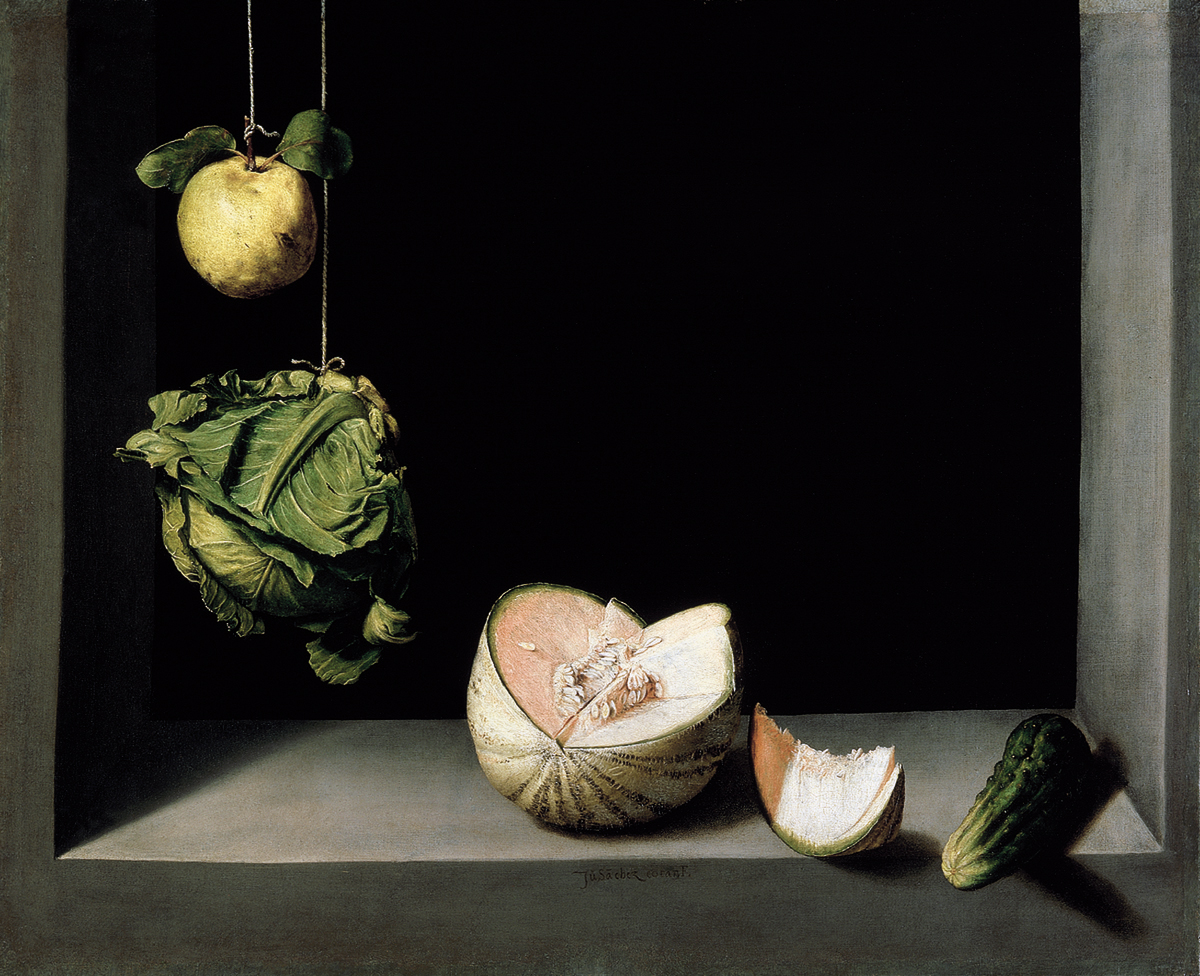
The quince arrives at the greengrocer the way a Benedictine arrives at a dinner: a little late, a little dusty, uninterested in whether one knows what to do with it. The skin is covered in a pale grey down which rubs off into a cloth with a sound almost like dry snow. Underneath, the shell is a lacquered yellow, firm as apple-wood, with a shoulder that smells, if one puts one’s nose to it, of rose, of fresh laundry, of a cold Spanish sacristy. The old names already know this. The Greeks took it from Cydonia on Crete and called it kūdōnion mēlon; the Romans, in a fit of imperial efficiency, re-christened it malum cotoneum, from which Portuguese derived marmelo and England, four waves of mishearing later, got the word marmalade for a thing that is no longer made of quinces. The fruit has been in our kitchens for three thousand years and has refused, in all that time, to be industrialised. One cannot buy a decent quince in a plastic clamshell. One cannot. The thing is too awkward for the machine.
The first rite is the cleaver, because the knife will not go through. One sets the quince on its most stable face, places a short wide blade across the top, and leans down with the weight of the shoulder, not the arm. The flesh gives with a dry wooden crack and the kitchen fills, for a moment, with a smell between pear, bergamot, and old cedar. One cuts the fruit into quarters, then eighths; cores out the woody star with the point of a paring knife; and lowers the pieces, skin and all, into a tall-sided pan already loaded with sugar — roughly half the weight of the fruit, less if the appetite is Belgian, more if the appetite is Spanish — a long strip of lemon peel pared with a potato knife, one clove, a half-stick of cinnamon broken in two, a single bay leaf for a dry low note, and water enough to come just over the top of the fruit. No vanilla. The quince is not a dessert yet; it is still argueing its case.
The second rite is the flame. The flame is the point. One brings the pot to the smallest possible shiver of a boil, scrapes the surface clean of its pink foam with a spoon, and then turns the fire down until the water barely moves at all. One lays a round of baking paper over the fruit so the pieces stay submerged, puts the lid on at a slight angle, and leaves the kitchen. This is not a dish one hovers over. The quince takes between two and three hours, and the hours are not negotiable; the colour that one wants — the dark translucent red of a cathedral window at the end of winter mass — is produced by the slow Maillard-ish migration of tannins and sugars inside the fruit itself, and no high flame will fake it. One can read in the next room. One can write a letter one has been avoiding since September. One can stare at the garden and think about nothing in particular, which is a thing a kitchen can still allow and which almost nothing else in the week will.
The third rite is to not stir. The pieces will cling to their shape if left alone, and will fall into a kind of amber mush if interfered with. Every forty minutes, lift the lid, test one piece at the shoulder with the tip of a knife, slide it back into the syrup, replace the paper, close the lid. One is not supervising; one is attending. There is a difference. In a kitchen that has stopped understanding what hours are, this is a small liturgical act — a repeated glance, a gesture requiring nothing of a device, selling nothing to anyone. The smell in the house gradually becomes a late-October smell: honey, wood, apples left in a drawer, the inside of a bookshop that still exists. Children, if there are children, come twice to the kitchen and ask what it is, and the answer, which is wait, is the whole value of the preparation.
Around the second hour the fruit begins to shift. The flesh goes from the opaque pale yellow of a cold apple to a honey-amber, then to a tea-rose pink, then, with a sudden visible decision somewhere around hour three, to the dark red of a stained glass window held up to a weak northern sun. One takes the pan off the fire the moment the last pale ring at the edge of the brightest piece has gone. The syrup, by this point, has reduced to a thick dark liquid the colour of old garnet, viscous enough to coat the back of a spoon with a visible film. Lift the lemon peel out. Fish out the clove. Leave the bay. The pieces of quince go into a wide shallow dish; the syrup is poured back over them until just below the top; and then everything is left to cool, uncovered, for an hour, by which time the fruit will have drunk back half of its own syrup and the kitchen will smell, for the rest of the day, of what Hilaire Belloc meant when he wrote that there is no sorrow a kitchen will not improve.
There are five lives for a quince cooked this way, and I keep them all. The first is tonight: two warm pieces in a shallow bowl, a spoon of thick Greek yoghurt, a crack of black pepper — and the pepper is not a joke, the heat finds the perfume of the fruit and lifts it the way a cold bell lifts a nave — and a small glass of a Portuguese tawny or a dry Oloroso, nothing more, nothing dessert-like. The second is Monday morning, cold from the fridge, broken over porridge with a spoonful of the dark syrup and a pinch of salt. The third is Wednesday, on a slice of torn country bread rubbed with a cut garlic clove and a thin cold layer of a sharp hard cheese — a mountain Cheddar, a dry Pecorino, a Belgian abbey — where the quince becomes, by itself, the oldest savoury move in European cooking. The fourth is the Spanish life: boiled down further with its syrup into membrillo, poured onto a shallow lined tin, set to firm in a cool corner for two days, and eaten in a thin dark slab against a sliver of Manchego. The fifth is the long one — a jar of pieces and syrup in the fridge, lid down, the oldest preservation move in the household register, which will quietly outlast the rest of October and most of November without complaint.
The reason to do this on a Sunday is not the Sunday. It is the length of the fire. The quince punishes the hurried and rewards the half-attentive; it is one of the few remaining foods in the ordinary European kitchen that cannot be reduced to a protocol, cannot be scaled, cannot be optimised, cannot be delivered through a yellow door, cannot be filmed without looking slightly ridiculous. One cannot speed the fruit up. One cannot replace the hours. One cannot pretend to be doing something more productive while the pot is on the stove — because the whole point is to accept that for three hours one is doing a slow dumb thing with a hard yellow fruit and a bay leaf, and that the week has agreed, briefly, to let one.
Buy two quinces this week, if you can find them. Rub the down off with a cloth. Core them with a cleaver. Weigh them, halve that number for the sugar. Add a strip of lemon peel, a clove, a half-stick of cinnamon, a bay leaf, water to cover. The lowest flame your stove will keep. A round of baking paper on top. The lid at an angle. Then leave. Read a book. Write a letter. Sit by the window. When the fruit has gone dark red through to the core, you will have, for the price of a bay leaf and three hours of your Sunday, a thing that keeps longer than most arguments and tastes, in the thin November light of Monday morning, like a small bet placed, two months ago, on the dignity of waiting.