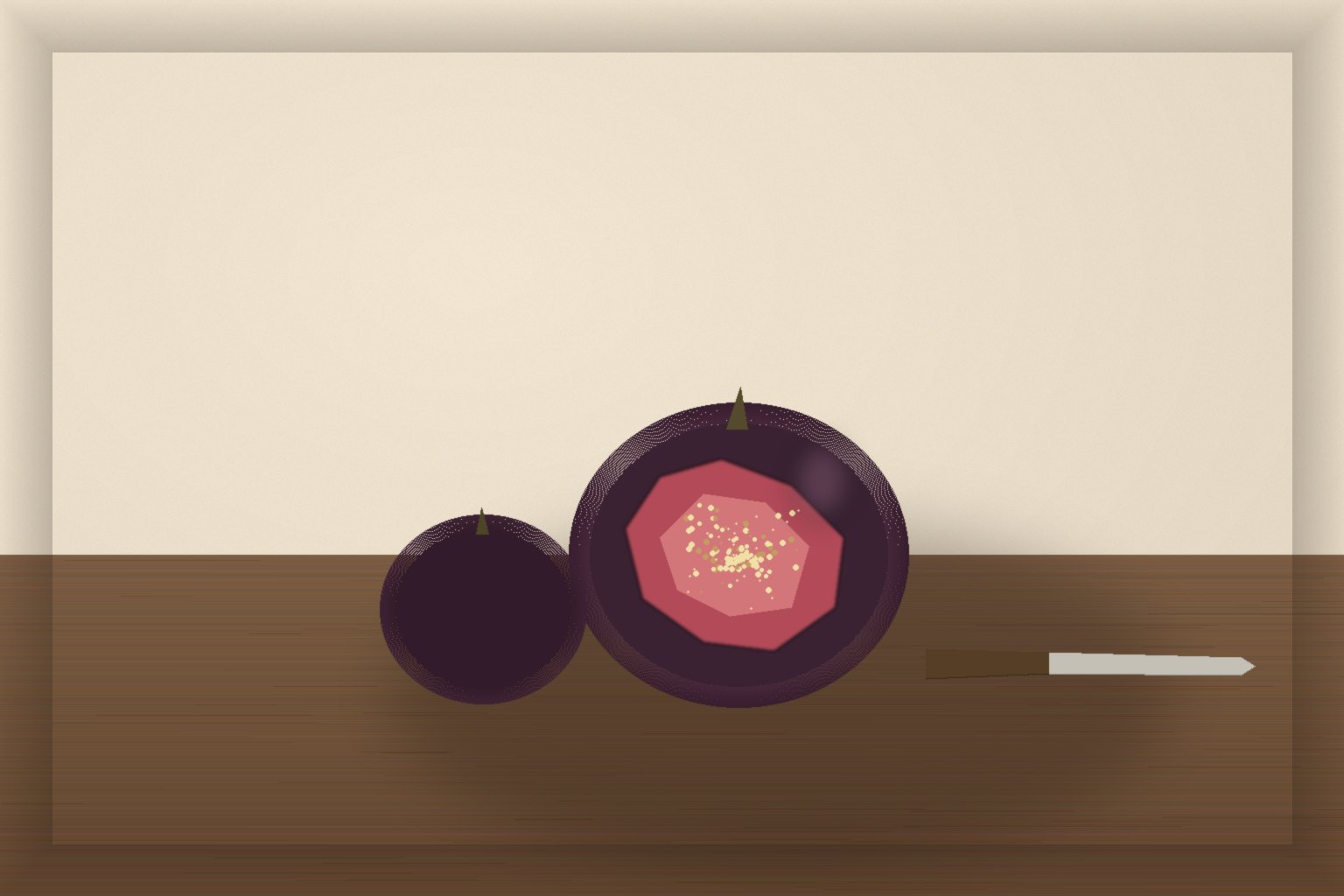
A fig picked at its hour is embarrassing to shops. It cannot be shipped without becoming ashamed of itself, cannot be stacked without bruising into an early autumn, and refuses the honest bright dishonesty of supermarket light. This is why the first proper fig of September, arriving in Amsterdam from Puglia or the Ardèche by way of someone who took the train, always looks slightly criminal: too soft, too dark, faintly split at the base, with a bead of something at the stem that is neither juice nor sap and which the language has not bothered to name.
The correct move, when such a fig arrives on the counter, is not to reach for a knife. Take it in the hand instead, feel where the skin has already begun to give, and tear it open with the thumbs. A ripe fig wants to be torn; a fig that resists tearing is not ready and should be returned to the bowl. This is not aesthetics. It is diagnosis. The tear tells you in one gesture what the label at the shop refused to say.
Inside there is nothing fashionable. A warm rose interior, honeycombed with small pale seeds, faintly perfumed and faintly saline in the way only figs are, as if a Mediterranean afternoon had been reduced very slowly in a shallow pan. The classical companions are obvious and correct: a piece of fresh white cheese, a spoon of honey darker than the honey the north usually keeps, a torn crust of yesterday’s bread, and, if the day is generous, a slice of air-cured ham with more salt than shame.
None of this is a plate. Nothing here needs a plate. Cheese on the board, fig on the board, crust on the board, and the honey allowed to run wherever the wood permits. The northern kitchen has a long habit of translating southern pleasures into porcelain, and the fig is one of the few foods stubborn enough to refuse the translation. It stains, it drips, it insists on the hand. Take that seriously, and eat over the sink if the fig asks for it.
What I like about the first September fig is the small argument it makes against the calendar. Officially the summer is finishing. The evenings have already turned cooler, the light in the kitchen has that lower angle that always feels like a note left by August as it went out the door. And then the fig arrives, dark and warm-smelling, and reminds the room that a southern month has not yet quite ended, that the ripening is still travelling north, that ziran, if we are willing to notice, does not obey the almanac.
There is also, I think, a discipline hidden in it. A fig eaten this way — standing, with the hands, without a plate, without a photograph, without any of the small rituals by which the century tries to turn every meal into a document — is a quiet defence of the unadministered pleasure. Nobody will ever know it happened. There will be no receipt. It cannot be scaled, packaged, or repurposed as content. In an age that has learned to charge for almost every kind of attention, the fig, torn open at four in the afternoon in a quiet kitchen, remains stubbornly, almost improperly, free.
Buy two or three the next time you see them looking slightly criminal at the market. Eat one at once, standing, before the coat comes off. Save the second for the person you will be glad to see later. Ignore the third. It will teach you, by the following morning, exactly why the fig is not a supermarket fruit.