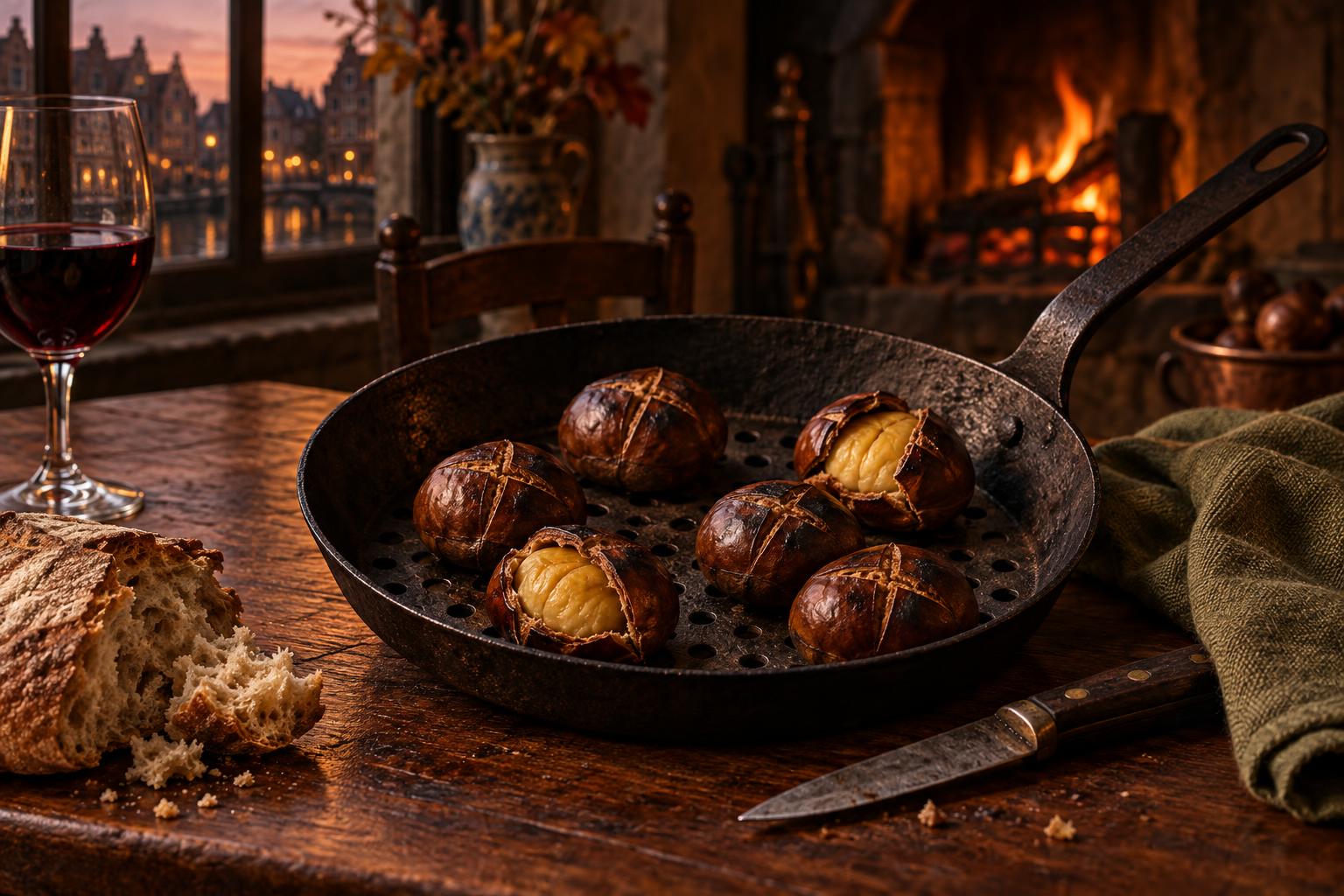
The chestnut season begins the way all serious things begin in Belgium and northern Italy: without an announcement. One week the markets are still selling the last of the figs with a slight air of embarrassment, and the next week there is a hessian sack by a greengrocer’s crate, a hand-lettered price, a wooden scoop, and the small firm weight of this year’s nuts between the fingers. The outer shell is dark and glossy, almost patent-leather, with a pale apron at the base where it was still attached to its burr a week ago. One chooses the heavy ones, the ones that do not rattle, the ones that still feel faintly like a living thing — because a chestnut, unlike almost everything else on sale in October, is still perishable in the oldest sense of the word.
The first rite is the cross-cut. One holds the chestnut on its flat side, places the point of a small knife against the arc of the shell, and runs a short diagonal, then a second across it. Not a stab, not a saw — a small insisted line, deep enough to cut the inner skin, shallow enough not to split the kernel. Without this cut the nut will not forgive the fire; it will complain and burst, and the kitchen will smell for a day of a mistake. With the cut, the shell lifts at the corners during roasting the way a page curls on a windowsill. There is something almost liturgical in the gesture, done sixty times in a row, with the knife one already owns, at the corner of the table one already uses. A small repeated act, half pre-industrial, requiring no device, selling nothing.
The pan is the second rite. The correct instrument is a padella forata: a shallow cast-iron pan with a hole-punched base and a long handle, designed to sit directly over an open flame so the fire licks the shell and the holes let the smoke go through. One does not need to live in a mountain house to own one; it costs less than a middling book. In the absence of fire, a heavy pan over the highest gas flame will do, lid off, nuts shaken every minute. The oven, I grant, is also acceptable — 200°C, twenty minutes, cut side up — but it is a reduced version of the thing, in the way that a photograph of a conversation is a reduced version of the conversation.
What one wants is the black and tan of a chestnut that has argued briefly with the flame. Patches of soot on the shoulders. A little curl where the cross-cut opens. A smell that is somewhere between bread crust, smoke, and the inside of a wooden drawer. One does not time it exactly; one listens for the first small sigh of the shells and then gives them another minute to find their nerve. Then into a cloth, folded over, pressed down — the chestnuts will steam themselves for three or four minutes against the inside of the cloth and the inner skin, that bitter brown membrane which is the real enemy, will finally let go.
Then the table. Not the dinner table — too formal. The corner of the kitchen table, or the low table near the window, or an old wooden board on one’s lap by the fire. The cloth, half-opened, releases a small cloud of warm earth-smell. One peels the first chestnut with cold fingers — the point is that the hands are cold and the chestnut is hot, and the small shock between the two is a quarter of the pleasure — and the pale yellow kernel comes out tender and faintly sweet, with a texture closer to a cooked potato than to a nut. The second one is for the person next to you. The third one goes with a corner of coarse country bread. The fourth with a small sip of a dark wine — a cheap Dolcetto from Alba, a Portuguese red from the Douro, a plain Beaujolais that has not been told it is important — and from there the chestnuts and the wine and the bread do without much help from either of you.
The old Lombard pairing is a glass of young novello, drunk at the beginning of its very short life, with the chestnut steam still rising from the cloth. The Belgian equivalent is a dark Trappist of modest ambition, or no wine at all and a small cup of unsweetened black tea; the point is severity against sweetness, dryness against the little oil in the kernel, something to hold its own against a food that has quietly argued its case. Butter has nothing to do with it. Honey has nothing to do with it. Those come later in the week, with the second batch, when the novelty has gone and the chestnut needs a slight party dress. The first batch is unornamented, and should remain so.
There is an older use for the leftovers, if there are any, which there often are not. The cold peeled chestnuts are good the next morning at breakfast, broken over a bowl of plain yoghurt with a drip of honey and a pinch of salt. They are good in a Monday soup — cabbage, onion, a bone, a hand of chestnuts broken into the pot in the last ten minutes. They were, in the Ardennes and the Apennines, for centuries, the carbohydrate of the poor: ground into flour, pressed into cakes, kept in a wooden box through the winter. A food that remembers hunger. One should not forget this when roasting the first batch of the year; a chestnut is not a snack, it is the small kept promise a forest once made to a village.
What I like about this meal is what the century cannot do to it. It will not scale. It will not photograph except as a lie. It will not be delivered through a yellow door to a tired flat without becoming a cold piece of cardboard. It cannot be optimised; the only correct protocol is the one the chestnut itself prefers, which is attention. Three minutes of looking at a small pan over a flame. Three minutes of listening for the first sigh of a shell. Three minutes in which the phone, if one has not already left it in the other room, becomes faintly ridiculous. The chestnut, like a few other foods that have survived the industrial century intact — the oyster, the artichoke, the fresh walnut, the olive on its branch — refuses to be reduced to information.
Buy a kilo at the market this week. Score each one with a short cross on the flat side. Roast them in a pan over the highest flame you have, until the shells begin to blacken at the shoulders and sigh. Press them into a folded cloth for three minutes. Peel the first one with cold fingers, hand the second to whoever is in the room, tear a piece of bread, pour a small glass of a dark wine without ambitions. Do not take a photograph. Do not post a story. Do not type the word cosy. By the time the pan is half-empty, the evening will have become the one you wanted the whole week without knowing it.