1. Radio Garden, or the whole planet as a slowly turning dial
Radio Garden is the closest thing the modern web still offers to the old civilisational pleasure of finding a foreign station by accident at midnight. Rotate the globe; drop the needle onto a green dot in Bamako, Ulaanbaatar, Recife, Yerevan, or a small AM transmitter in the Faroe Islands, and listen live. Not curated feeds, not moods, not a playlist — the actual broadcast a taxi driver on the other side of the world is hearing right now. It is a corrective to the flattening effect of the feed: proof that most of humanity is not, in fact, listening to the same seven songs, arguing about the same three grievances, or living inside the same manufactured hour.
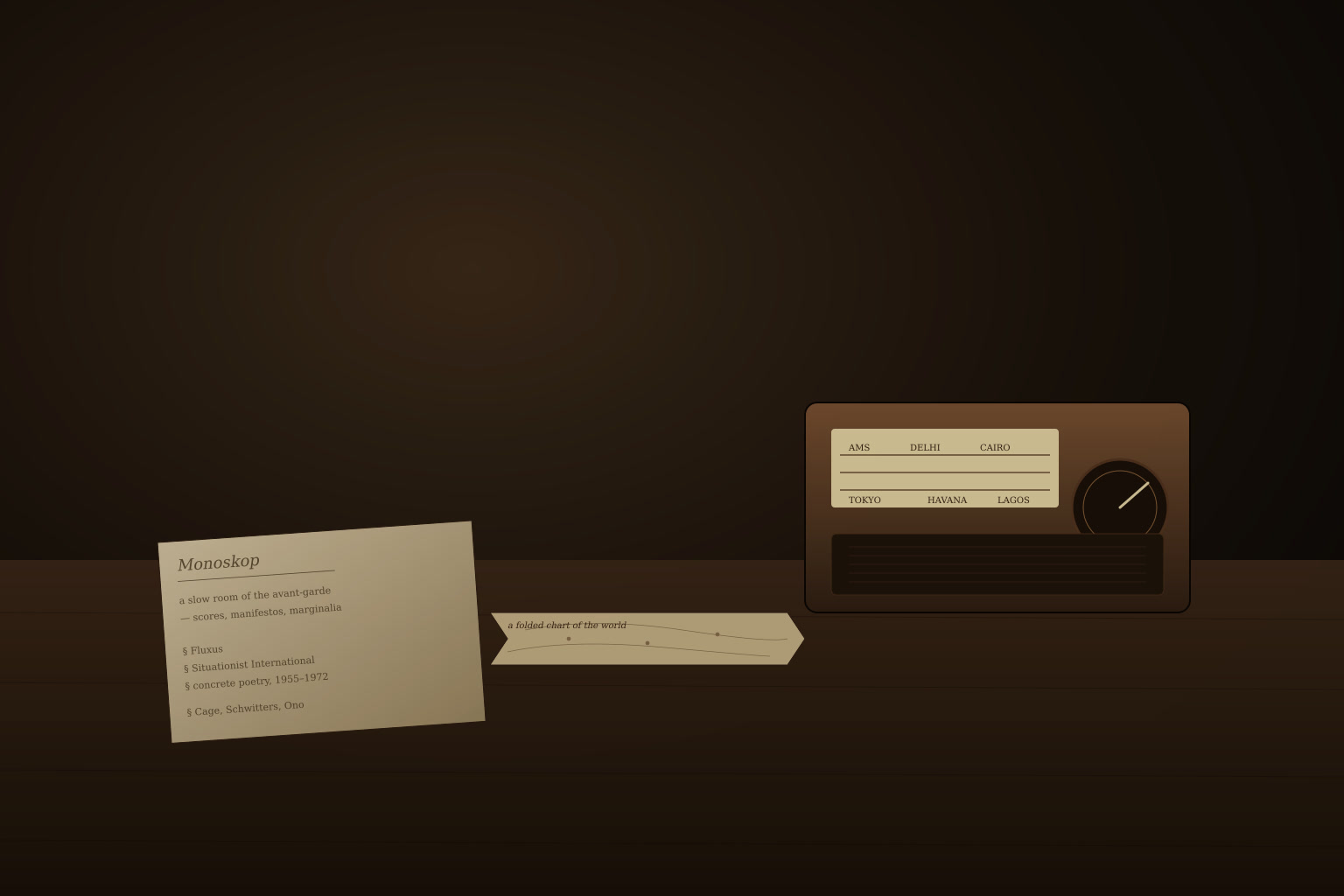
2. Monoskop, or the twentieth-century avant-garde as an unlocked library
Monoskop is a Bratislava-anchored, quietly heroic wiki-and-library for art, media, and the humanities: Fluxus scores, Situationist tracts, concrete-poetry catalogues, forgotten Eastern European film journals, artist books, sound-art anthologies, samizdat, media-theory pamphlets, everything the standard curriculum embarrassedly leaves out. The interface is austere and refuses to flatter you. That is part of the gift. It assumes you are willing to read your way in, follow a thread from Schwitters to Ono to Xu Bing without a guiding hand, and treat the archive as a room to inhabit rather than a search result to consume. In an age of algorithmic condescension, Monoskop is what a library looked like when librarians still believed you might grow up.
3. Rijksstudio, or the Dutch state quietly setting a whole collection free
A find with a local edge: the Rijksmuseum's own Rijksstudio. Roughly eight hundred thousand works, more than half a million at high resolution, released under an open licence: download, crop, print, tile your wallpaper with a Vermeer, re-cut Rembrandt as a book cover, make a fabric out of a seventeenth-century flower still life, do what you like. The lesson is not really about the collection, sizable as it is. It is about a public institution treating its own holdings as belonging, in the deep sense, to the people who paid for them. Set beside the current default of paywalled JPEGs and stock-image ransom, this is what civilisational confidence looks like: a museum that does not confuse ownership with hoarding.
Amsterdam: three reasons to leave the house
Julidans is well into its second half. On Friday and Saturday at the Internationaal Theater Amsterdam, Sharon Eyal's Delay the Sadness arrives with L-E-V's characteristic mixture of trance discipline and near-liturgical dread — ninety minutes in which the body becomes something more like weather than choreography. Across the weekend, Kalpana Raghuraman's Winged at De Meervaart puts South Indian classical rigour into direct conversation with contemporary European stage language, without collapsing either. Both are proper Julidans propositions: not spectacle, but bodies at work.
At the Rijksmuseum, the summer exhibition on Fiep Westendorp is a small quiet room worth an hour of anyone's July. Around one hundred and fifty original drawings by the woman who taught two generations of Dutch children what a book looked like from the inside: Jip and Janneke, Pluk van de Petteflet, Otje, and the sharp weekly work for Het Parool's women's page that most visitors will not know. A reminder that illustration — when it is done with this much line-economy and this little self-regard — is a serious civilisational craft, not decorative filler for children's rooms.
And on Sunday afternoon, the courtyard of the H'ART Museum hosts the closing evening of its summer jazz series, with the Marietta Arushanian Quartet playing Armenian jazz under the chestnut trees. Armenian jazz is a genuinely underrated corner of the form: minor modes from a mountainous small nation that has spent a century watching empires misbehave around it, translated into a language that still swings. If the weather holds, take a blanket. If it does not, go anyway.
Enough. Turn one dial into a country you cannot pronounce, read one small manifesto that was never supposed to survive, and go stand in a room where a body, a line, or a horn is still trying to say something the century did not want said.