Sōetsu Yanagi is one of the great uninvited guests at the table of twentieth-century thought. He wrote in Japanese, mostly between the late nineteen-twenties and his death in 1961, and only reached English in 1972, when his old friend Bernard Leach edited a slim selection of the essays into a book called The Unknown Craftsman: A Japanese Insight into Beauty. It has been in and out of print ever since. Serious potters know it. Serious designers occasionally rediscover it, then quietly change how they work. Almost no one else has read a page.
This is a pity, because Yanagi did what almost no European aesthetician of his century managed. He argued — patiently, systematically, without ever raising his voice — that the highest reach of beauty is not the signed masterpiece of the exceptional artist but the anonymous, humble, everyday useful object made without self-consciousness by a hand that has forgotten it is a hand. He called this doctrine mingei, folk-craft, and spent forty years assembling its evidence out of Korean pots, Okinawan textiles, Ainu spoons, Japanese kitchen ware, and the slipware jugs he and Leach brought back from an English village near St Ives.
The line I return to is the beginning of his description, in the first English essay, of a specific Korean rice-bowl:
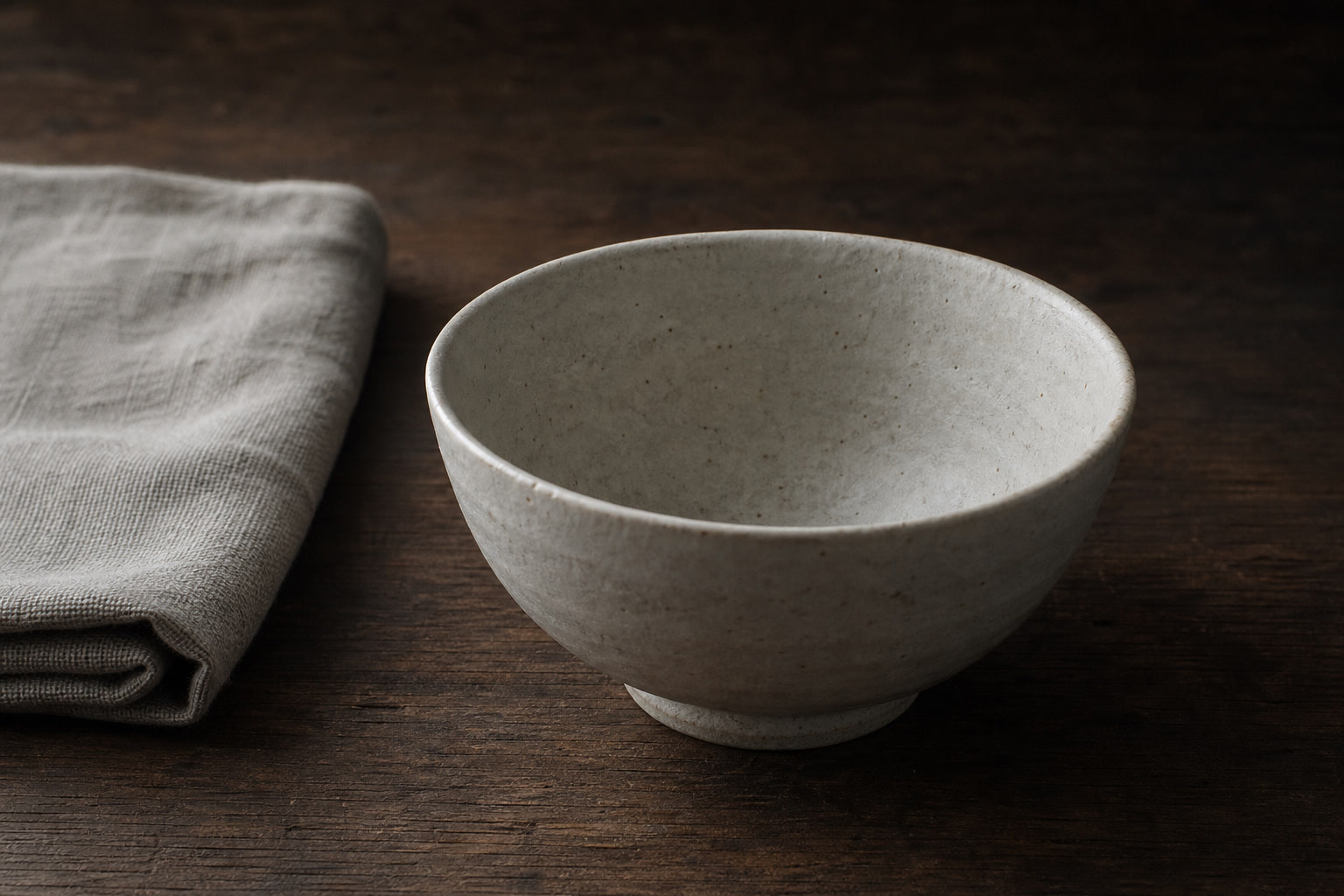
“It is enough to make a man weep. It is a Korean food bowl, a bowl, moreover, that a poor man would use every day — commonest crockery. A typical thing for his use; costing next to nothing; made by a poor man; an article without the flavour of personality; used carelessly by its owner; bought without pride; something anyone could have bought anywhere and everywhere. That is the nature of this bowl. The clay had been dug from the hill at the back of the house; the glaze was made with the ash from the hearth; the potter's wheel had been irregular. The shape revealed no particular thought: it was one of many. The work had been fast; the turning was rough, done with dirty hands; the throwing slipshod; the glaze had run over the foot. And yet — this was how a tea-bowl should be.”
The bowl he is describing is the Kizaemon Ido, a coarse sixteenth-century Korean rice-bowl that some anonymous peasant threw for the price of a meal, that some Japanese tea master a century later carried home in a silk pouch, and that Japan eventually classified as a national treasure. Yanagi is not being sentimental about poverty. He is drawing a philosophical line so sharp that most of us have never recovered from it and do not know it. The bowl is beautiful, he says, precisely because none of the modern conditions of beauty were present when it was made. No signature. No intention to make art. No aesthetic self-regard. No market for taste. No ambition to be exceptional. The potter did not know he was making a masterpiece because he was not making one. He was making a bowl a man could eat rice out of, and he had done it four hundred times before breakfast.
From this Yanagi drew a set of quiet, ruinous conclusions. First: that the modern cult of the signed individual artist is a very recent and very local superstition, mostly European, mostly post-Renaissance, and mostly wrong about how beauty actually enters the world. Second: that the anonymous craftsman working inside a tradition is not a lesser figure than the celebrated artist but, on Yanagi's account, a freer one — freer because he is not being asked to invent himself every morning. Third: that a civilisation which no longer produces such objects, or which produces them only as expensive artisanal cosplay for wealthy people who cannot cook, has lost something more serious than a craft skill. It has lost the everyday grammar of beauty and replaced it with a market for signatures.
He is unusually clear-eyed for a mystic. He knows perfectly well that most industrial objects are ugly, that most peasant objects were also ugly, and that romanticising the pre-modern hand is a European bourgeois hobby. He is after something more precise. He is after the moment at which use, humility, tradition, materials, and a certain unforced attention come together and produce, without anyone deciding to produce it, something the eye returns to. His whole book is a slow accumulation of such moments, and a slow patient refusal of the aesthetic of the exceptional.
He would find our century painful. We live in the late imperial phase of the signature: the signed studio, the signed founder story, the signed newsletter, the signed dinner plate, the signed lamp, the signed AI-generated portrait. Every object is asked to carry a name so that a name can carry a premium. The unsigned useful object — the ordinary competent tool, the honest cup, the well-turned handle, the plain shirt cut without theatre — has become quietly unfashionable, or has been priced out of the everyday and back into boutique. Yanagi's point, made with almost embarrassing patience, is that this is a spiritual defeat before it is a market condition. A culture that can no longer see the beauty of the unsigned useful thing has stopped seeing most of what it lives among.
Read him now. Start with the title essay and the passage on the Kizaemon Ido bowl. Then walk into your own kitchen and look at what you actually eat from. Look at the wooden spoon that has been in the drawer for eleven years, the pan that has cooked ten thousand dinners, the plain cotton cloth folded on the shelf. Ask which of them were made by someone who had time to make them well and no ambition to be photographed doing it. Very few, probably. Notice which ones you love anyway, and why. That is the mingei door opening.
Yanagi died before the internet finished doing what he predicted the market would do to attention. He would not be surprised. He would say, in that mild, uninsistent voice, that the useful, humble, unsigned object is still available to be made and used and defended, and that the small daily choice to prefer it — in a spoon, in a chair, in a room, in a sentence — is not nostalgia. It is a form of resistance so old and so quiet that most centuries have forgotten to notice it. Ours has been given the book again. There is still time to eat rice out of an honest bowl.