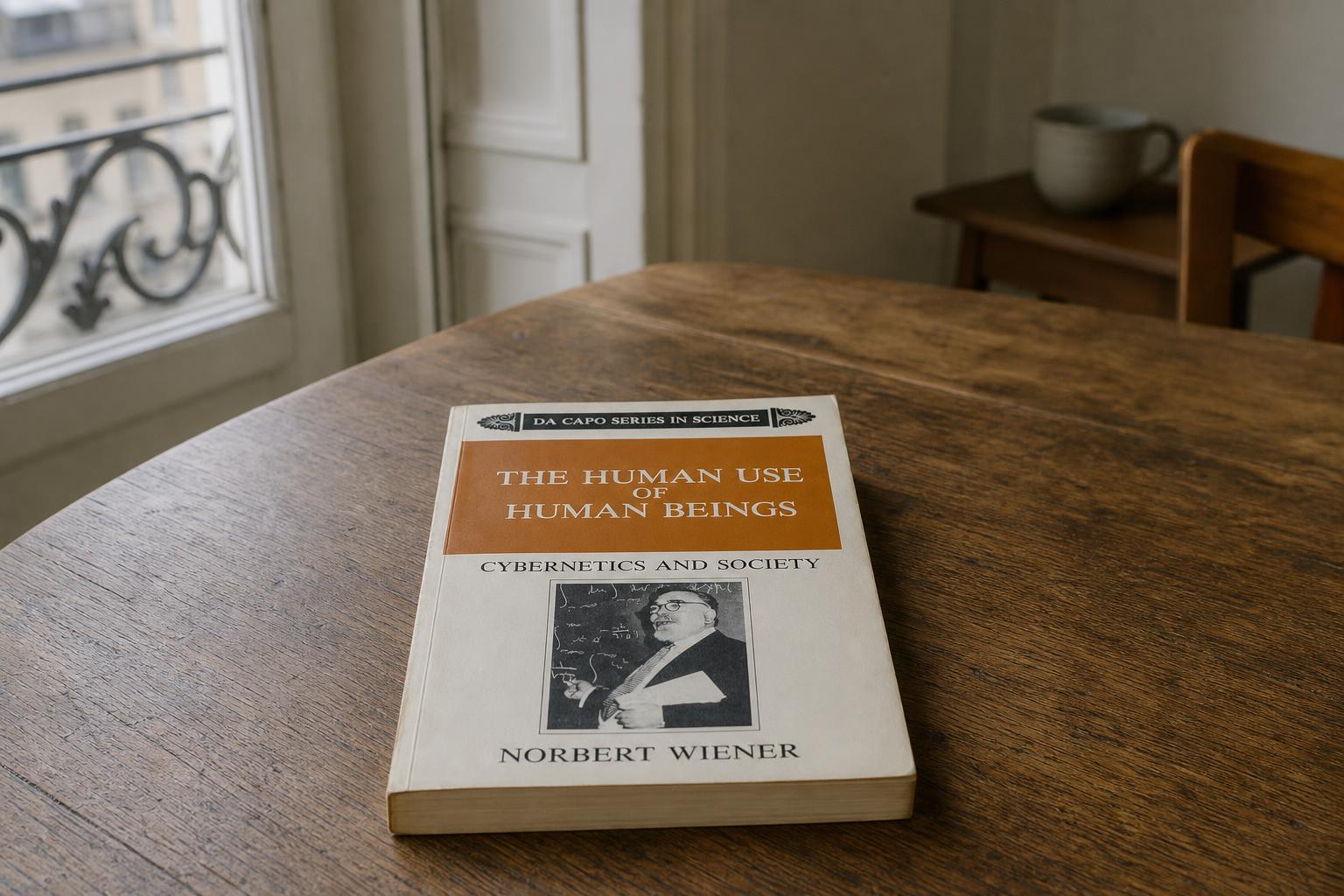
The Human Use of Human Beings is a small mid-century book that deserves to be carried back into the room before our present machine delirium finishes making everyone stupid. It appeared in 1950, which is to say before the internet, before platform monopolies, before venture capital began dressing extraction up as destiny. And yet Wiener saw the essential thing with remarkable clarity: the machine question is never only about the machine.
It is about the social order built around communication, command, and feedback. It is about what kind of civilisation emerges when information begins to move faster than judgment, and when institutions start treating human beings as components in a control system rather than as ends with dignity, memory, and local intelligence.
One line is enough to show how far ahead he was: “society can only be understood through a study of the messages and the communication facilities which belong to it; and that in the future development of these messages and communication facilities, messages between man and machines, between machines and man, and between machine and machine, are destined to play an ever-increasing part.”
That does not read like a relic. It reads like the hidden constitution of the present. We live inside systems that continuously measure, prompt, rank, infer, and nudge; then we flatter ourselves that the issue is whether the machine is intelligent. Often it is not. Often the more serious issue is that the surrounding institution has become too machine-like in its appetites, its tempo, and its contempt for anything that cannot be cleanly counted.
Wiener was not a rustic smashing looms in a state of erotic confusion. He admired technical power. What he distrusted was the moral laziness that hands such power to administrative and commercial systems without asking what sort of human being they will reward. That question has become unfashionable precisely because it is the only one worth asking.
The book sits in a curious ditch now: too literary for the engineers, too technical for the humanities, too morally serious for the optimists. Excellent. That is usually where the oxygen still is.
Read Wiener before the next glossy prophet tells you the future is inevitable. The future is usually just a procurement decision with better typography.