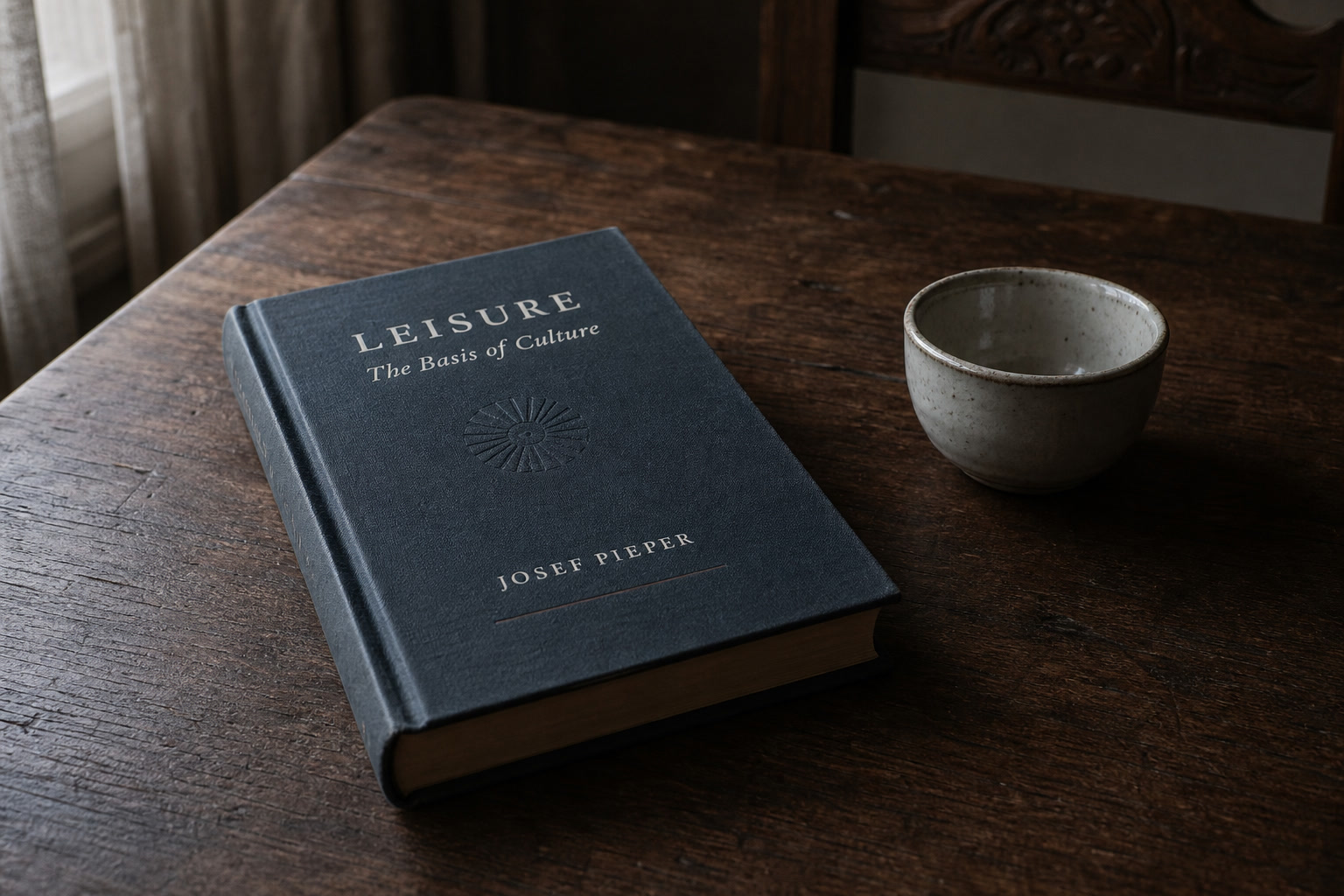
Josef Pieper published Muße und Kult in 1948, when his country lay open-hearted and starving, and the natural reflex of every reasonable German was to rebuild by working harder than any people had ever worked. Into that mood he placed a book so quiet, so almost impertinent, that it now reads like an act of civilisational courage. He suggested that the deepest problem was not the ruined factories or the ruined roads. It was the ruined interior — the loss of the capacity to be still.
The line that has stayed with me for years is this:
“Leisure is a form of silence, of that silence which is the prerequisite of the apprehension of reality: only the silent hear and those who do not remain silent do not hear.”
Notice how much he has already refused in a single sentence. Leisure is not spare time. It is not tourism, not weekends, not the little consumer sabbaths we grant ourselves between deliveries. It is not even rest, if by rest we mean the recharging of a battery so the machine may run again on Monday. Leisure is the disciplined silence in which reality is permitted to arrive.
He is writing against what he calls the world of total work: the assumption that human beings only justify their existence through utility, that thinking must be productive to count as thinking, that the highest activity is servile because it earns. Against this he defends the older intuition that the deepest knowing is receptive rather than acquisitive. Truth is not stormed. It consents to be seen by those who have learned to keep quiet in front of it.
I do not need to belabour how completely we have inverted this. Our age has industrialised distraction and monetised attention, and now, with its newer instruments, it proposes to industrialise thinking itself. The machine that never stops writing is very impressive and very useful and, in a Piepermannian sense, almost entirely deaf. It cannot fall silent. It cannot fast from producing. It has no interior room for reality to enter.
We are not much better, if we are honest. Our diaries are full, our screens are loud, our worth is measured in output, our rest is scored by algorithms. The strange word for what we have lost is not relaxation. It is consent. The consent to sit before a table, a room, a person, an evening, and allow it to arrive without conscripting it into use.
Pieper knew that leisure was inseparable from festival, and festival inseparable from a sense that the world is, at its base, worth affirming. This is why he distrusted the tired weekend and the anaesthetic holiday: both admit that the working week is the real life and rest is only its shadow. He wanted the reverse. He wanted work to serve a life that already knew how to celebrate.
Read him now, quietly, in a chair, without a device within reach. Read him as the Taoists were read by the Chinese literati, and as the desert fathers were read by weary men in the imperial century: as an antidote to the noise of one's own age. Then close the book. Sit for a moment longer. The silence he describes is not scarce. It is only unattended.