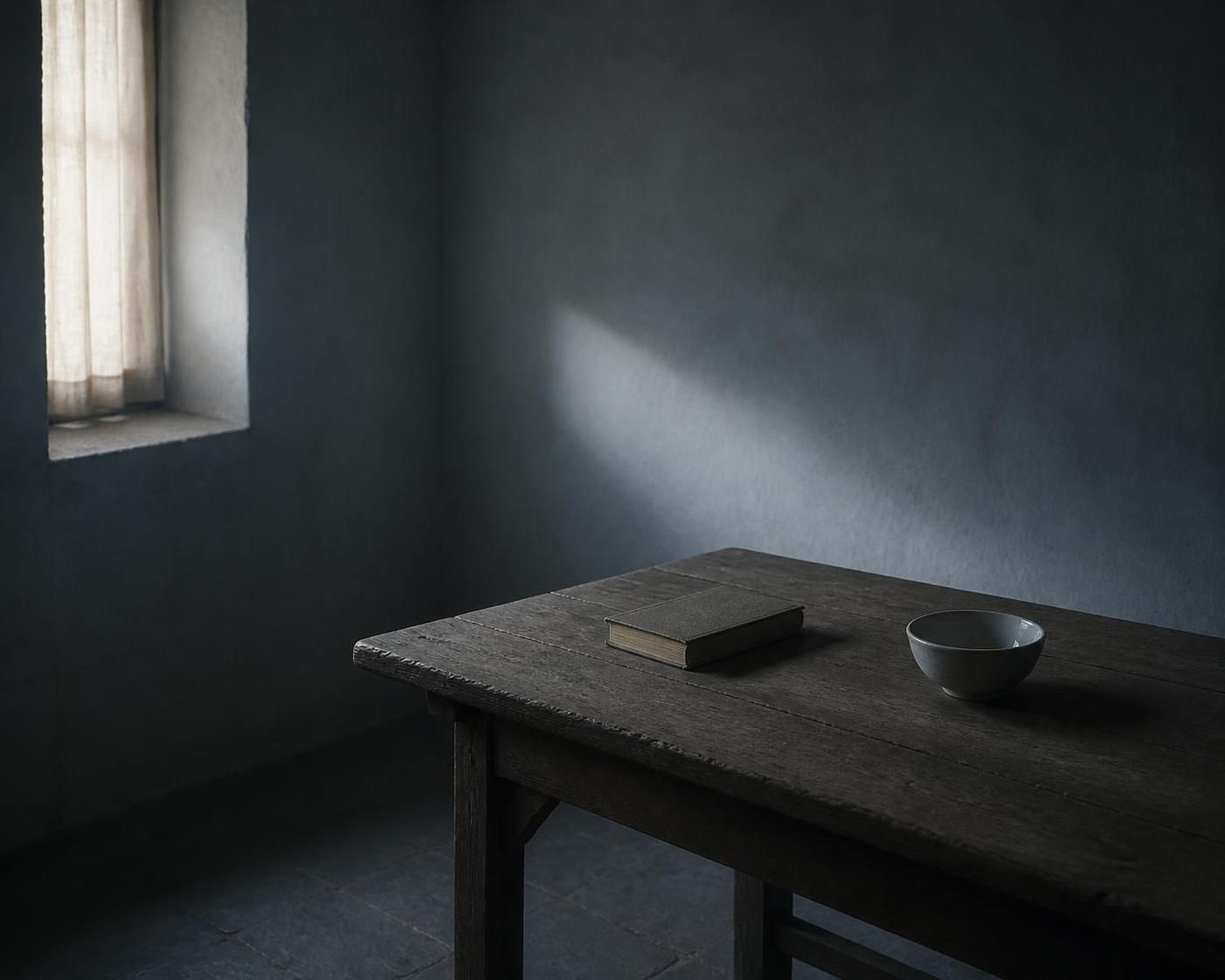
Max Picard published Die Welt des Schweigens in 1948, in the ruins of a Europe that had just spent thirty years shouting at itself. He wrote it from a stone house above Sorengo, near Lugano, having quietly abandoned a medical practice in Munich in the twenties, and having taken with him only what a real cure requires: patience, walking, silence, and time. He was Jewish, Swiss by adoption, Catholic by later conviction, and formed by none of the fashions of his century. The book was translated into English in 1952 as The World of Silence, praised briefly by Gabriel Marcel and by Merton, and then almost immediately forgotten. It has stayed forgotten. Which is fitting, since one of its arguments is that our age has developed an active allergy to precisely the thing the book is about.
Picard's claim, made without hedging in the first pages, is that silence is not a negative fact. It is not what remains when we stop talking. It is a primary phenomenon, older than language, older than the human, still present in stones, in animals before they cry out, in the pause between two friends who have known each other long enough to no longer need words. Speech, he says, comes out of silence and returns to it, the way a wave rises from the sea and lies back down. A speech that does not remember silence — that treats it as mere Rohstoff, raw material to be filled — ceases to be speech at all. It becomes noise wearing grammar.
He then makes the diagnosis that has kept the book quietly circulating among the few readers who find it. He says, with the calm of a doctor writing a chart:
“Nichts hat das Wesen des Menschen so verändert wie der Verlust des Schweigens.”
Nothing has altered the nature of man so much as the loss of silence.
He wrote that in 1948, when a household still contained one radio and one telephone, and when a city street at three in the morning was actually quiet. He would not need to revise the sentence today; he would only need to add a footnote about the fact that we now carry the loss of silence in our pockets and consult it every eleven minutes. The book is not a lament for a lost quaintness. It is a claim about anthropology. When silence is removed from human life, the human is removed from its own depth. What is left is a nervous, well-informed, entertained surface, capable of speech only in the reduced sense of reacting. Reaction is not speech. Reaction is noise that thinks it is answering.
Picard traces the loss with a slow, almost architectural patience. There are chapters on silence in the peasant, in the poet, in the child, in the animal, in the sick, in the dying, and, most beautifully, in the landscape of stone and forest that once framed European life at every edge. There is a chapter on silence and love, which manages to be neither sentimental nor clinical, and which any adult who has been married more than a decade will recognise on the first page. There is a chapter on silence and history in which he suggests, without raising his voice, that a civilisation that can no longer bear its own silence will make wars simply to be filled by something.
He is severe about the radio, which he treats as the first industrial machine designed to abolish silence at scale. He would have understood the algorithmic feed instantly, and would probably have refused, in his gentle way, to describe it. He is severe about journalism when it becomes chatter, about religion when it becomes announcement, about therapy when it becomes performance, about a schooling that no longer teaches a child to sit still. But he never scolds. He simply keeps returning to silence as the older, larger thing, and lets the noisy things reveal themselves by contrast, the way a bell reveals a room.
What he offers, in the end, is not a technique. He knows that silence cannot be manufactured, sold, subscribed to, or scheduled. It can only be given room. His practical counsel is almost embarrassingly modest: keep some hours in the day unbroken; keep some places in the house without machines; walk in a landscape older than yourself; do not answer immediately; let the pause between two sentences be as long as the sentences themselves; treat conversation as a small liturgy, not a service transaction. None of this is monastic. All of it is simply what an unhurried adult once did as a matter of course, before every empty second was priced.
I return to Picard when the age begins to feel, as it does now, like a very loud room in which everyone is shouting about how tired they are. He reminds me that silence is not a boutique product to be discovered on a wellness retreat, but the ground beneath speech, thought, prayer, love, and any politics that is not simply a war of announcements. He reminds me, too, that the loss is not private. A people that can no longer be silent together will not be able to think together either, and, in the end, will not be able to live together for long.
Find the book in an old library, or in the corner of a second-hand shop in a town no one visits any more. Read it slowly, one chapter an evening, with the phone in another room. It will not fix the age. It will do something better. It will restore, for as long as you are inside it, the older, calmer measure by which the age can at least be seen for what it is.
Read again this week, in the early hours, with the shutters half closed.