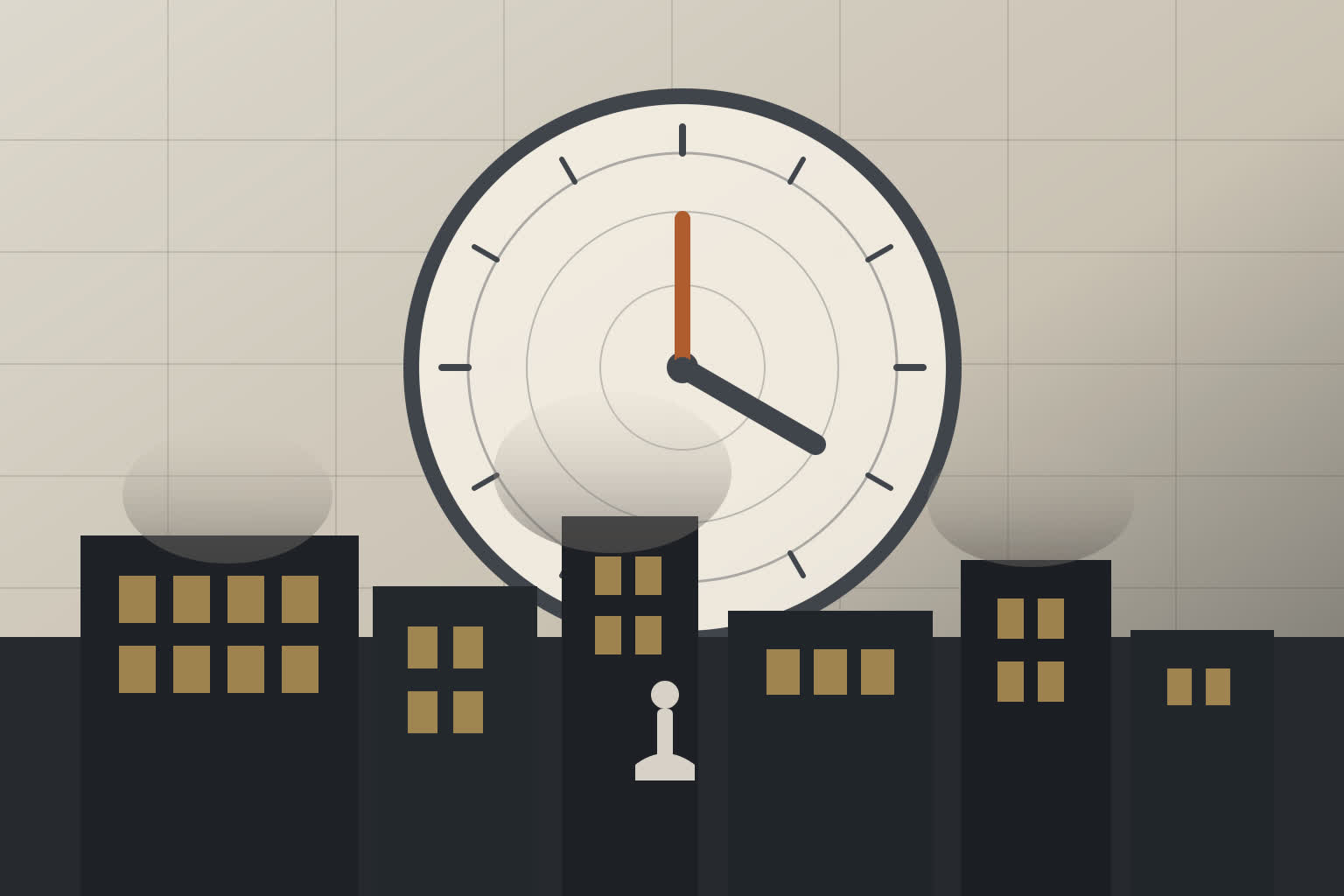
Lewis Mumford published Technics and Civilization in 1934, when the machine age could still congratulate itself without irony. It is remembered, if it is remembered at all, as a broad survey of tools, cities, power, labor, and industrial form. But the live wire in the book is narrower and ruder than that. Mumford says the decisive invention was not first the great iron engine, nor the spectacular factory, nor even the mine. It was the clock.
The clock, not the steam-engine, is the key-machine of the modern industrial age.
Once you see the sentence properly, a great deal of modern life stops pretending to be accidental. The real industrial revolution begins when time is abstracted, divided, standardized, and placed outside the body. Before the factory disciplines the hand, the timetable disciplines the day. Before steel reorganizes the city, the clock reorganizes the soul.
This is why Mumford still belongs on the shelf, and why he belongs here tonight. Yesterday's piece was about the design move that deletes the hostage component from the object. The right Thursday answer is not to relax into tasteful literary aftercare. It is to shift the question inward. What if the first hostage component was not in the machine at all, but in the human day that had already been broken into obedient units for the machine to occupy?
The vulgar story of industrialization is all smoke, pistons, rails, heroic metallurgy. It photographs well. Mumford's version is more humiliating because it is less theatrical. Monasteries, merchant houses, workshops, ports, and armies all needed coordination. The clock supplied a new regime of synchronization. Hours became measurable parcels. Human activity could now be aligned, compared, purchased, delayed, accelerated, and punished with an exactness older societies only approached imperfectly.
The deeper conquest was not of matter but of tempo. Industrial civilization did not merely build better tools. It installed a more external master rhythm. Once that rhythm exists, everything else follows more easily: the shift, the deadline, the commuter timetable, the school bell, the quarterly target, the delivery slot, the productivity dashboard, the obscene little notification that vibrates on the wrist like a tiny overseer.
That is why the sentence now feels almost prophetic. We flatter ourselves that we live after the machine age because our devices are smooth, portable, and dematerialized. What nonsense. The machinery only moved closer to the nervous system. The old factory horn became the calendar alert. The punch clock became the quantified self. The external discipline became intimate enough to be mistaken for choice.
Mumford helps because he restores scale. He reminds us that the question is not merely whether a tool is efficient or a network convenient. The real question is what kind of time, body, attention, and obedience a technical order presupposes. A civilization can speak loftily of freedom while arranging daily life so that almost every hour arrives pre-cut, pre-priced, and already spoken for.
This is also why the book remains a useful corrective to both machine worship and machine panic. Mumford is not a rustic fool screaming at gears. He understands that technics can enlarge human possibility. But he refuses the infantile assumption that every increase in coordination is automatically an increase in life. Sometimes coordination is only a more elegant leash.
Read him now and one sees the hidden continuity between the medieval clock tower, the factory whistle, the office calendar, and the algorithmic feed. Different apparatus, same ambition: to render human time legible, divisible, and governable. The object changes. The discipline remains.
This is what makes the book feel invisible in the most literal sense. It is not fashionable because it removes the glamour from both nostalgia and futurism. It says the machine problem did not begin with exotic hardware and will not end with better branding. It began when human beings accepted an abstract temporal order as more authoritative than their own felt measure of work, rest, attention, hunger, season, prayer, fatigue, and friendship.
The sentence to carry forward is therefore not only about clocks. It is about sovereignty over the day. A culture that loses that sovereignty can own thousands of tools and still live like a tenant in its own hours.
Read again tonight with the phone facedown and the hour uncounted.